Mixed Number Unit Rate Calculator
Use this mixed number unit rate calculator to find how much of one quantity corresponds to 1 unit of another quantity. Enter mixed numbers such as 3 1/2 and 1 3/4 to calculate the unit rate quickly and clearly.
A mixed number unit rate calculator divides one mixed-number quantity by another to find the amount per 1 unit. The result can help you solve problems involving speed, price, distance, time, measurements, and other rates. When available, the calculator also shows the exact fraction and decimal result so you can check your answer in the format you need.
Enter two mixed-number quantities and their units to find the unit rate with steps.
Unit Rate
Steps
Enter the two quantities you want to compare, such as 3 1/2 miles ÷ 1 3/4 hours. The calculator finds the unit rate and expresses the result per 1 unit. It converts each mixed number to an equivalent improper fraction before performing the division. This keeps the calculation exact and makes the result easier to verify. When supported, you can also view the simplified fraction, mixed-number form, decimal value, units, and calculation steps.
What Is a Mixed Number Unit Rate?
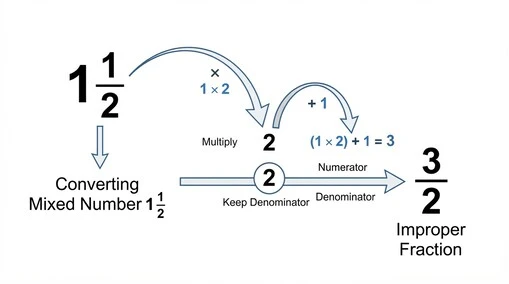
A mixed number combines a whole number with a fraction, such as 3 1/2. A unit rate compares two quantities and shows how much corresponds to 1 unit of the second quantity. To find it, divide the first quantity by the second:
Unit Rate = First Quantity ÷ Second Quantity
For example, if someone travels 3 1/2 miles in 1 3/4 hours, divide 3 1/2 by 1 3/4. The result is 2 miles per hour. The denominator represents the unit you are measuring against, so the final rate tells you the amount per one unit. This makes a mixed-number unit rate useful for comparing quantities in real-world problems. The concept also aligns with Grade 7 standard 7.RP.A.1, which covers unit rates associated with ratios of fractions.
How to Calculate a Unit Rate With Mixed Numbers
Finding a unit rate with mixed numbers takes a few simple steps. The key is to convert the mixed numbers before dividing.
Step 1: Identify the Two Quantities
Determine what you are measuring and what you want per 1 unit. For example, 3 1/2 miles in 1 3/4 hours means you need miles per hour:
3 1/2 miles ÷ 1 3/4 hours
Step 2: Convert Each Mixed Number to an Improper Fraction
Use this formula:
a b/c = (a × c + b)/c
So:
3 1/2 = 7/2
1 3/4 = 7/4
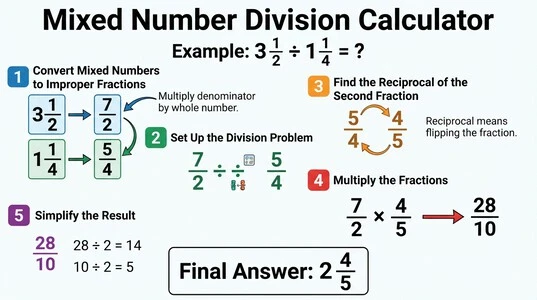
Step 3: Divide the Fractions
Divide the first fraction by the second:
7/2 ÷ 7/4
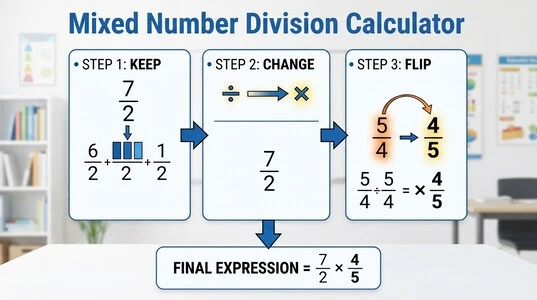
Change division to multiplication and use the reciprocal of the second fraction:
7/2 × 4/7
Step 4: Simplify the Result
Cancel common factors and simplify:
7/2 × 4/7 = 2
Step 5: Add the Units
The calculation gives 2, but the units explain what that number means. Therefore, the unit rate is:
2 miles per hour
This five-step method works for many mixed-number rate problems involving distance, time, price, quantity, or other measurements.
Mixed Number Unit Rate Formula
The basic formula for finding a unit rate is:
Unit Rate = First Quantity ÷ Second Quantity
When the quantities are mixed numbers, convert them to fractions before dividing. For fraction division, use:
a/b ÷ c/d = a/b × d/c
For example, 3 1/2 ÷ 1 3/4 becomes 7/2 ÷ 7/4. Then multiply by the reciprocal:
7/2 × 4/7 = 2
The result represents the first quantity per 1 unit of the second quantity. A rate compares two quantities, such as miles per hour. A unit rate takes that relationship one step further by expressing it for exactly 1 unit. This makes unit rates easier to compare across different quantities.
Mixed Number Unit Rate Example
A runner travels 3 1/2 miles in 1 3/4 hours. What is the unit rate?
Step 1: Write the Division
Divide the distance by the time:
3 1/2 miles ÷ 1 3/4 hours
Step 2: Convert the Mixed Numbers
Convert each mixed number to an improper fraction:
3 1/2 = 7/2
1 3/4 = 7/4
The calculation becomes:
7/2 ÷ 7/4
Step 3: Multiply by the Reciprocal
Change division to multiplication and flip the second fraction:
7/2 × 4/7
Step 4: Simplify
Cancel the common factors and calculate:
7/2 × 4/7 = 2
Step 5: Attach the Units
The first quantity is miles, and the second quantity is hours. Therefore, the unit rate is:
2 miles per hour
So, the runner travels 2 miles per hour on average.
How to Find Unit Rate With Fractions and Mixed Numbers
Unit rates can involve proper fractions, improper fractions, mixed fractions, whole numbers, or decimals. The same division process applies in each case.
When Both Values Are Mixed Numbers
Convert both mixed numbers to improper fractions before dividing. For example:
2 1/2 ÷ 1 1/4 = 5/2 ÷ 5/4 = 2
The quotient is 2, so the unit rate is 2 units per unit.
When One Value Is a Mixed Number
One quantity can be a mixed number while the other is a whole number, fraction, or decimal. Convert the mixed number first, then divide using the appropriate form.
When the Answer Is a Fraction
A unit rate does not have to be a whole number. For example, a result such as 3/4 is already a simplified fraction and can represent 0.75 per unit.
When the Answer Is a Mixed Number
If the quotient is an improper fraction, convert it to a mixed number when that form is easier to read. Always keep the correct units with the final result.
Mixed Number Unit Rate vs. Rate
A rate compares two quantities with different units, while a unit rate expresses that relationship for exactly 1 unit of the second quantity.
| Concept | Meaning |
| Rate | Compares two quantities |
| Unit rate | Expresses the rate for exactly 1 unit |
For example:
6 miles ÷ 2 hours = 3 miles per hour
The original rate is 6 miles per 2 hours. Dividing both quantities by 2 gives 3 miles per 1 hour. The denominator becomes 1, which makes the result a unit rate.
Common Mixed Number Unit Rate Problems
Mixed-number unit rates appear in many everyday and classroom problems. Common examples include:
Speed
Find miles per hour or kilometers per hour when distance and time include fractions or mixed numbers.
Unit Price
Calculate dollars per pound, cost per ounce, or price per item to compare different quantities.
Productivity
Measure work rates such as pages per hour or items per minute.
Recipes and Measurements
Determine quantities such as cups per serving when a recipe uses fractional or mixed-number measurements.
Distance and Time
Calculate the distance traveled per hour or another time unit. For example, dividing 7 1/2 miles by 2 1/2 hours gives 3 miles per hour.
These problems all use the same basic idea: divide one quantity by another and express the result per 1 unit.
Common Mistakes When Finding a Unit Rate
Avoid these common errors when calculating a unit rate with mixed numbers.
Mistake 1: Reversing the Quantities
The order matters. Miles ÷ hours gives miles per hour, while hours ÷ miles gives hours per mile. These are different unit rates.
Mistake 2: Forgetting to Convert Mixed Numbers
Convert a mixed number correctly before dividing. For example, 2 1/2 = 5/2, not 2/1 + 1/2.
Mistake 3: Dividing Fractions Incorrectly
When dividing fractions, multiply the first fraction by the reciprocal of the second fraction.
Mistake 4: Forgetting to Simplify
Always reduce the resulting fraction when possible. An unsimplified fraction may represent the correct value but is harder to read.
Mistake 5: Omitting Units
A result such as 2 is incomplete. If the calculation measures distance and time, write 2 miles per hour.
Exact Fraction vs. Decimal Unit Rate
A unit rate can appear as an exact fraction or a decimal approximation. Both formats can help, depending on the problem.
For example:
66 2/3 miles per hour
can also be written as:
≈ 66.6667 miles per hour
The mixed-number form is exact, while 66.6667 is a rounded decimal value. They represent the same underlying quantity, but the decimal shown is not exact because the digits continue. Always use an approximation symbol (≈) or label the decimal as rounded when appropriate. Keeping the exact fraction helps prevent confusion when two calculation methods appear to produce slightly different answers.
Why Does the Denominator Become 1?
The denominator becomes 1 because a unit rate shows how much corresponds to one unit of the second quantity. In simple terms, it answers the question, “How much per one?”
For example:
12 miles ÷ 3 hours = 4 miles ÷ 1 hour
Dividing 12 miles by 3 gives 4 miles. Dividing 3 hours by 3 gives 1 hour. Therefore, the unit rate is:
4 miles per hour
The denominator of 1 hour makes the rate a unit rate.
Mixed Number Unit Rate and 7.RP.A.1
CCSS 7.RP.A.1 focuses on computing unit rates associated with ratios of fractions, including measured quantities. It appears within the Grade 7 Ratios and Proportional Relationships domain.
Mixed-number unit rates connect naturally to this skill because mixed numbers can be converted to fractions before calculating a unit rate. This makes the topic useful for Grade 7 students, teachers, parents, and tutors working on ratio and rate problems. It can also support homework and classroom practice. This calculator and guide are learning resources and should not be interpreted as an official endorsement by the Common Core State Standards.
How to Use the Mixed Number Unit Rate Calculator
Follow these steps to calculate a unit rate with mixed numbers:
- Enter the first mixed number in the first input.
- Enter its unit, such as miles or dollars.
- Enter the second mixed number in the next input.
- Enter its unit, such as hours or pounds.
- Calculate the unit rate using the calculator.
- Review the exact result and check the fraction form.
- Check the decimal result, if the calculator provides one.
- Review the calculation steps to see how the mixed numbers were converted and divided.
Always check that the quantities appear in the correct order. This ensures the final unit rate matches the relationship you want to measure.
Frequently Asked Questions
What is a mixed number unit rate?
A mixed number unit rate shows how much of one quantity corresponds to 1 unit of another quantity.
How do you find a unit rate with mixed numbers?
Identify the quantities, convert mixed numbers to improper fractions, divide, simplify, and add the correct units.
Can a unit rate be a fraction?
Yes. The unit rate depends on the quantities being compared, so the result can be a proper or improper fraction.
Can a unit rate be a mixed number?
Yes. Convert an improper fraction into a mixed number when that form makes the result easier to read.
How do you divide mixed numbers?
Convert each mixed number to an improper fraction. Then multiply the first fraction by the reciprocal of the second.
What is the formula for a unit rate?
Unit Rate = First Quantity ÷ Second Quantity
Why is a unit rate written per 1?
A unit rate normalizes the second quantity to exactly 1 unit. This makes different rates easier to compare.
Can I use decimals instead of mixed numbers?
Yes, when decimal values are appropriate. Exact fractions can help avoid rounding during calculations.
What happens if the second quantity is zero?
The calculation is undefined because division by zero is not allowed.
Final Takeaway
To find a mixed-number unit rate, enter the two quantities in the correct order. Convert mixed numbers to improper fractions when needed. Divide the first quantity by the second, then simplify the result. Add the correct units to show the meaning of the answer. For a quick check, enter your values in the Mixed Number Unit Rate Calculator and review the result and calculation steps. Explore our other mixed-number calculators, such as the mixed number exponents calculator and the mixed number square root calculator.