
Mixed Number Simplifier Calculator (With Step-by-Step Solutions)
Our Mixed Number Simplifier Calculator helps you reduce mixed numbers to their simplest form in seconds. Enter your values, and the tool finds the Greatest Common Factor (GCF) to reduce the fractional part automatically. Every answer appears in the lowest terms, so you get accurate results without extra work.
This calculator works well for students, teachers, parents, and anyone solving fraction problems. It also shows clear, step-by-step solutions to help you understand each calculation instead of only giving the final answer. Whether you need to simplify mixed numbers, check homework, or verify classwork, this tool makes the process quick and easy. You can also use it as a mixed fraction calculator, fraction simplifier, lowest terms calculator, and simplest form calculator. It saves time, reduces mistakes, and helps you build confidence when working with fractions.
Mixed Number Simplifier Calculator
Use the calculator below to simplify any mixed number in seconds. The tool follows the correct math steps and gives accurate results every time. Start by entering the whole number in the first box. Next, enter the numerator and denominator of the fraction. Check that the denominator is not zero. Then, click the Simplify button. The calculator instantly finds the Greatest Common Factor (GCF) of the numerator and denominator. It reduces the fraction to its lowest terms and keeps the whole number unchanged. If needed, it also performs fraction reduction after converting between mixed numbers and improper fractions.
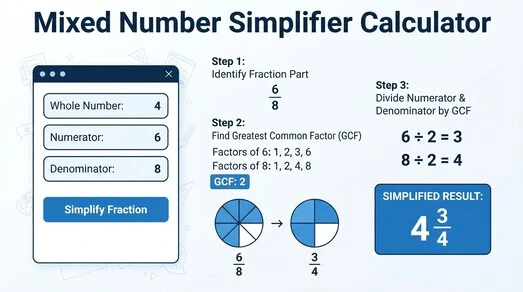
Your result appears immediately in its simplest form. You also see every calculation step, making it easy to understand how the answer was found. This feature helps you learn the process, check homework, and avoid common mistakes while simplifying mixed numbers. A mixed number combines a whole number and a proper fraction. It shows a value greater than one in a simple, easy-to-read format. Students often use mixed numbers in school because they make fractions easier to understand.
For example:
4 6/8
This mixed number has two parts:
- Whole number: 4 tells you there are four complete units.
- Numerator: 6 shows how many equal parts you have.
- Denominator: 8 shows the total number of equal parts that make one whole.
In the fraction 6/8, the numerator is smaller than the denominator. That makes it a proper fraction. When you combine it with the whole number, you get the mixed number 4 6/8. A mixed number does not always appear in its simplest form. In this example, the fraction 6/8 can be reduced because both numbers share a common factor. After simplification, 4 6/8 becomes 4 3/4. The whole number stays the same, while only the fraction changes. Understanding the whole number, numerator, and denominator makes it much easier to simplify any mixed number correctly in the next step.
What Does Simplifying a Mixed Number Mean?
Simplifying a mixed number means reducing only the fractional part. The whole number stays the same because it already represents complete units. You only simplify the fraction until it reaches its lowest terms or simplest form. To do this, find the Greatest Common Factor (GCF) of the numerator and denominator. Divide both numbers by the GCF. This creates a smaller fraction with the same value. These are called equivalent fractions because they represent the same amount.
For example:
3 6/12
↓
3 1/2
The whole number 3 does not change. Only the fraction 6/12 changes to 1/2 because both 6 and 12 divide evenly by 6. The final answer is easier to read and follows standard math rules.
A reducer calculator performs these steps automatically. It finds the GCF, reduces the fraction, and returns the answer in the simplest form within seconds. This saves time and helps you avoid calculation errors, especially when working with larger numbers.
How Our Mixed Number Simplifier Calculator Works
Our calculator follows a simple process to produce accurate results. Each step ensures your mixed number reaches its simplest form without changing its value.
Step 1: Read the Mixed Number
The calculator reads the whole number and the fraction. It treats each part separately before starting the calculation.
Step 2: Identify the Numerator and Denominator
Next, it identifies the numerator and denominator of the fractional part. These numbers determine whether the fraction can be reduced.
Step 3: Find the Greatest Common Factor (GCF)
The calculator finds the Greatest Common Factor (GCF) shared by the numerator and denominator. The GCF is the largest number that divides both values evenly.
Step 4: Divide the Numerator and Denominator
The calculator divides both numbers by the GCF. This fraction reduction creates a smaller but equal fraction. The value stays the same because both parts are divided by the same number.
Step 5: Return the Simplified Mixed Number
Finally, the calculator combines the unchanged whole number with the reduced fraction. The result appears in the lowest terms and is ready to use.
The Greatest Common Factor guarantees the fraction cannot be reduced any further. Once no larger common factor exists, the fraction reaches its simplest form. That is why a lowest terms calculator always starts by finding the GCF before performing any reduction.
How to Simplify Mixed Numbers Manually
You do not always need a calculator to simplify a mixed number. You can solve it by hand with a few easy steps. The process stays the same for every mixed number. You only reduce the fractional part while keeping the whole number unchanged.
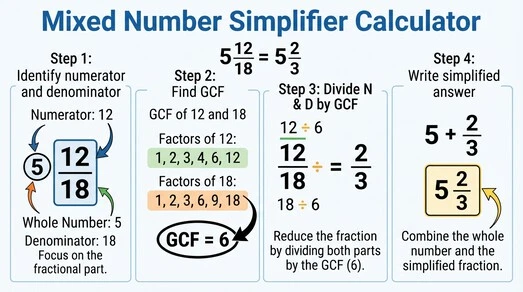
Step 1: Write the Mixed Number
Start by writing the mixed number clearly. Separate the whole number from the fraction so you can focus on the fractional part.
Example:
5 12/18
The whole number is 5, and the fraction is 12/18.
Step 2: Find the Greatest Common Factor (GCF)
Look at the numerator and denominator. Find the largest number that divides both without leaving a remainder.
For 12 and 18, the Greatest Common Factor (GCF) is 6.
Step 3: Divide the Numerator and Denominator
Divide both numbers by the GCF.
- 12 ÷ 6 = 2
- 18 ÷ 6 = 3
The fraction 12/18 becomes 2/3. This fraction is now in its simplest form because no larger common factor remains.
Step 4: Write the Final Answer
Keep the whole number the same and replace the original fraction with the simplified one.
Worked Example
5 12/18
↓ Find the GCF = 6
↓ Divide both numbers by 6
5 2/3
The final answer is 5 2/3. Always check whether the fraction can be reduced further. If the numerator and denominator share no common factor other than 1, your mixed number is already in its lowest terms.
Simplifying Improper Fractions After Conversion
Some mixed numbers need an extra step before you can fully simplify them. This happens when converting the mixed number into an improper fraction makes the reduction easier. Many students and teachers use this method because it works well with larger fractions. To convert a mixed number, multiply the whole number by the denominator. Then add the numerator. Place the result over the original denominator.
After the conversion, check whether the numerator and denominator share a Greatest Common Factor (GCF). If they do, divide both numbers by the GCF. This helps you simplify improper fractions quickly and accurately. If the simplified answer is still an improper fraction, convert it back into a mixed number. The final result becomes easier to read and follows standard math practice.
Worked Example
Start with:
2 8/12
Step 1: Convert to an improper fraction
Multiply the whole number by the denominator:
(2 × 12) + 8 = 32
So,
2 8/12
↓
32/12
Step 2: Simplify the Improper Fraction
The GCF of 32 and 12 is 4.
Divide both numbers by 4:
32 ÷ 4 = 8
12 ÷ 4 = 3
↓
8/3
Step 3: Convert Back to a Mixed Number
Divide 8 by 3.
- Quotient = 2
- Remainder = 2
So,
8/3
↓
2 2/3
The final answer is 2 2/3.
A good fraction simplifier or mixed fraction simplifier performs these steps automatically. It converts the mixed number, reduces the improper fraction, and returns the answer in its simplest form with clear working.
Examples of Simplifying Mixed Numbers
The best way to learn is by solving real examples. Follow each step carefully. Notice that the whole number never changes. Only the fractional part is reduced to its simplest form.
Example 1: Simplify 5 4/8
Find the Greatest Common Factor (GCF) of 4 and 8.
The GCF is 4.
Divide both numbers by 4.
- 4 ÷ 4 = 1
- 8 ÷ 4 = 2
Replace the original fraction with the simplified one.
5 4/8
↓
5 1/2
The whole number stays 5 because only the fraction needs simplification.
Example 2: Simplify 7 15/20
Find the GCF of 15 and 20.
The GCF is 5.
Divide both numbers by 5.
- 15 ÷ 5 = 3
- 20 ÷ 5 = 4
Write the simplified mixed number.
7 15/20
↓
7 3/4
The fraction 3/4 cannot be reduced further because 3 and 4 share no common factor except 1.
Example 3: Simplify 9 18/27
Find the GCF of 18 and 27.
The GCF is 9.
Divide both numbers by 9.
- 18 ÷ 9 = 2
- 27 ÷ 9 = 3
Write the final answer.
9 18/27
↓
9 2/3
The fraction 2/3 is already in its lowest terms.
Example 4: Simplify 10 25/100
Find the GCF of 25 and 100.
The GCF is 25.
Divide both numbers by 25.
- 25 ÷ 25 = 1
- 100 ÷ 25 = 4
Write the simplified mixed number.
10 25/100
↓
10 1/4
The fraction 1/4 is in its simplest form because 1 and 4 have no common factor other than 1.
These examples show the same pattern every time. Find the GCF, divide the numerator and denominator, then combine the simplified fraction with the original whole number. Once you understand this process, you can simplify almost any mixed number with confidence.
Common Mistakes When Simplifying Mixed Numbers
Even small mistakes can lead to the wrong answer. Knowing the most common errors helps you simplify mixed numbers correctly every time.
Forgetting to Simplify the Fraction
Some people stop after writing the mixed number. They forget to reduce the fractional part.
Quick correction: Always check whether the numerator and denominator share a common factor. If they do, simplify the fraction before writing your final answer.
Using the Wrong GCF
Choosing the wrong Greatest Common Factor (GCF) creates an incorrect result. Sometimes people use a smaller common factor and stop too early.
Quick correction: Find the largest number that divides both the numerator and denominator evenly. This ensures the fraction reaches its simplest form.
Changing the Whole Number
The whole number already represents complete units. It does not need simplification.
Quick correction: Only reduce the fraction. Keep the whole number exactly the same unless you convert an improper fraction back into a mixed number.
Dividing Incorrectly
A small division mistake changes the entire answer.
Quick correction: Divide both the numerator and denominator by the same GCF. Check your calculations before moving to the next step.
Converting Incorrectly
Errors often happen when changing a mixed number into an improper fraction or converting it back.
Quick correction: Multiply the whole number by the denominator, then add the numerator. After simplifying, divide the numerator by the denominator to convert back if needed.
A reliable calculator can help you verify your work, but understanding these mistakes will improve your fraction skills and build confidence when solving problems by hand.
Why Use an Online Mixed Number Simplifier Calculator?
An online Mixed Number Simplifier Calculator makes fraction problems faster and easier. It handles the calculations for you while helping you understand each step. Whether you are studying at home or teaching in class, the tool provides accurate results in seconds.
Saves Time
You do not need to simplify fractions by hand. Enter the values, and the calculator returns the answer instantly. This lets you spend more time learning instead of calculating.
Reduces Mistakes
Manual calculations can lead to small errors. The calculator finds the correct Greatest Common Factor (GCF) and reduces every fraction accurately. This improves confidence and accuracy.
Instant Answers
The result appears immediately after you click Simplify. You can solve one problem or several without repeating the same calculations.
Step-by-Step Learning
The calculator explains every stage of the solution. You can follow the process, understand why the fraction changes, and learn how to solve similar problems on your own.
Perfect for Homework
Students can check their answers before submitting assignments. Parents can also use the tool to help children practise fraction problems at home.
Helpful in the Classroom
Teachers can demonstrate fraction reduction quickly during lessons. Tutors can use worked solutions to explain each concept more clearly.
Mobile Friendly
The calculator works on phones, tablets, and computers. You can simplify mixed numbers anywhere without installing extra software.
Whether you need a simplest form calculator, reducer calculator, or lowest terms calculator, this tool gives fast, accurate, and easy-to-understand results for every mixed number.
Mixed Number vs Improper Fraction
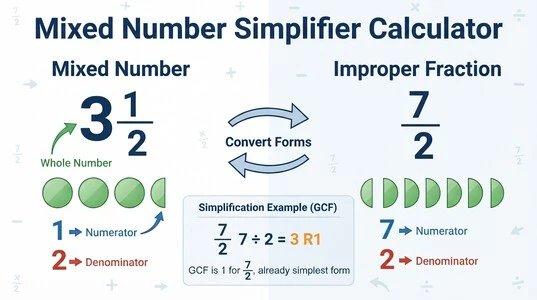
A mixed number and an improper fraction can represent the same value, but they look different. Understanding both forms helps you convert between them and simplify fractions correctly.
| Feature | Mixed Number | Improper Fraction |
| Definition | A mixed number combines a whole number with a proper fraction. | An improper fraction has a numerator that is equal to or greater than the denominator. |
| Appearance | Contains two parts: a whole number and a fraction. | Contains only one fraction. |
| Example | 3 1/2 | 7/2 |
| Conversion | Multiply the whole number by the denominator, then add the numerator to create an improper fraction. | Divide the numerator by the denominator. The quotient becomes the whole number, and the remainder becomes the numerator. |
| Simplification | Simplify only the fractional part while keeping the whole number unchanged. | Reduce the numerator and denominator using the Greatest Common Factor (GCF). Convert back to a mixed number if needed. |
Both forms represent the same mathematical value. For example, 3 1/2 and 7/2 are equivalent fractions. The difference lies only in how they are written. A mixed number is usually easier to read in everyday math and classroom work. An improper fraction often makes multiplication, division, and other fraction operations simpler. Many math problems require you to switch between the two forms before finding the final answer. Knowing how the numerator and denominator work in each form helps you convert, simplify, and solve fraction problems with confidence.
Frequently Asked Questions
What is a Mixed Number Simplifier Calculator?
A Mixed Number Simplifier Calculator is an online tool that reduces the fractional part of a mixed number to its simplest form. It automatically finds the Greatest Common Factor (GCF), performs the calculation, and shows the final answer. Many calculators also provide step-by-step solutions, making them useful for learning and checking homework.
How do I simplify a mixed number?
Start by looking at the fraction. Find the Greatest Common Factor (GCF) of the numerator and denominator. Divide both numbers by the GCF while keeping the whole number unchanged. If the fraction cannot be reduced further, the mixed number is already in its simplest form.
What is the Greatest Common Factor?
The Greatest Common Factor (GCF) is the largest number that divides both the numerator and denominator without leaving a remainder. Using the GCF ensures the fraction is reduced completely. This is the standard method used in mathematics to simplify fractions.
What are lowest terms?
A fraction is in lowest terms when the numerator and denominator share no common factor other than 1. At this stage, the fraction cannot be reduced any further. Lowest terms and simplest form mean the same thing when simplifying fractions.
Can every mixed number be simplified?
No. Some mixed numbers are already in their simplest form. If the numerator and denominator have no common factor except 1, the fraction cannot be reduced. For example, 4 3/5 is already simplified because 3 and 5 share no common factor.
Why is my mixed number not changing?
Your mixed number may already be in its simplest form. Another possibility is that the fractional part cannot be reduced because the numerator and denominator have no common factor other than 1. Check the fraction before expecting a different result.
Does the calculator show every step?
Yes. Most Mixed Number Simplifier Calculators display each calculation step. They identify the GCF, reduce the fraction, and present the final answer. This helps students understand the process instead of memorising it.
Is this calculator free?
Yes. Most online mixed number simplifier calculators are free to use. You can simplify as many mixed numbers as you need without creating an account or downloading software.
Can I use it on mobile?
Yes. The calculator works on smartphones, tablets, laptops, and desktop computers. You only need an internet connection and a web browser to access the tool.
What is the difference between simplest form and lowest terms?
There is no mathematical difference. Simplest form and lowest terms both describe a fraction that cannot be reduced any further. Once the numerator and denominator share no common factor except 1, the fraction is in both simplest form and lowest terms.
Final Thoughts
A Mixed Number Simplifier Calculator gives accurate answers in seconds and makes fraction work much easier. You enter the whole number, numerator, and denominator, and the tool reduces the fraction to its lowest terms automatically. The process is quick, simple, and reliable. This calculator does more than provide answers. It also teaches the method by showing each step clearly. Students can learn how fraction reduction works, parents can check homework, and teachers can demonstrate examples during lessons. The step-by-step approach builds confidence and improves understanding of mixed numbers and improper fractions.
The tool works well for homework, classroom teaching, tutoring sessions, and everyday math problems. It is also mobile friendly, so you can use it anywhere. Instead of spending time on long calculations, simplify every mixed number in seconds and focus on understanding the math behind the answer.