Whole Number to Mixed Fraction Calculator
Use this whole number to mixed fraction calculator to rewrite a whole number as a fraction, convert it to an equivalent fraction with a chosen denominator, or regroup it into a mixed number for subtraction. Enter the whole number and, when needed, a target denominator to see the exact result with clear steps.
A whole number can be written as a fraction by placing it over 1. If you need a specific denominator, multiply the whole number by that denominator and use the same denominator below it.
Calculator
Enter a whole number and an optional target denominator to see the standard fraction, equivalent fraction, and regrouped mixed-number forms with steps.
Results
Steps
Three Ways to Represent a Whole Number
The answer depends on what your math problem requires:
- Fraction form: n1\frac{n}{1}
- Chosen denominator: ndd\frac{nd}{d}
- Subtraction/regrouping form: (n−1)dd(n-1)\frac{d}{d}
For example, with 6 and a denominator of 5:
6=61=305=5556=\frac61=\frac{30}{5}=5\frac55
All of these represent the same value, but they serve different purposes. The calculator helps you choose the form that matches your problem instead of treating every “whole number to mixed fraction” question as the same conversion.
Google says its AI search features use core Search systems and related queries to find information, so clearly answering these connected intents in useful, well-organized content can help a page serve both traditional Search and generative Search experiences.
This distinction matters because “whole number to mixed fraction” can describe more than one mathematical task. Understanding the difference helps you choose the correct form before calculating.
What Is a Whole Number?
A whole number is a number with no fractional or decimal part. The set starts at zero and continues with positive integers:
0,1,2,3,4,5,…0,1,2,3,4,5,\ldots
For example, 7, 25, and 100 are whole numbers. Values such as 1/21/2, 3.5, and −2-2 are not whole numbers under the standard definition. (Maths Is Fun)
A whole number is already a complete quantity. A fraction represents a quantity in parts, using a numerator and denominator, while a mixed number combines a whole-number part with a proper fraction. (Maths Is Fun)
For example:
66
is a whole number,
61\frac{6}{1}
is its standard fraction representation, and
3253\frac{2}{5}
is a mixed number.
What Is a Mixed Number or Mixed Fraction?
A mixed number contains a whole number and a proper fraction together. For example:
3253\frac{2}{5}
means:
3+253+\frac{2}{5}
The term mixed number is standard in mathematics education, while mixed fraction is also commonly used and means the same thing. (Maths Is Fun)
The fraction part must normally be a proper fraction, meaning its numerator is smaller than its denominator. For instance, 3253\frac{2}{5} is a mixed number, while 3753\frac{7}{5} is better represented after regrouping because 7/57/5 contains another whole. (OpenStax)
Why the Query Can Be Confusing
A whole number does not normally need to be turned into a mixed number. The correct representation depends on what your math problem requires.
For example, the whole number 6 can be represented in several equivalent ways:
6=616=\frac{6}{1}
If you need a denominator of 5, you can write:
6=3056=\frac{30}{5}
because:
305=6\frac{30}{5}=6
Equivalent fractions have the same value, even when their numerators and denominators are different. (OpenStax)
For a subtraction problem, you may instead need to regroup one whole:
6=5556=5\frac{5}{5}
Here, 5/5=15/5=1, so the value remains 6. This form is useful when the fraction you need to subtract has denominator 5.
So these expressions are all equal:
61=305=555=6\frac61=\frac{30}{5}=5\frac55=6
but they are not interchangeable in every calculation. The fraction 30/530/5 is an equivalent improper fraction, while 5555\frac55 is a regrouped mixed-number form used when a whole is being exchanged for fractional parts.
That is why a good whole number to mixed fraction calculator should identify the form you actually need instead of simply performing a generic fraction conversion.
How to Convert a Whole Number to a Fraction
Converting a whole number to a fraction is simple: place the whole number over 1. When a particular denominator is needed, multiply the whole number by that denominator and keep the same number on the bottom. This creates an equivalent fraction with the exact value of the original whole number. Expressing whole numbers as fractions is also a recognized elementary fraction skill.
Write a Whole Number Over 1
Every whole number can be written as a fraction by using 1 as the denominator:
n=n1n=\frac{n}{1}
For example:
5=515=\frac{5}{1}
and:
12=12112=\frac{12}{1}
The value does not change because dividing a number by 1 leaves it unchanged. This is the standard fraction form when no specific denominator is required.
Write a Whole Number With a Given Denominator
Sometimes a fraction problem requires a whole number to use a particular denominator. This commonly happens when you need a common denominator before adding or subtracting fractions.
Use this formula:
n=n×ddn=\frac{n\times d}{d}
where nn is the whole number and dd is the denominator you need.
For example, to write 6 as a fraction with denominator 5:
6=6×556=\frac{6\times5}{5} 6=3056=\frac{30}{5}
The new fraction is equivalent to 6 because:
30÷5=630\div5=6
The important rule is that you multiply the whole number by the same denominator you place underneath it. In effect, you are creating an equivalent fraction rather than changing the quantity. Equivalent-fraction principles allow numbers to be represented with different numerators and denominators while keeping the same value.
This becomes especially useful when working with fractions that already have a particular denominator. For example, if another fraction is written in fifths, expressing 6 as 30/530/5 puts both quantities in fifths and makes fraction operations easier. Using equivalent fractions to create common denominators is a standard strategy for fraction addition and subtraction.
Examples With Common Denominators
| Whole number | Denominator | Equivalent fraction |
| 3 | 2 | 6/26/2 |
| 4 | 3 | 12/312/3 |
| 6 | 5 | 30/530/5 |
| 8 | 8 | 64/864/8 |
| 10 | 10 | 100/10100/10 |
For each example, the numerator is found by multiplying the whole number by the chosen denominator. For instance:
8×8=648\times8=64
so:
8=6488=\frac{64}{8}
These fractions may look different from the original whole numbers, but they represent exactly the same quantities. On a number line, a fraction whose numerator is a whole-number multiple of its denominator lands on the corresponding whole-number point.
The key distinction is that writing a whole number with a chosen denominator is not the same as converting an improper fraction into a mixed number. Here, you are simply creating an equivalent fraction. The regrouped mixed-number form used for subtraction is a separate step, covered next.
How to Convert a Whole Number to a Mixed Number for Subtraction
A whole number sometimes needs to be regrouped before you can subtract a fraction or mixed number from it. The key is to take one whole and rename it as a fraction with the same denominator as the fraction you are subtracting. This is a standard fraction-subtraction method taught in intermediate algebra and developmental mathematics.
Why You Sometimes Need to Regroup a Whole Number
Consider:
6−3456-3\frac45
The whole number 6 has no fractional part. You can subtract the whole-number parts, but there is no fraction to subtract 4/54/5 from:
6−3456-3\frac45
To make the fractional parts compatible, regroup one of the six wholes. One whole can be renamed as 5/55/5 because:
55=1\frac55=1
So the original 6 can be rewritten without changing its value. This creates a fractional part with denominator 5, allowing the subtraction to proceed normally. NROC gives the same method for problems such as 8−4258-4\frac25, rewriting 8 as 7557\frac55.
How 6 Becomes 5 5/5
Start by separating one whole from 6:
6=5+16=5+1
Now rename that one whole as five fifths:
1=551=\frac55
Substitute 5/55/5 for the 1:
6=5+556=5+\frac55
Therefore:
6=555\boxed{6=5\frac55}
Nothing has been added or removed. You simply changed the way the same amount is represented.
A common mistake is to write:
6556\frac55
That is not equal to 6. It means:
6+55=6+1=76+\frac55=6+1=7
The whole-number part must decrease from 6 to 5 because one whole was exchanged for 5/55/5. Pressbooks similarly instructs learners to subtract 1 from the whole-number part when borrowing and then rename that one as a fraction with the required denominator.
Why the Denominator Matches the Other Fraction
Return to:
6−3456-3\frac45
The fraction being subtracted is in fifths, so the borrowed whole must also be expressed in fifths:
1=551=\frac55
That gives:
6=5556=5\frac55
Now rewrite the subtraction:
555−3455\frac55-3\frac45
Subtract the whole parts:
5−3=25-3=2
Then subtract the fractional parts:
55−45=15\frac55-\frac45=\frac15
So:
6−345=215\boxed{6-3\frac45=2\frac15}
The denominator stays 5 because both fractional parts are now measured in fifths. You can subtract their numerators directly because they have the same denominator. This “borrow one, rename it using the same denominator, then subtract” procedure is explicitly described in standard instructional material.
The same idea works with any denominator. For fourths:
1=441=\frac44
For thirds:
1=331=\frac33
For eighths:
1=881=\frac88
So when a whole number must be regrouped for subtraction, use:
n=(n−1)+dd\boxed{n=(n-1)+\frac dd}
where dd is the denominator you need. The resulting mixed-number form is:
(n−1)dd\boxed{(n-1)\frac dd}
This is the practical reason a whole number to mixed fraction calculator can be useful: it can perform the regrouping and show exactly why the whole-number part decreases by one.
Equivalent Fraction vs. Regrouped Mixed Number
A whole number can have several equivalent representations, but each form serves a different purpose. Knowing the difference between a standard fraction, an equivalent fraction with a chosen denominator, and a regrouped mixed number prevents common mistakes.
6/1
A whole number can always be written as a fraction by placing it over 1:
6=616=\frac61
This is the standard fractional representation of 6. Since 6÷1=66\div1=6, the value does not change.
Use this form when you simply need to express a whole number as a fraction and no particular denominator is required.
30/5
You can also express 6 as an equivalent fraction with denominator 5:
6=3056=\frac{30}{5}
because:
30÷5=630\div5=6
Here, both parts of the fraction represent the same value as the original whole number. The denominator is 5 because that is the denominator we want to work with.
This form is useful when fractions need a common denominator. For example, if another quantity contains fifths, writing 6 as 30/530/5 expresses the entire 6 in fifths.
The important point is that 305\frac{30}{5} is an improper fraction, not a mixed number. It still represents six complete wholes.
5 5/5
For subtraction, you may need a different representation:
6=5556=5\frac55
This is called regrouping. One whole is taken from 6 and renamed as 5/55/5:
6=5+16=5+1
Since:
1=551=\frac55
we get:
6=5+55=5556=5+\frac55=5\frac55
The value remains exactly 6.
This form is particularly useful for a problem such as:
6−3456-3\frac45
Rewrite 6 as:
555−3455\frac55-3\frac45
Now the fractional parts have the same denominator, so subtraction is straightforward.
The distinction is important: 305\frac{30}{5} expresses all six wholes as fifths, while 5555\frac55 separates five wholes from one whole that has been regrouped into fifths.
What About 6 0/5?
You may also see:
6056\frac05
This has the same numerical value as 6 because:
05=0\frac05=0
so:
6+05=66+\frac05=6
However, 6056\frac05 is generally not the useful way to write a whole number in a fraction problem. Standard mixed-number notation is normally used for quantities that actually have a fractional part. A Mathematics Stack Exchange discussion reaches the same practical conclusion: forms such as 2012\frac01 are mathematically equivalent to 2, but writing the whole number simply as 22 is the usual convention.
For subtraction, 6056\frac05 also does not solve the problem. If you need to subtract 4/54/5, the useful regrouped form is:
5555\frac55
not:
6056\frac05
So, for the whole number 6:
6=61=305=555=605\boxed{6=\frac61=\frac{30}{5}=5\frac55=6\frac05}
All four expressions have the same value, but they are used differently. The standard fraction is 6/16/1, the equivalent fraction with denominator 5 is 30/530/5, and the regrouped mixed-number form is 5555\frac55. The last form is the one you need when borrowing one whole for subtraction.
How the Whole Number to Mixed Fraction Calculator Works
This calculator is designed for the different ways a whole number may need to be represented in a fraction problem. Enter the whole number, add a target denominator when needed, and choose the result that matches your calculation.
Enter the Whole Number
Start by entering the whole number you want to convert. Whole numbers include 0, 1, 2, 3, 4, and other non-negative integers without fractional parts.
For example, enter:
Whole Number: 6
The calculator can immediately show the standard fraction form:
6=616=\frac61
If you enter 0, the result is:
0=010=\frac01
Zero does not require regrouping because there is no whole unit to borrow. The calculator should therefore treat zero separately rather than trying to create a form such as (−1)d/d(-1)d/d.
Enter the Target Denominator
The target denominator is optional when you only want the standard fraction form. In that case, the denominator is simply 1.
For example:
8=818=\frac81
However, a target denominator becomes important when you are working with another fraction. If the denominator you need is 5, enter:
Target Denominator: 5
The calculator can then create the equivalent fraction:
6=6×55=3056=\frac{6\times5}{5}=\frac{30}{5}
This is especially useful when fractions must use the same denominator before an addition or subtraction.
For subtraction, the denominator also determines how one whole is regrouped. With a denominator of 5:
1=551=\frac55
so:
6=5556=5\frac55
The target denominator therefore tells the calculator how to express the whole number in the form your problem requires.
Choose the Result You Need
A useful whole number to mixed fraction calculator should separate the available representations instead of combining them into one confusing answer.
Fraction form
Use this when you simply want the whole number written as a fraction:
6=616=\frac61
Equivalent fraction
Use this when you need a particular denominator:
6=3056=\frac{30}{5}
This keeps the value unchanged while expressing the whole number in fifths.
Regroup for subtraction
Use this when you need to borrow one whole to subtract a fraction or mixed number:
6=5556=5\frac55
The calculator should make clear that this is not the same operation as simply converting 6 to 30/530/5. Both are equivalent to 6, but the regrouped form is designed for subtraction.
View the Steps
A trustworthy calculator should show how it reached the answer, not just display a final number. This makes the result easier to verify and helps students understand the conversion.
For example:
Input: 6
Denominator: 5
Equivalent fraction:
6=6×55=3056=\frac{6\times5}{5}=\frac{30}{5}
Regrouped mixed number:
6=5+16=5+1 1=551=\frac55 6=5+55=5556=5+\frac55=5\frac55
Check:
5+55=5+1=65+\frac55=5+1=6
The final check confirms that the converted form has the same value as the original whole number. Showing the formula, the intermediate step, and the verification also makes the calculator more useful for homework, learning, and answer checking than a tool that returns an unexplained result.
Worked Examples
The following examples show the three main ways to rewrite a whole number: as a standard fraction, as an equivalent fraction with a chosen denominator, and as a regrouped mixed number for subtraction.
Example 1 — Convert 7 to a Fraction
When no specific denominator is required, place the whole number over 1:
7=717=\frac71
So the fraction form of 7 is:
71\boxed{\frac71}
This works because every number divided by 1 stays unchanged.
Example 2 — Convert 7 With Denominator 4
Suppose you need to express 7 in fourths. Multiply 7 by the target denominator and place the same denominator underneath:
7=7×447=\frac{7\times4}{4} 7=2847=\frac{28}{4}
Therefore:
7=284\boxed{7=\frac{28}{4}}
Checking the result:
28÷4=728\div4=7
The fraction 28/428/4 is an equivalent fraction, so it has exactly the same value as 7.
Example 3 — Regroup 8 for Fifths
If you need to subtract a fraction in fifths from 8, rewrite one whole as five fifths.
Start with:
8=7+18=7+1
Since:
1=551=\frac55
replace the 1:
8=7+558=7+\frac55
Therefore:
8=755\boxed{8=7\frac55}
This is the regrouped mixed-number form of 8. It is useful when a subtraction problem needs a fractional part in fifths.
Notice that 8558\frac55 would not be equivalent to 8:
8+55=98+\frac55=9
That is why the whole-number part must decrease from 8 to 7 when one whole is renamed as 5/55/5.
Example 4 — Subtract a Mixed Number From a Whole Number
Consider:
8−4258-4\frac25
There is no fractional part in 8 from which to subtract 2/52/5, so regroup one whole:
8=7558=7\frac55
Now substitute it into the problem:
755−4257\frac55-4\frac25
Subtract the whole-number parts:
7−4=37-4=3
Then subtract the fractional parts:
55−25=35\frac55-\frac25=\frac35
So:
8−425=335\boxed{8-4\frac25=3\frac35}
The denominator remains 5 because both fractional parts are measured in fifths. This regrouping method is commonly used when subtracting a mixed number from a whole number. (content.nroc.org)
Example 5 — When the Answer Is a Whole Number
Sometimes the fractional parts cancel completely.
For example:
735−2357\frac35-2\frac35
Subtract the whole-number parts:
7−2=57-2=5
Then:
35−35=0\frac35-\frac35=0
So:
5+0=55+0=5
Therefore:
735−235=5\boxed{7\frac35-2\frac35=5}
The answer is a whole number because the two fractional parts are equal and cancel out. A result does not have to remain a mixed number after subtraction; it should always be simplified to its appropriate final form.
Common Mistakes When Converting Whole Numbers
Whole-number fraction problems can look simple, but a small notation error can change the value completely. These are the mistakes most likely to cause confusion when converting or regrouping a whole number.
Adding the Fraction Without Removing One Whole
When regrouping 6 into fifths, you are replacing one whole with 5/55/5. You are not adding another whole to the original number.
The correct conversion is:
6=5556=5\frac55
A common mistake is:
6556\frac55
But:
655=6+1=76\frac55=6+1=7
So 6556\frac55 is not equal to 6. The whole-number part must decrease by 1 because that one whole has been renamed as 5/55/5.
The same rule applies to any denominator:
8=7888=7\frac88
not:
8888\frac88
Forgetting to Match the Denominator
When regrouping a whole number for subtraction, the new fractional part must use the same denominator as the fraction you are working with.
For fifths:
1=551=\frac55
For fourths:
1=441=\frac44
For thirds:
1=331=\frac33
For eighths:
1=881=\frac88
For example, if the problem contains 3/53/5, rewrite one whole as 5/55/5, not 4/44/4. Matching denominators allows the fractional parts to be subtracted directly.
6−3256-3\frac25
becomes:
555−3255\frac55-3\frac25
The denominator is 5 because the original fractional part is measured in fifths.
Dropping the Whole Number
Another common error is focusing on the numerator and denominator and accidentally losing the original whole-number part.
For example, when regrouping:
8=7558=7\frac55
The answer is not simply 5/55/5. The 5/55/5 represents only the one whole that was regrouped. The other seven wholes are still part of the original quantity.
Think of it as:
8=7+18=7+1
then:
8=7+558=7+\frac55
This makes it easier to see why the whole-number part remains in the mixed number.
Confusing Mixed Numbers With Multiplication
A mixed number such as:
4124\frac12
normally means:
4+124+\frac12
It does not mean that 4 is being multiplied by 1/21/2. In standard mathematical notation, the whole number placed directly beside a proper fraction indicates a mixed number. A 2025 discussion on r/askmath showed that this notation can still confuse learners, particularly when they are unsure whether adjacent values mean addition or multiplication. (reddit.com)
So:
412=4+12=4.54\frac12=4+\frac12=4.5
If multiplication is intended, it is normally made explicit with a multiplication sign or parentheses:
4×12=24\times\frac12=2
Keeping these two meanings separate is especially important when using a whole number to mixed fraction calculator, because the correct interpretation determines which calculation should be performed.
How to Check Your Answer
Checking a fraction conversion takes only a few seconds, but it can catch mistakes such as using the wrong denominator, changing the value, or forgetting the whole-number part. A good way to check is to work backward and confirm that the new form equals the original whole number.
Convert Back to a Whole
Suppose you regrouped 6 as:
5555\frac55
Convert the mixed number back into its value:
5+555+\frac55
Since:
55=1\frac55=1
you get:
5+1=65+1=6
So:
555=6\boxed{5\frac55=6}
The conversion is correct because the regrouped mixed number returns to the original whole number.
Use Equivalent Fractions
If you converted 6 to an equivalent fraction with denominator 5, you get:
305\frac{30}{5}
Check it by dividing the numerator by the denominator:
30÷5=630\div5=6
Therefore:
305=6\boxed{\frac{30}{5}=6}
This is a quick way to verify that the equivalent fraction has not changed the original value.
Use the Calculator’s Reverse Check
A reliable whole number to mixed fraction calculator should make verification easy instead of giving you an unexplained answer. After calculating, check that the displayed fraction or mixed number evaluates to the same whole number you entered.
For example, if the calculator gives:
6→5556\rightarrow5\frac55
the result should also show:
5+55=65+\frac55=6
Likewise, if it gives:
6→3056\rightarrow\frac{30}{5}
you should be able to confirm:
30÷5=630\div5=6
Showing the original input, conversion steps, final result, and reverse check makes the calculation easier to understand and independently verify. It also helps distinguish a useful educational calculator from a tool that simply outputs a number without showing how that result was obtained.
Special Cases
Most whole-number conversions are straightforward, but a few inputs need special handling. Understanding these cases helps prevent invalid or confusing results.
Whole Number 0
Zero can be written as a fraction over 1:
0=010=\frac01
You cannot use the usual regrouping method for 0 because there is no whole unit to borrow. The formula
(n−1)+dd(n-1)+\frac dd
is intended for a positive whole number when one whole needs to be exchanged for fractional parts.
Denominator 1
A denominator of 1 produces the standard fraction form of the whole number. For example:
7=717=\frac71
Because dividing by 1 does not change a number, 7/17/1 has exactly the same value as 7.
There is usually no need to create a regrouped mixed number when the denominator is 1. The simple fraction 7/17/1 is the clearer representation.
Negative Whole Numbers
If the calculator accepts negative integers, they should be handled separately from the standard positive whole-number workflow. For example, the ordinary fraction form of −6-6 is:
−6=−61-6=\frac{-6}{1}
The negative sign applies to the value of the entire fraction. Regrouping negative values can require different notation and rules, so a calculator should clearly state whether negative inputs are supported rather than returning an ambiguous mixed-number result.
When the Fractional Part Is Zero
A whole number can technically be written with a zero fractional part. For example:
6=6056=6\frac05
because:
05=0\frac05=0
So:
6+05=66+\frac05=6
This is mathematically valid, but it is generally not the preferred mixed-number notation because there is no actual fractional amount. Writing simply 66 is clearer.
It is also different from the regrouped form:
6=5556=5\frac55
The first form keeps all six wholes and adds zero, while the second takes one whole and renames it as five fifths. The regrouped form is the useful choice when a subtraction problem requires a fractional part.
Whole Number to Mixed Fraction Calculator FAQs
What is a whole number to mixed fraction calculator?
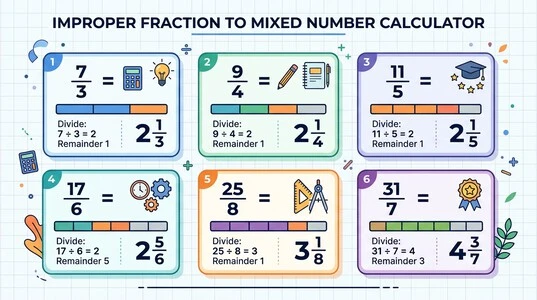
A whole number to mixed fraction calculator helps you rewrite a whole number in different fraction forms. Depending on the problem, it can show the standard fraction n/1n/1, an equivalent fraction with a chosen denominator, or a regrouped mixed number for subtraction. This is different from an improper-fraction-to-mixed-number calculator, which works in the opposite direction.
How do you convert a whole number to a mixed fraction?
A whole number does not normally need to be written as a mixed number. You can write it as n/1n/1, or as an equivalent fraction with a chosen denominator dd:
n=nddn=\frac{nd}{d}
For subtraction, you may regroup one whole:
n=(n−1)+ddn=(n-1)+\frac{d}{d}
The correct form depends on what your calculation requires.
How do I write 6 as a fraction with denominator 5?
Multiply 6 by the desired denominator and keep 5 as the denominator:
6=6×556=\frac{6\times5}{5} 6=305\boxed{6=\frac{30}{5}}
You can verify it by dividing:
30÷5=630\div5=6
So 30/530/5 is an equivalent fraction that represents exactly 6.
Why does 6 become 5 5/5?
When you need to subtract a fraction in fifths from 6, one whole must be regrouped into fifths. First take one whole from 6:
6=5+16=5+1
Then:
1=551=\frac55
So:
6=5556=5\frac55
The value has not changed. This is the standard regrouping method used when a whole number must be expressed with a fractional part for subtraction. (content.nroc.org)
Can a whole number be written as a mixed number?
A whole number can be represented in a mixed-number-style form, but this is not normally necessary. For example, 6056\frac05 equals 6, while 5555\frac55 also equals 6. The second form is useful for regrouping during subtraction. In ordinary writing, however, the simplest representation of the quantity is simply 66.
Is 6/1 the same as 30/5?
Yes. Both fractions have the same value:
61=6\frac61=6
and:
305=6\frac{30}{5}=6
Therefore:
61=305\boxed{\frac61=\frac{30}{5}}
They are different representations of the same quantity. The 30/530/5 form is useful when you specifically need a denominator of 5.
Is 6 0/5 equal to 6?
Yes. Because:
05=0\frac05=0
we have:
605=6+0=66\frac05=6+0=6
However, 6056\frac05 is usually unnecessary because there is no fractional part to represent. If you are solving a subtraction problem that requires regrouping, 5555\frac55 is the useful form because one whole has been exchanged for five fifths.
Why do I subtract 1 when borrowing?
You subtract 1 because you are taking one whole and changing its form, not adding another fraction to the original number. For example:
6=5+16=5+1
Then replace that 1 with 5/55/5:
6=5+556=5+\frac55
So the whole-number part becomes 5. If you wrote 6556\frac55, you would have added an extra whole and obtained 7 instead of 6. (openstax.org)
How do I convert a whole number for subtraction?
First identify the denominator of the fraction you need to subtract. For example:
8−4258-4\frac25
Because the fraction uses fifths, regroup one of the eight wholes:
8=7558=7\frac55
Then subtract:
755−425=3357\frac55-4\frac25=3\frac35
The denominator of the regrouped fraction matches the denominator needed for the subtraction. (content.nroc.org)
Does the denominator stay the same?
During regrouping, the new fractional part uses the denominator required by the other fraction. For example, if you need fifths, one whole becomes 5/55/5. If you need fourths, it becomes 4/44/4. Using a common denominator allows the fractional parts to be subtracted directly. (openstax.org)
Can I use any denominator?
Yes, a positive whole number can be written as an equivalent fraction using any positive denominator dd:
n=nddn=\frac{nd}{d}
For example:
4=123=2054=\frac{12}{3}=\frac{20}{5}
The useful denominator depends on the problem. When adding or subtracting fractions, you normally choose a denominator that matches the existing fraction or helps create a common denominator.
How do I know my answer is correct?
Work backward and make sure the new form equals the original whole number. For example:
555=5+1=65\frac55=5+1=6
For an equivalent fraction:
305=30÷5=6\frac{30}{5}=30\div5=6
You can also check a subtraction result by adding the amount you subtracted back to the answer. This reverse-check method is recommended in instructional fraction material because addition and subtraction are inverse operations. (content.nroc.org)
Is “mixed fraction” the same as “mixed number”?
Yes. Mixed number is the more common mathematical and educational term, while mixed fraction is widely used in search queries and everyday explanations. Both refer to a number made from a whole-number part and a proper fraction, such as:
3253\frac25
which means:
3+253+\frac25
Is this calculator the same as an improper fraction to mixed number calculator?
No. An improper-fraction-to-mixed-number calculator starts with something such as:
175\frac{17}{5}
and converts it to:
3253\frac25
A whole number to mixed fraction calculator starts with a whole number such as 6 and can produce an equivalent fraction or a regrouped mixed number such as 5555\frac55, depending on the selected task.
Note: These FAQs are included to answer common user questions and improve the page’s topical usefulness. Google Search no longer displays the FAQ rich result for general sites; Google says the feature stopped appearing in Search on May 7, 2026.
(developers.google.com)