Mixed Number Square Root Calculator
Enter a mixed number to find its exact square root and decimal approximation.
Result
Exact resultCalculation steps
Verify the answer
Use this mixed number square root calculator to find the square root of a mixed number such as 5 44/49. Enter the whole number, numerator, and denominator to get the result without first converting the mixed number yourself. The calculator can show the improper fraction, simplified exact square root, mixed-number form when possible, and decimal approximation. You can also choose the number of decimal places you need.
For example, if you enter 5 44/49, the calculator converts it to 289/49 and finds:
√(5 44/49) = √(289/49) = 17/7 = 2 3/7 ≈ 2.428571
Enter a mixed number
You can enter the value using separate fields:
- Whole number: 5
- Numerator: 44
- Denominator: 49
If supported, you can also enter the complete value directly as 5 44/49.
What the calculator shows
After you calculate, the result can include:
- Original mixed number — the value you entered.
- Improper fraction — the equivalent fraction used for the calculation.
- Exact square root — the simplified result when an exact form is available.
- Mixed-number answer — shown when the exact result can be written as a mixed number.
- Decimal approximation — useful when the exact result is not a convenient fraction.
- Calculation steps — so you can see how the answer was obtained.
Verify your answer
For an exact result, you can check the calculation by squaring the answer. For example:
(17/7)² = 289/49 = 5 44/49
This confirms that 17/7 is the exact principal square root of 5 44/49. A rounded decimal, such as 2.43, is only an approximation, so squaring it may not reproduce the original value exactly.
What Is a Mixed Number Square Root Calculator?
A mixed number square root calculator finds the square root of a number written as a whole number plus a fraction, such as 5 44/49. It converts the mixed number into an equivalent improper fraction, simplifies the square root when possible, and can provide a decimal approximation.
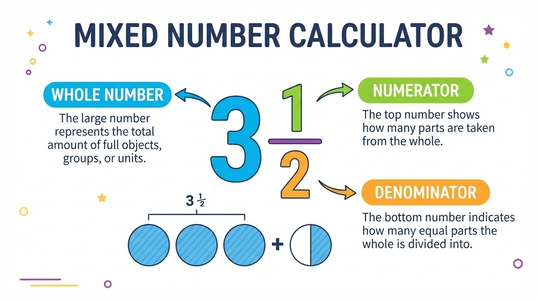
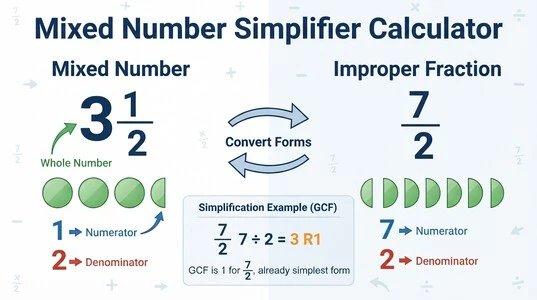
A mixed number (also called a mixed fraction) contains a whole number and a proper fraction. For example, 5 44/49 has:
- 5 as the whole number
- 44 as the numerator
- 49 as the denominator
To calculate its square root correctly, the mixed number is first converted to an improper fraction:
5 44/49 = 289/49
The calculator then evaluates:
√(289/49) = 17/7
The √ symbol is the radical symbol used for a square root. The exact answer is 17/7, which can also be written as the mixed number 2 3/7. If an exact fractional result is not available, the calculator can show a decimal approximation instead. This conversion step helps prevent mistakes because a mixed number should be treated as one value before taking its square root, rather than calculating the whole-number and fractional parts separately.
How to Use the Mixed Number Square Root Calculator
The calculator is designed to make finding a mixed number square root quick and easy. Enter the whole number and fraction, choose your preferred decimal precision, and the tool will show both the result and the calculation steps.
Enter the whole number
Enter the whole-number part of your mixed number in the Whole Number field. For example, in 5 44/49, enter 5. Do not include the fraction in this field. The numerator and denominator have their own fields.
Enter the numerator and denominator
Enter the fractional part separately:
- Whole number: 5
- Numerator: 44
- Denominator: 49
Together, these fields represent 5 44/49. The calculator uses the three values to convert the mixed number into an equivalent improper fraction before finding its square root.
Choose decimal precision
If the calculator provides a precision setting, choose how many decimal places you want in the approximate answer. Common options include:
- 2 decimal places
- 3 decimal places
- 4 decimal places
- Custom precision, when available
Use fewer decimal places for a quick answer and more places when you need greater numerical detail. The exact result remains separate from the rounded decimal approximation.
View the exact answer and decimal answer
The calculator can provide two forms of the result:
Exact answer: Keeps the mathematical value in its exact fractional or radical form when possible.
Decimal answer: Converts the result into a decimal and rounds it according to your selected precision.
For example:
√(5 44/49) = 17/7 ≈ 2.428571
Here, 17/7 is the exact answer, while 2.428571 is its decimal approximation.
View the calculation steps
The calculator should show the mathematical transformation instead of displaying only a final number. For a mixed number, the steps can show the conversion to an improper fraction, the square-root calculation, simplification, and decimal conversion.
This makes the tool useful for checking homework and understanding the method, not just getting an answer. On mobile, the calculation steps and result should remain easy to read without requiring a page reload or unnecessary navigation. Google also recommends a strong page experience that considers mobile usability, Core Web Vitals, secure delivery, and avoiding intrusive elements.
How to Find the Square Root of a Mixed Number
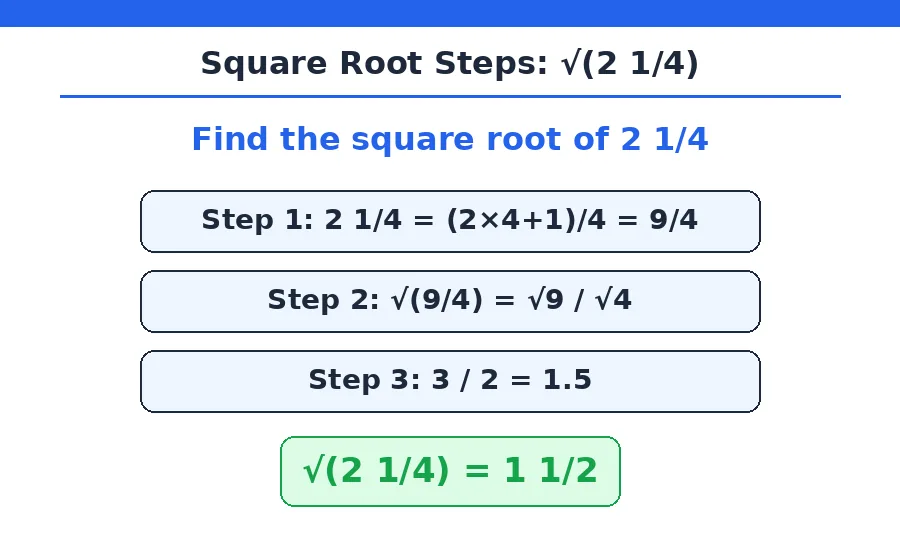
To find the square root of a mixed number, first convert it to an improper fraction. Then take the square root, simplify the result, and convert it to a mixed number or decimal if needed. This method keeps the whole number and fractional part together and avoids calculation errors.
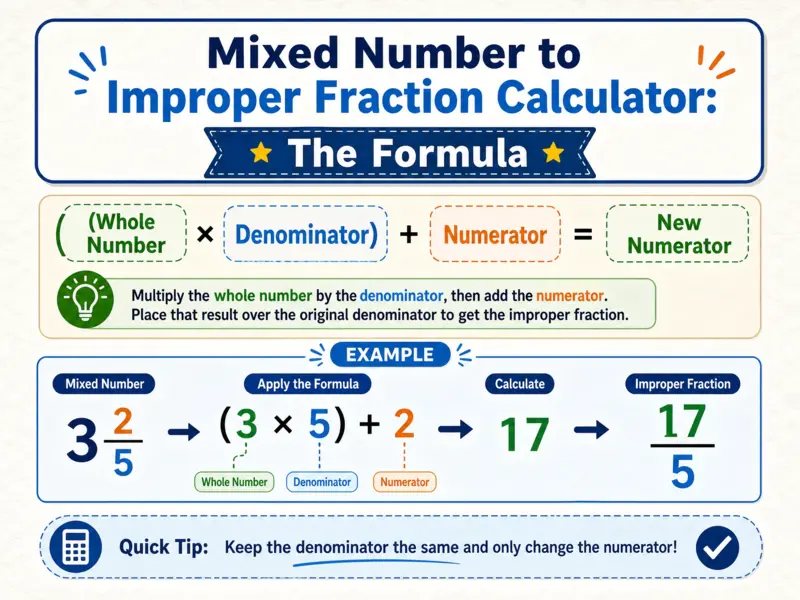
Step 1 — Convert the mixed number to an improper fraction
Use this formula:
a b/c = (a × c + b) / c
For example:
5 44/49
Convert it as follows:
(5 × 49 + 44) / 49
= (245 + 44) / 49
= 289/49
So, 5 44/49 = 289/49.
Step 2 — Take the square root
Now find the square root of the improper fraction:
√(289/49) = √289 / √49
= 17/7
For nonnegative values, the square root of a quotient can be evaluated as the quotient of the square roots when the denominator is nonzero.
Step 3 — Convert the result back to a mixed number
If the exact answer is an improper fraction, divide the numerator by the denominator:
17 ÷ 7 = 2 remainder 3
Therefore:
17/7 = 2 3/7
So the exact square root of 5 44/49 is 2 3/7.
Step 4 — Convert to a decimal
Divide the numerator by the denominator:
17/7 ≈ 2.428571
Therefore:
√(5 44/49) ≈ 2.428571
You can round the decimal according to the required precision. For example, to two decimal places, the result is 2.43.
Quick method
For any mixed number a b/c:
- Convert it to an improper fraction: (a × c + b)/c.
- Take the square root of the resulting fraction.
- Simplify the exact result and convert it back to a mixed number when possible.
- Convert the exact result to a decimal if an approximation is needed.
Worked Examples of Square Roots of Mixed Numbers
These examples cover three common outcomes: an exact fraction, a decimal approximation, and a result that remains in radical form.
Example 1 — Perfect-square mixed number
Find:
√(5 44/49)
First convert the mixed number to an improper fraction:
5 44/49 = (5 × 49 + 44)/49 = 289/49
Then:
√(289/49) = √289/√49 = 17/7
Convert the improper fraction back to a mixed number:
17/7 = 2 3/7
Therefore:
√(5 44/49) = 17/7 = 2 3/7
This is an exact result because both 289 and 49 are perfect squares. The square-root quotient rule supports separating the numerator and denominator roots in this form.
Example 2 — Mixed number with a decimal result
Now consider:
√(3 3/7)
Convert the mixed number first:
3 3/7 = (3 × 7 + 3)/7 = 24/7
So:
√(3 3/7) = √(24/7)
The numerator and denominator do not produce a simple rational square root, so a decimal approximation is more useful:
√(24/7) ≈ 1.8516
Rounded to two decimal places:
√(3 3/7) ≈ 1.85
You can increase the number of decimal places when greater numerical precision is needed.
Example 3 — A result that remains a radical
Consider:
√(2 1/3)
Convert the mixed number:
2 1/3 = (2 × 3 + 1)/3 = 7/3
Therefore:
√(2 1/3) = √(7/3)
Neither 7 nor 3 is a perfect square, so the expression does not simplify to a rational fraction. Its exact form can remain:
√(7/3)
Its decimal approximation is:
√(7/3) ≈ 1.5275
So this example has both an exact radical form and a decimal approximation. Keeping the radical preserves the exact value, while the decimal provides a convenient rounded value.
Can You Take the Square Root of a Mixed Number Directly?
You can enter a mixed number directly into a calculator designed to accept mixed-number input, but mathematically, you should treat the mixed number as one value before finding its square root. A mixed number such as 5 44/49 means:
5 44/49 = 5 + 44/49
The whole number and fraction are added together, so they cannot generally be treated as two independent square roots.
Why you convert it first
A mixed number follows the relationship:
a b/c = a + b/c
For example:
5 44/49 = 5 + 44/49
The safest method is to convert this expression into an improper fraction:
5 44/49 = 289/49
Then take the square root:
√(289/49) = 17/7
This keeps the complete value under one square-root operation.
The common mistake to avoid
Do not use this incorrect rule:
√(a + b/c) ≠ √a + √(b/c)
In general, square roots do not distribute across addition. For example:
√(9 + 16) = √25 = 5
but:
√9 + √16 = 3 + 4 = 7
Since 5 ≠ 7, the two expressions are not equivalent. This is a common error when working with mixed numbers.
Correct method
For a mixed number, follow this sequence:
Mixed number → Improper fraction → Square root → Simplify
For example:
5 44/49 → 289/49 → √(289/49) → 17/7
If the exact result is an improper fraction, you can convert it back to a mixed number. If it cannot be simplified to a rational fraction, keep the exact radical form and provide a decimal approximation when needed.
Exact Answer vs Decimal Answer
A mixed number square root can have an exact answer, a decimal approximation, or both. The right format depends on whether the square root simplifies to a rational number or remains irrational.
When the answer is an exact fraction
An exact answer represents the value without rounding. For example:
√(289/49) = √289/√49 = 17/7
The fraction 17/7 is exact. It can also be written as the mixed number:
17/7 = 2 3/7
No decimal rounding is needed when you want to preserve the exact mathematical value.
When the answer needs a decimal approximation
Some mixed numbers produce square roots that cannot be expressed as a simple rational fraction. For example:
√(2 1/3) = √(7/3)
This radical is an exact form, but its decimal value is approximately:
1.527525…
Because the decimal continues without terminating, you must round it to a chosen number of decimal places when a finite decimal is required.
How rounding works
The calculator can display the decimal approximation at different levels of precision:
- 2 decimal places: 1.53
- 3 decimal places: 1.528
- 4 decimal places: 1.5275
- More decimal places: useful when additional numerical detail is required
No single precision is correct for every situation. Use the number of decimal places required by your assignment, calculation, or application. When precision is not specified, keeping the exact fraction or radical alongside the decimal helps make the result clear.
How to Convert the Square Root Back to a Mixed Number
When the square root simplifies to an improper fraction, you can convert that fraction into a mixed number. This is useful when the original problem expects the answer in mixed-number form.
Convert an improper fraction
Suppose the exact square-root result is:
17/7
Divide the numerator by the denominator:
17 ÷ 7 = 2 remainder 3
The quotient becomes the whole number, the remainder becomes the numerator, and the denominator stays the same:
17/7 = 2 3/7
So the exact square root can be written as either 17/7 or 2 3/7.
What if the answer is irrational?
Not every square root produces an improper fraction that can be converted into a mixed number. For example:
√(7/3) ≈ 1.527525…
This is an irrational number, so its decimal expansion does not terminate or repeat in a fixed pattern. A rounded value such as 1.53 is only an approximation and is not an exact mixed number.
In such cases, keep the exact radical form, such as √(7/3), and use a decimal approximation when needed. A finite mixed number can represent a rational value exactly, but it cannot represent an irrational square root exactly.
How to Check Your Answer
A simple way to verify a square-root result is to square the answer. Squaring reverses the square-root operation, so an exact answer should return the original value. For decimal results, remember that rounding can introduce a small difference.
Square the result
Using the earlier example:
√(5 44/49) = 17/7
Square the result:
(17/7)² = 289/49
Now convert 289/49 back to a mixed number:
289/49 = 5 44/49
The result matches the original mixed number, so 17/7 is verified as the exact square root.
Check the decimal
A rounded decimal does not necessarily reproduce the original value exactly when squared. For example:
√5 ≈ 2.24
But:
2.24² = 5.0176
The result is close to 5, but not exactly 5 because 2.24 is a rounded approximation, not the full value of √5. Standard algebra texts use this same squaring check to demonstrate why rounded square-root values are approximations.
For this reason, use the exact fraction or radical when exactness matters, and use the decimal result when an approximation is appropriate.
Common Mistakes When Finding a Mixed Number Square Root
A few simple errors can change the entire result when finding the square root of a mixed number. Knowing what to check can help you avoid incorrect answers.
Taking the square root of each part separately
Do not treat the whole number and fraction as separate square roots. A mixed number represents one value:
5 44/49 = 5 + 44/49
So this is incorrect:
√(5 + 44/49) ≠ √5 + √(44/49)
Convert the mixed number to an improper fraction first, then take its square root.
Forgetting to convert the mixed number
A value such as 5 44/49 must be treated as one mathematical value. Use:
a b/c = (a × c + b)/c
Therefore:
5 44/49 = (5 × 49 + 44)/49 = 289/49
Taking the square root of 289/49 is then straightforward.
Incorrect improper-fraction conversion
A common mistake is adding or multiplying the wrong numbers during conversion. Remember the order:
whole number × denominator + numerator
For 5 44/49:
(5 × 49 + 44)/49 = 289/49
The denominator stays unchanged.
Forgetting to simplify
After finding the square root, check whether the resulting fraction or radical can be simplified.
For example:
√(289/49) = 17/7
The numerator and denominator are both perfect squares, so the radical simplifies completely.
For other results, look for common factors in fractions or square factors inside radicals before giving the final answer.
Treating an approximate answer as exact
An exact result and a rounded decimal are not the same thing.
For example:
17/7 = 2.428571…
If rounded to two decimal places:
17/7 ≈ 2.43
The fraction 17/7 is exact, while 2.43 is an approximation. Use the approximation symbol ≈ when rounding a result.
Ignoring the denominator
The denominator must be a valid nonzero number. A fraction with a denominator of zero is undefined, so an expression such as:
5 44/0
cannot be used as a valid mixed number for this calculation.
Always check that the denominator is not zero before calculating the square root.
What Happens With Different Types of Mixed Numbers?
Not every mixed number produces the same type of square-root result. The outcome depends on whether the resulting fraction is a perfect square, a non-perfect square, zero, or a negative value.
Perfect-square result
When the converted fraction has a numerator and denominator that are both perfect squares, the square root can simplify to an exact rational number.
For example:
√(5 44/49) = √(289/49) = 17/7
The result can then be written as the mixed number:
17/7 = 2 3/7
Non-perfect-square result
If the converted fraction does not have square factors that allow the radical to simplify completely, the answer may remain an irrational number.
For example:
√(2 1/3) = √(7/3) ≈ 1.5275
Here, √(7/3) is the exact radical form, while 1.5275 is a decimal approximation.
Zero
If the mixed-number value is zero, its square root is also zero:
√0 = 0
Zero is the only number whose square root is exactly zero.
Negative input
A negative value does not have a real square root. For example:
√(-4)
has no real-number answer.
A mixed-number square root calculator should identify a negative radicand and display a clear message rather than returning a misleading real decimal. If complex-number calculations are supported, the result belongs to the complex-number system and should be labeled accordingly.
Mixed Number Square Root Calculator vs Regular Square Root Calculator
A regular square-root calculator is useful for whole numbers and standard numerical inputs, but mixed-number input may require an extra conversion step. A dedicated mixed number square root calculator is built around the way mixed numbers are written, so it can handle the conversion and square-root calculation as one workflow.
| Feature | Regular square-root calculator | Mixed-number calculator |
| Whole-number input | Yes | Yes |
| Fraction input | Sometimes | Yes |
| Mixed-number input | Often inconvenient | Yes |
| Improper-fraction conversion | Usually manual | Automatic |
| Exact answer | Depends on the tool | Yes, when an exact form exists |
| Decimal approximation | Usually | Yes |
| Calculation steps | Varies | Yes |
The main difference is convenience and transparency. Instead of manually changing 5 44/49 into 289/49, a dedicated calculator can perform that conversion automatically and show the intermediate steps. Existing mixed-number tools commonly use separate whole-number, numerator, and denominator inputs and display converted or simplified forms, but their primary purpose is usually fraction arithmetic rather than square-root calculations.
That makes a dedicated tool useful for users who specifically want to calculate the square root of a mixed number, compare the exact and decimal answers, and see how the result was obtained.
Frequently Asked Questions
What is the square root of a mixed number?
The square root of a mixed number is a value that produces the original number when multiplied by itself. To find it, convert the mixed number to an improper fraction, then simplify its square root.
How do you find the square root of a mixed fraction?
Convert the mixed fraction to an improper fraction using (whole number × denominator + numerator) / denominator. Then take the square root and simplify the result.
Can I enter a mixed number directly into the calculator?
Yes. A dedicated mixed number square root calculator can accept the whole number, numerator, and denominator separately. If a single-input field is available, you can enter a value such as 5 44/49 directly.
How do I convert a mixed number to an improper fraction?
Use:
a b/c = (a × c + b) / c
For example:
5 44/49 = (5 × 49 + 44)/49 = 289/49
Can I take the square root of the whole number and fraction separately?
No, not generally. A mixed number represents one combined value, so:
√(a + b/c) ≠ √a + √(b/c)
in general. Convert the mixed number to an improper fraction first.
What is the square root of 5 44/49?
Convert it first:
5 44/49 = 289/49
Then:
√(5 44/49) = 17/7 = 2 3/7
So the exact answer is 17/7, or 2 3/7 as a mixed number.
Can a square root of a fraction be written as a fraction?
Yes, when the numerator and denominator have suitable square factors. For example:
√(289/49) = 17/7
If the fraction does not simplify to a rational square root, the exact result may remain a radical.
What if the square root is not a perfect square?
Keep the simplified exact radical when possible and provide a decimal approximation. For example:
√(7/3) ≈ 1.5275
The radical is exact, while the decimal is rounded.
How do I round a mixed-number square root?
First calculate the square root, then round its decimal value to the required precision. For example:
17/7 = 2.428571…
So it is 2.43 to 2 decimal places and 2.429 to 3 decimal places.
Can a negative mixed number have a real square root?
No. A negative radicand does not have a square root in the real-number system. A calculator should identify this as an invalid real square-root input rather than display a misleading real decimal.
How can I verify the calculator’s answer?
Square the exact result and check whether it returns the original mixed number. For example:
(17/7)² = 289/49 = 5 44/49
A rounded decimal may produce a slightly different value when squared because it is only an approximation.