Mixed Number Equivalent Calculator
Mixed Number Equivalent Calculator
Convert mixed numbers to equivalent fractions, generate equivalent forms, and solve missing values.
Calculation steps
How it works
Enter a target denominator to find the missing numerator. Or enter a target numerator to find the missing denominator.
Calculation steps
Verification
A mixed number equivalent calculator helps you convert a mixed number such as 2 3/4 into its equivalent improper fraction, 11/4. Both forms represent exactly the same value. The calculator can also generate additional equivalent fractions, such as 22/8 and 33/12, and show the calculation step by step so you can check how the answer was reached. For ratio-based equivalence problems, see our mixed number proportion calculator.
What is a mixed number equivalent calculator?
A mixed number equivalent calculator converts a mixed number into an equivalent fraction without changing its value. For example, 2 3/4 = 11/4. It can also find additional equivalent fractions by multiplying the numerator and denominator by the same nonzero number.
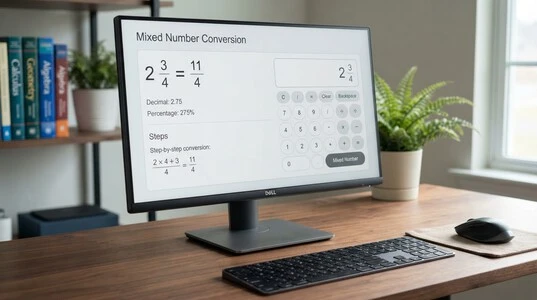
To calculate the result manually, multiply the whole number by the denominator, add the numerator, and keep the original denominator.
How to Use the Mixed Number Equivalent Calculator
Enter a Mixed Number
Enter the mixed number you want to convert, such as:
2 3/4
You can also enter:
5 1/2
7 3/8
If the calculator uses separate fields, enter the whole number, numerator, and denominator individually. The fractional part should normally be a proper fraction, meaning the numerator is smaller than the denominator.
See the Equivalent Fraction
After you enter a mixed number, the calculator can immediately show its equivalent improper fraction:
2 3/4 = 11/4
Depending on the calculator, the result may also include:
- Equivalent improper fraction: 11/4
- Simplified fraction: 11/4
- Decimal: 2.75
- Percentage: 275%
Showing several forms makes it easier to understand the result and verify that each representation has the same value.
Generate More Equivalent Fractions
You can generate additional fractions that represent the same value. For example:
2 3/4 = 11/4 = 22/8 = 33/12 = 44/16
Once the mixed number is converted to 11/4, multiply both the numerator and denominator by the same nonzero number. For example, multiplying by 2 gives 22/8, while multiplying by 3 gives 33/12. Because you multiply both parts equally, the value stays unchanged.
Find a Missing Numerator or Denominator
The calculator can also help solve equivalent-fraction problems where one number is missing. For example:
2 3/4 = ?/8
Since 2 3/4 = 11/4, multiply the numerator and denominator by 2:
11/4 = 22/8
So the missing numerator is 22.
You can also find a missing numerator when the denominator is 12:
?/12 = 11/4
Multiply both parts of 11/4 by 3:
11/4 = 33/12
Therefore, the missing numerator is 33.
What Is a Mixed Number?
Mixed Number Definition
A mixed number combines a whole number and a proper fraction. For example:
2 3/4 = 2 + 3/4
Here, 2 is the whole number, while 3/4 is the fractional part. In 3/4, the 3 is the numerator, which tells you how many parts are being used, and 4 is the denominator, which tells you how many equal parts make one whole.
A mixed number therefore represents one or more complete wholes plus a fraction of another whole.
What Does “Equivalent” Mean?
Equivalent fractions or numbers have the same value even when they are written in different forms. For example:
2 3/4 = 11/4
Both expressions represent the same amount. Likewise:
11/4 = 22/8
The notation changes, but the value does not. This is why 2 3/4, 11/4, and 22/8 can all describe the same quantity.
How to Convert a Mixed Number to an Equivalent Fraction
Converting a mixed number to an equivalent improper fraction is straightforward once you understand what the mixed number represents. The goal is to rewrite the same value in fraction form without changing its value.
The Mixed Number to Improper Fraction Formula
Use this formula:
(Whole Number × Denominator + Numerator) / Denominator
For example, to convert 2 3/4:
2 3/4
(2 × 4 + 3) / 4
= (8 + 3) / 4
= 11/4
So:
2 3/4 = 11/4
The result is an improper fraction because its numerator, 11, is larger than its denominator, 4.
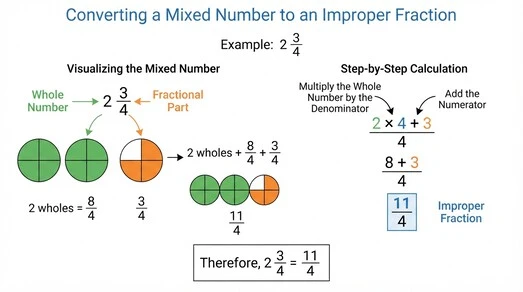
Why Does the Formula Work?
The formula works because a mixed number is simply a whole number added to a fraction. In this example:
2 3/4 = 2 + 3/4
To add these values, rewrite the two whole numbers using the same denominator as the fraction:
2 = 8/4
Now both parts are expressed in fourths:
8/4 + 3/4 = 11/4
Therefore:
2 3/4 = 11/4
The formula is simply a shortcut for this process. Multiplying the whole number by the denominator tells you how many fractional parts are contained in the whole numbers. Adding the numerator then gives the total number of fractional parts.
Steps to Convert a Mixed Number
- Multiply the whole number by the denominator.
- Add the numerator to the result.
- Keep the original denominator.
- Write the result as an improper fraction.
- Simplify the fraction if necessary.
For example:
3 2/5 → (3 × 5 + 2)/5 → 17/5
So, 3 2/5 = 17/5.
Equivalent Fractions From a Mixed Number
A mixed number can be converted into an improper fraction first, then used to create other equivalent fractions. This is different from the initial conversion: conversion changes the form of the mixed number, while finding equivalent fractions creates different fraction forms with the same value.
First Convert the Mixed Number
Start with the mixed number:
3 2/5
Convert it to an improper fraction:
3 2/5 = (3 × 5 + 2) / 5
= 17/5
So, 3 2/5 and 17/5 are equivalent representations of the same value.
Multiply Both Parts by the Same Number
To create additional equivalent fractions, multiply both the numerator and denominator by the same nonzero number:
17/5 × 2/2 = 34/10
17/5 × 3/3 = 51/15
17/5 × 4/4 = 68/20
Therefore:
3 2/5 = 17/5 = 34/10 = 51/15 = 68/20
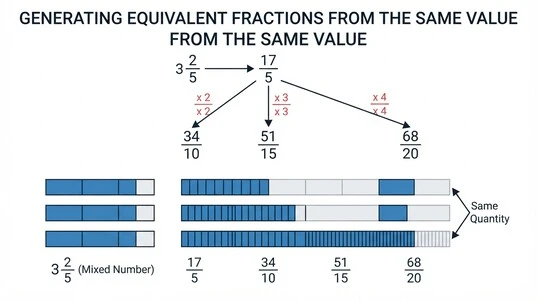
Each fraction looks different, but each represents the same quantity.
Why Are They Equivalent?
Multiplying the numerator and denominator by the same nonzero number does not change the fraction's value because the operation is equivalent to multiplying by 1. For example:
2/2 = 1
Therefore:
17/5 × 2/2 = 17/5 × 1 = 34/10
The value remains unchanged.
How do you find equivalent fractions? Multiply the numerator and denominator by the same nonzero number. For example, 17/5 × 2/2 = 34/10, so 17/5 and 34/10 are equivalent fractions. Equivalent fractions form a proportion; our proportion calculator can solve for a missing value.
How to Convert an Equivalent Improper Fraction Back to a Mixed Number
An improper fraction can be converted back into a mixed number by dividing its numerator by its denominator. This reverses the conversion process while keeping the same mathematical value.
Divide the Numerator by the Denominator
Start with:
17/5
Divide the numerator, 17, by the denominator, 5:
17 ÷ 5 = 3 remainder 2
The quotient is 3, and the remainder is 2. Therefore:
17/5 = 3 2/5
So 17/5 and 3 2/5 are equivalent forms of the same value.
What Happens to the Quotient and Remainder?
When converting an improper fraction to a mixed number:
- Quotient → whole number
- Remainder → numerator
- Original denominator → denominator
For example, 29/6 gives:
29 ÷ 6 = 4 remainder 5
So:
29/6 = 4 5/6
How do you turn an improper fraction into a mixed number?
- Divide the numerator by the denominator.
- Use the quotient as the whole number and the remainder as the numerator.
- Keep the original denominator.
Examples of Mixed Number Equivalent Fractions
These examples show how to convert mixed numbers, generate equivalent fractions, solve missing values, and convert an improper fraction back to a mixed number.
Example 1 — Simple Conversion
Convert 1 1/2 to an improper fraction:
1 1/2 = (1 × 2 + 1) / 2
= 3/2
Therefore:
1 1/2 = 3/2
Example 2 — Generate Equivalent Fractions
First convert 2 3/4:
2 3/4 = 11/4
Then multiply the numerator and denominator by the same number:
11/4 × 2/2 = 22/8
11/4 × 3/3 = 33/12
So:
2 3/4 = 11/4 = 22/8 = 33/12
Example 3 — Larger Numbers
Convert 5 3/8 to an improper fraction:
5 3/8 = (5 × 8 + 3) / 8
= 43/8
You can then generate equivalent fractions:
43/8 × 2/2 = 86/16
43/8 × 3/3 = 129/24
Therefore:
5 3/8 = 43/8 = 86/16 = 129/24
Example 4 — Missing Numerator
Suppose you need to solve:
3 1/2 = ?/4
First convert the mixed number:
3 1/2 = 7/2
Because the denominator needs to change from 2 to 4, multiply both parts by 2:
7/2 × 2/2 = 14/4
Therefore:
3 1/2 = 14/4, so the missing numerator is 14.
Example 5 — Reverse Conversion
Convert 29/6 to a mixed number:
29 ÷ 6 = 4 remainder 5
Use the quotient as the whole number and the remainder as the numerator:
29/6 = 4 5/6
The denominator remains 6.
How to Check if Two Mixed Numbers or Fractions Are Equivalent
You can check whether two mixed numbers or fractions are equivalent by converting them to the same form or by using cross multiplication. If both methods show the same value, the numbers represent the same quantity.
Convert Both to Improper Fractions
First, convert any mixed numbers into improper fractions. For example:
2 1/2 = 5/2
Now compare it with 10/4. Simplifying gives:
10/4 = 5/2
Both expressions equal 5/2, so:
2 1/2 = 10/4
The two fractions are equivalent because they have the same value, even though they are written differently.
Use Cross Multiplication
For two fractions:
a/b and c/d
check whether:
a × d = b × c
For example, to check 5/2 and 10/4:
5 × 4 = 20
2 × 10 = 20
Because both products are equal, 5/2 and 10/4 are equivalent.
This method provides a quick way to answer questions such as “Are these fractions equivalent?” or to verify an equivalent-fraction calculation.
Visualizing Equivalent Mixed Numbers
Equivalent fractions are easier to understand when you can see that they represent the same amount. A fraction bar or number line can show why different-looking fractions can have the same value.
Fraction Bar Example
Consider:
2 3/4
This means 2 complete wholes plus 3 out of 4 equal parts of another whole.
The equivalent improper fraction is:
11/4
The improper fraction counts the same amount using fourths: 11 fourths. So 2 3/4 and 11/4 describe the same quantity; they simply count and write the parts differently.
Number Line Example
On a number line, 2 3/4 and 11/4 land at exactly the same point:
2 2 1/4 2 1/2 2 3/4 3
|---------|--------|--------●---------|
11/4
The mixed number and improper fraction therefore identify the same location on the number line.
Why Different Fractions Can Have the Same Value
A fraction can be rewritten using more equal pieces without changing the amount. For example:
1/2 = 2/4 = 4/8
One-half can be divided into two fourths or four eighths. The number of pieces changes, but the total portion of the whole remains the same.
The same principle explains why:
2 3/4 = 11/4 = 22/8
Different numerators and denominators can describe the same quantity when the fraction is transformed correctly.
Common Mistakes When Converting Mixed Numbers
Small mistakes can change the value of a fraction or produce the wrong equivalent form. These are some of the most common errors when converting mixed numbers.
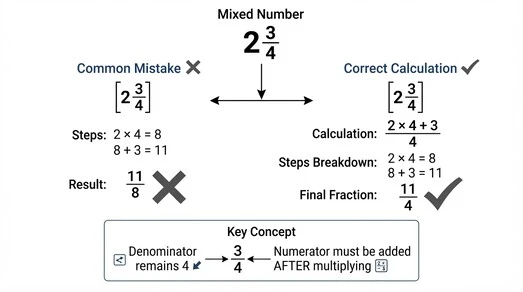
Changing the Denominator
A common mistake is changing the denominator during the conversion:
2 3/4 → 11/8
This is incorrect. The denominator stays 4 because the fractional part is measured in fourths. The correct calculation is:
(2 × 4 + 3) / 4 = 11/4
So:
2 3/4 = 11/4, not 11/8.
Forgetting to Add the Numerator
Multiplying the whole number by the denominator is only the first step. For 2 3/4:
2 × 4 = 8
You must then add the numerator:
8 + 3 = 11
Therefore:
2 3/4 = 11/4
Stopping at 8/4 leaves out the fractional part of the original mixed number.
Thinking an Improper Fraction Is Wrong
An improper fraction is not incorrect simply because its numerator is greater than its denominator. It is another valid way to represent a quantity.
For example:
11/4 = 2 3/4
Both forms have exactly the same value. The mixed number shows complete wholes and a remaining fraction, while the improper fraction expresses the entire amount in fourths.
Confusing a Mixed Number With Multiplication
When a whole number appears directly beside a fraction, it represents addition within a mixed number:
2 3/4 = 2 + 3/4
It does not mean:
2 × 3/4
The context matters. In a mixed number, the whole number and fraction together describe one quantity made up of complete wholes plus a fractional part.
Putting the Remainder Over the Wrong Number
When converting an improper fraction to a mixed number, the remainder becomes the numerator, while the original denominator stays unchanged.
For:
17/5
divide:
17 ÷ 5 = 3 remainder 2
Therefore:
17/5 = 3 2/5
The answer is 3 2/5, not 3 5/2. The denominator remains 5, and the remainder 2 becomes the numerator.
Mixed Number Equivalent Calculator vs. Manual Calculation
Both methods can be useful, depending on whether your priority is speed, learning, or checking an answer.
| Method | Best for |
| Calculator | Quick answers and checking work |
| Manual method | Learning the conversion process |
| Step-by-step calculator | Learning and verifying calculations |
A useful calculator should show how the answer was calculated, rather than returning only a final number. For example, when converting 2 3/4, it can show (2 × 4 + 3) / 4 = 11/4. This makes the result easier to understand, verify, and use when solving similar problems manually.
Special Cases and Calculator Limitations
Most mixed numbers follow the standard conversion rules, but some inputs need special handling. Understanding these cases also helps you recognize whether a calculator result is mathematically valid.
Whole Numbers
A whole number can be written as a fraction by placing it over 1:
5 = 5/1
This allows a whole number to be used in fraction calculations while keeping the same value.
Proper Fractions
A proper fraction has a numerator smaller than its denominator, so its value is less than one whole. For example:
3/5
A proper fraction does not need to be converted into a mixed number because it has no complete whole number.
Improper Fractions
An improper fraction has a numerator greater than or equal to its denominator. It can be converted into a mixed number by dividing the numerator by the denominator.
For example:
17/5 = 3 2/5
The quotient becomes the whole number, while the remainder becomes the numerator.
Negative Mixed Numbers
Negative mixed numbers require careful interpretation. For example:
-2 3/4 = -11/4
Here, the negative sign applies to the entire mixed number. It represents the negative of 2 3/4, not:
-2 + 3/4
These two expressions have different values, so a calculator should interpret negative mixed-number input consistently.
Zero Denominator
A denominator cannot equal zero. An expression such as:
3/0
is undefined and cannot be converted into a valid fraction or mixed number.
Calculator Accuracy and Limitations
A trustworthy mixed number calculator should make its calculation method clear. It should indicate how the input is interpreted, show the conversion steps when applicable, and return exact fractional results rather than hiding the calculation behind a single number.
It is also useful to state whether the calculator:
- simplifies fractions automatically;
- supports mixed numbers, improper fractions, and whole numbers;
- shows decimal or percentage equivalents;
- displays the calculation steps; and
- performs calculations locally in the browser, only if the tool actually does so.
The calculator should accurately describe its supported inputs and technical behavior rather than making unsupported claims about precision, privacy, or how calculations are processed.
Mixed Number Equivalent Calculator FAQs
What is a mixed number equivalent calculator?
A mixed number equivalent calculator converts a mixed number into an equivalent fraction while preserving its value. For example, it converts 2 3/4 to 11/4. It can also generate additional equivalent fractions, convert between mixed and improper forms, and show calculation steps for easier verification.
What is the equivalent fraction of 2 3/4?
The equivalent improper fraction of 2 3/4 is 11/4. Calculate it by multiplying the whole number by the denominator, then adding the numerator: (2 × 4 + 3) / 4 = 11/4. Therefore, 2 3/4 = 11/4, and both expressions represent exactly the same value.
How do you convert a mixed number to an improper fraction?
Multiply the whole number by the denominator, add the numerator, and keep the original denominator. For example, 3 2/5 becomes (3 × 5 + 2) / 5 = 17/5. The result is an improper fraction because its numerator is greater than its denominator.
How do you convert an improper fraction to a mixed number?
Divide the numerator by the denominator. The quotient becomes the whole number, the remainder becomes the numerator, and the original denominator stays unchanged. For example, 17/5 gives 3 remainder 2, so 17/5 = 3 2/5.
Are mixed numbers and improper fractions equivalent?
Yes. A mixed number and its corresponding improper fraction can represent exactly the same value. For example, 2 3/4 = 11/4. The mixed number shows the value as complete wholes plus a fraction, while the improper fraction expresses the entire amount using equal fractional parts.
How do you find equivalent fractions?
Multiply the numerator and denominator by the same nonzero number. For example, 17/5 × 2/2 = 34/10. Because 2/2 = 1, the multiplication does not change the value. Therefore, 17/5 and 34/10 are equivalent fractions.
Why do you multiply the whole number by the denominator?
Multiplying the whole number by the denominator converts the complete wholes into the same fractional units as the fractional part. For example, in 2 3/4, two wholes equal 8/4. Adding 3/4 gives 11/4, which explains why the formula begins with 2 × 4.
Why does the denominator stay the same?
The denominator identifies the size of each fractional part. When converting 2 3/4 to an improper fraction, the two wholes become 8/4, so the fractional units remain fourths. Adding 3/4 gives 11/4. The denominator stays 4 because all the parts are still fourths.
Can a mixed number have an improper fraction part?
In standard mixed-number notation, the fractional part is normally a proper fraction, such as 2 3/4. An expression such as 2 5/4 is not the usual simplified mixed-number form because 5/4 contains another whole. It can instead be rewritten as 3 1/4.
How do you find a missing numerator in an equivalent fraction?
First convert the mixed number to an improper fraction, then scale the numerator and denominator by the same number. For example, 3 1/2 = 7/2. To find ?/4, multiply by 2/2: 7/2 = 14/4. Therefore, the missing numerator is 14.
How do you know whether two fractions are equivalent?
You can simplify both fractions and compare their values, or use cross multiplication. For a/b and c/d, check whether a × d = b × c. For example, 5/2 and 10/4 are equivalent because 5 × 4 = 2 × 10 = 20.
Can a mixed number be converted to a decimal?
Yes. First convert the mixed number to an improper fraction, then divide the numerator by the denominator. For example, 2 3/4 = 11/4, and 11 ÷ 4 = 2.75. Therefore, 2 3/4 = 2.75.
What is 3 2/5 as an improper fraction?
3 2/5 = 17/5. Multiply the whole number by the denominator and add the numerator: (3 × 5 + 2) / 5 = (15 + 2) / 5 = 17/5. The denominator remains 5 because the original fractional part is measured in fifths.
What is 17/5 as a mixed number?
17/5 = 3 2/5. Divide 17 by 5 to get 3 remainder 2. The quotient, 3, becomes the whole number, while the remainder, 2, becomes the numerator. Keep the original denominator, 5, to get 3 2/5.
Can negative mixed numbers be converted to equivalent fractions?
Yes. A negative mixed number can be converted using the same basic process, while treating the negative sign as applying to the complete mixed value. For example, -2 3/4 = -11/4. It should not be interpreted as -2 + 3/4, which represents a different value.