Mixed Number to Decimal Calculator
A Mixed Number to Decimal Calculator quickly converts mixed numbers into decimal values. A mixed number combines a whole number and a fraction. Decimal conversion helps you read and use these values more easily. This calculator provides accurate results in seconds. It also reduces manual calculation errors. You can use it as a Mixed Fraction to Decimal Calculator, Fraction to Decimal Calculator, or Decimal Conversion Calculator. In this guide, you will learn how mixed numbers become decimal numbers and how to interpret the results with confidence.
A mixed number combines a whole number and a fraction. It shows a value greater than one in a simple format. For example, 3 ½ includes the whole number 3 and the fractional part ½. The fraction itself has two parts: the numerator and the denominator. Mixed numbers appear in everyday math, including measurements, recipes, and classroom problems. They help represent values that are not complete whole numbers.
Converting a mixed fraction into a decimal makes calculations easier. Decimal values work well in digital tools and mathematical operations. They also improve accuracy when comparing numbers. Since every mixed number is a rational number, it has an equivalent decimal representation. Understanding this concept makes decimal conversion much easier in the next steps.
Understanding the Fraction-to-Decimal Concept
A decimal representation shows a number in decimal form instead of a fraction. It makes values easier to read and compare. For example, 2 ½ becomes 2.5 after conversion. Fractions often appear in mathematics, measurements, and calculations. However, decimal values work better in calculators and digital tools. They help users perform quick and accurate computations.
Every mixed number has an equivalent decimal value because it is a rational number. A mixed number combines a whole number with a fractional part. When you convert the fraction into a decimal, you create a single, easy-to-understand value. Decimal notation also improves consistency in mathematical conversion. It helps students and professionals interpret numbers more efficiently. A Fraction to Decimal Converter simplifies this process and reduces calculation mistakes. Understanding fraction conversion builds a strong foundation for using a Mixed Number to Decimal Calculator and interpreting its results with confidence.
How to Use the Mixed Number to Decimal Calculator
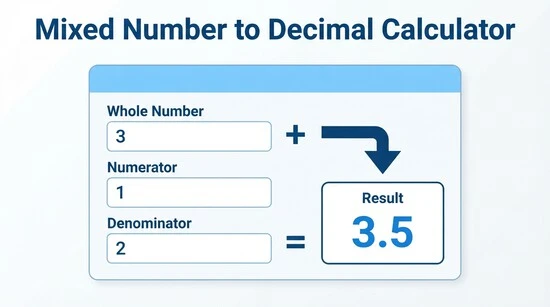
The Mixed Number to Decimal Calculator is simple to use. First, enter the whole number. Next, enter the numerator and denominator of the fractional part. Then, click the calculate button to start the conversion. The calculator instantly converts your mixed number into its decimal value. You can view the result immediately on your screen. An Online Mixed Number Converter saves time and improves accuracy by reducing manual calculation errors. It also helps beginners understand decimal outputs more easily. This Mixed Number Converter automates the calculation process without requiring any complex mathematical steps from the user.
Step-by-Step Conversion Method
Converting a mixed number into a decimal is straightforward. Follow these simple steps to get an accurate decimal result.
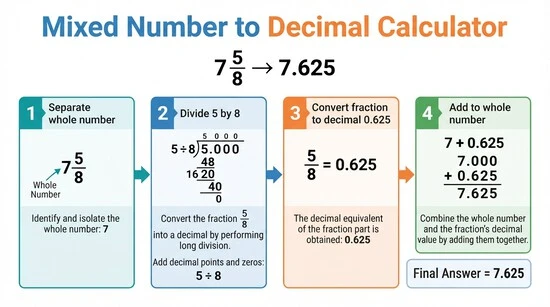
Separate the Whole Number
Start by identifying the whole number in the mixed number. This value remains unchanged during the conversion process. Keep it separate from the fractional part before moving to the next step.
Divide the Numerator by the Denominator
Next, divide the numerator by the denominator. This arithmetic operation converts the fractional portion into its decimal representation. The answer gives you the decimal value of the fraction.
Add Both Values Together
Now, add the whole number and the decimal value of the fraction. This mixed number conversion produces a single decimal number. The final sum is your decimal result.
Verify the Decimal Answer
Finally, review your calculation. Check that you entered the numerator, denominator, and whole number correctly. If needed, perform the calculation again to confirm the answer. A quick verification helps prevent common mistakes and improves accuracy.
This decimal conversion method uses simple arithmetic operations and a clear conversion formula. Understanding each step makes mixed number conversions easier and more reliable.
Understanding Decimal Interpretation
After converting a mixed number, it is important to understand what the decimal output means. Reading decimal values correctly helps you use them with confidence. A decimal number has two parts. The digits before the decimal point represent the whole number. The digits after the decimal point represent the fractional value. Together, they show the complete value of the number. Place values determine the meaning of each digit. The first digit after the decimal point shows tenths. The second shows hundredths. The third shows thousandths. Understanding place values makes decimal notation easier to read and compare.
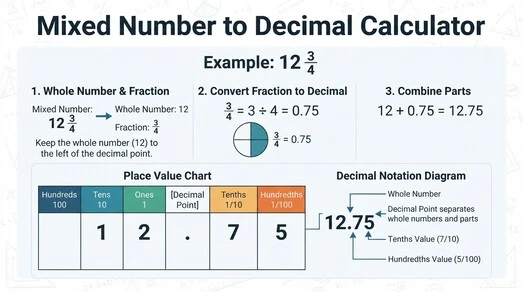
Decimal outputs may end after a few digits or continue for several places. This decimal expansion depends on the fractional part of the mixed number. Both forms are mathematically correct when displayed accurately. Decimal representation plays an important role in the number system. It provides a standard way to express values during decimal conversion. By understanding decimal notation and decimal values, you can interpret calculator results more easily and use them correctly in mathematical calculations. Knowing how to read decimal numbers will also help you understand rounding options in the next section.
Rounding Options Explained
Some mixed numbers produce long decimal values after conversion. Rounding helps make these values easier to read and use. It is especially useful when you need a simpler decimal output. Most calculators allow you to round numbers to a specific number of decimal places. Common options include one, two, or three decimal places. The choice depends on the level of precision you need. Rounding improves readability without changing the value significantly in most cases. However, greater decimal precision provides more accurate results for mathematical calculations. Understanding when to round is an important part of decimal mathematics.
A Decimal Conversion Calculator may display decimal values with several digits by default. Some decimal expansions terminate quickly, while others extend further. Always review the calculator output before selecting a rounding option. Choosing the appropriate level of decimal precision helps you interpret results more effectively. It also ensures that the decimal output meets your calculation or learning requirements.
Mixed Number to Decimal Examples
Examples make mixed number conversions easier to understand. They also help you interpret decimal outputs correctly. Use the following mixed fraction examples to practise the conversion method.
Beginner Examples
- 1 1/2 = 1.5
- 2 3/4 = 2.75
- 5 1/4 = 5.25
To find the decimal value, divide the numerator by the denominator and add the result to the whole number. For example, 1 ÷ 2 equals 0.5. Adding 1 gives 1.5.
Intermediate Examples
- 7 5/8 = 7.625
- 12 7/10 = 12.7
- 15 11/20 = 15.55
These examples follow the same process. First, convert the fractional part into a decimal. Then, combine it with the whole number to get the final answer.
Decimal Interpretation Examples
The decimal output shows the complete value of the mixed number. For instance, 2.75 means two whole units and seventy-five hundredths. Similarly, 7.625 means seven whole units and six hundred twenty-five thousandths.
Understanding decimal values helps you verify your calculations and interpret results accurately. These fraction conversion examples also demonstrate how decimal numbers represent mixed numbers in a simple format. You can use a Decimal Calculator Online to check your answers instantly and improve your understanding of mixed number conversions.
How Calculator Automation Helps
Calculator automation makes mixed number conversions faster and easier. It eliminates manual calculations and reduces human error. A calculator tool provides quick and accurate decimal results with just a few inputs. It also helps users focus on understanding the conversion process instead of performing lengthy calculations. As a mathematical calculator, it supports students and learners by improving accuracy and saving time. This makes decimal conversions more convenient for both learning and everyday use.
Common Mistakes When Converting Mixed Numbers
Small mistakes can lead to incorrect decimal answers. Understanding them will help you improve accuracy during mixed number conversions. One common mistake is dividing the fraction incorrectly. Always divide the numerator by the denominator before adding the whole number. Following the correct decimal conversion steps prevents calculation errors. Some users place the decimal point incorrectly when writing the answer. Double-check the decimal value before using it in calculations.
Ignoring rounding preferences can also create confusion. If your calculator provides several decimal places, decide whether rounding is necessary for your purpose. Another frequent mistake is entering incorrect values into the calculator. Verify the whole number, numerator, and denominator before clicking calculate. Careful mathematical conversion requires attention to each step. Reviewing your inputs and outputs will help you achieve accurate and reliable decimal results every time.
Frequently Asked Questions
What is a mixed number?
A mixed number combines a whole number and a fraction. For example, 4 1/2 contains the whole number 4 and the fraction 1/2.
How do I convert a mixed number into a decimal?
Divide the numerator by the denominator. Then, add the decimal value to the whole number.
Can mixed numbers produce repeating decimals?
Yes. Some fractions create repeating decimals when divided. For example, 1/3 becomes 0.333… and continues indefinitely.
How accurate is a Mixed Number to Decimal Calculator?
A calculator provides highly accurate results when you enter the values correctly. Always review your inputs before calculating.
What do decimal places mean?
Decimal places represent the digits after the decimal point. They indicate the precision of the decimal value.
Can I round decimal results?
Yes. You can round decimal values to the required number of decimal places for easier reading and calculations.
Why do some mixed numbers have long decimal answers?
Some fractions do not convert into short decimal values. Their decimal expansion may continue for several digits.
Is calculator automation accurate?
Yes. Calculator automation reduces manual errors and delivers instant decimal results.
Can students use this calculator for learning?
Absolutely. It helps students understand mixed numbers, decimal conversions, and decimal interpretation more easily.
Is manual conversion still useful?
Yes. Learning manual conversion strengthens mathematical skills and helps you verify calculator results when needed.
Conclusion
A Mixed Number to Decimal Calculator makes decimal conversions quick, simple, and accurate. It helps users convert mixed numbers into decimal values with confidence. Understanding the conversion steps and decimal interpretation improves both learning and accuracy. Knowing how decimal values work also helps you read calculator outputs correctly. Whether you are a student or a regular user, this calculator offers an easy way to perform mixed number conversions while building a stronger understanding of decimal concepts.