
Mixed Number Exponents Calculator
Use this mixed number exponents calculator to evaluate powers that contain mixed numbers, fractions, integers, or decimals. Enter the base and exponent, then choose Calculate to get the result in exact and decimal form, along with the steps used to solve the expression. The calculator is designed for expressions such as 1611416^{1\frac14}, 82138^{2\frac13}, and negative mixed-number exponents. It can also help when the mixed number is the base, such as (234)2\left(2\frac34\right)^2.
Enter a base and a mixed-number exponent to compute the power with steps.
Result
Steps
Quick example: A mixed-number exponent such as 1121\frac12 is first converted to the improper fraction 32\frac32. Therefore, 81128^{1\frac12} becomes 83/28^{3/2}, which can then be evaluated using the rules for rational exponents.
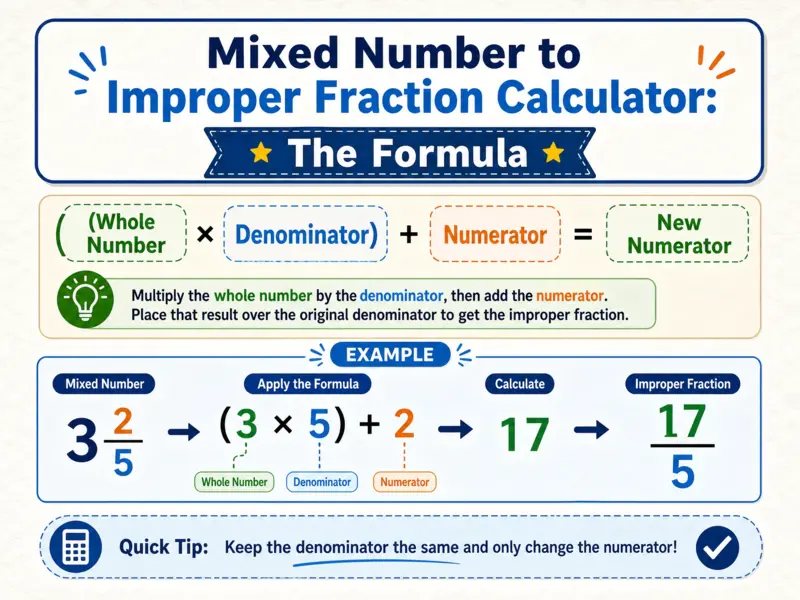
What are you calculating?
A number raised to a mixed-number exponent
1611416^{1\frac14}
Here, 1616 is the base and 1141\frac14 is the exponent. Convert the mixed number to an improper fraction:
114=541\frac14=\frac54
So the expression becomes:
165/4=3216^{5/4}=32
A mixed number raised to a power
(234)2\left(2\frac34\right)^2
Here, 2342\frac34 is the base and 22 is the exponent. Convert the mixed number first:
234=1142\frac34=\frac{11}{4}
Then:
(114)2=12116=7916\left(\frac{11}{4}\right)^2=\frac{121}{16}=7\frac9{16}
These two calculations are different, so identifying whether the mixed number is the base or exponent is important before entering an expression.
What the calculator can handle
- Whole-number exponents
- Mixed-number exponents
- Fractional and rational exponents
- Mixed numbers as bases
- Negative exponents
- Fractions and decimals
- Exact results when possible
- Decimal approximations
- Step-by-step calculations
For a rational exponent such as am/na^{m/n}, the denominator indicates the root and the numerator indicates the power. This relationship is the foundation for evaluating fractional and mixed-number exponents.
How to Use the Mixed Number Exponents Calculator
Using the mixed number exponent calculator is straightforward. Enter the base and exponent in the appropriate fields, then select Calculate. The calculator converts mixed numbers into their exact rational form before evaluating the expression, so you can work with fractions without first converting them manually.
Enter the base
The base is the number being raised to a power. You can enter different number formats, including:
- Whole numbers, such as 1616 or 88
- Fractions, such as 254\frac{25}{4}
- Decimals, such as 6.256.25
- Mixed numbers, such as 2342\frac34
- Negative numbers when the resulting expression is mathematically defined
For example, if you enter
82138^{2\frac13}
the base is 88, while 2132\frac13 is the exponent.
If the base is a mixed number, use parentheses to make the intended expression clear:
(234)2\left(2\frac34\right)^2
This tells the calculator to square the entire mixed number rather than only part of the expression.
Enter the mixed-number exponent
Enter the exponent exactly as it appears in your problem. The calculator can interpret values such as:
114,213,−1121\frac14,\qquad 2\frac13,\qquad -1\frac12
as rational numbers.
For example:
114=541\frac14=\frac54
and
213=732\frac13=\frac73
The calculator then uses the resulting fraction as the exponent. A rational exponent mn\frac{m}{n} represents a power and a root: the numerator indicates the power, while the denominator indicates the root.
A negative mixed exponent is handled in the same way. For example,
−112=−32-1\frac12=-\frac32
so an expression such as 16−11216^{-1\frac12} is evaluated as 16−3/216^{-3/2}. A negative exponent represents a reciprocal of the corresponding positive power.
View the exact and decimal answers
After you select Calculate, a useful mixed number exponent calculator with steps should distinguish between the exact result and its decimal approximation.
Depending on the expression, the result may be shown as:
- Exact integer: such as 3232
- Simplified fraction: such as 12116\frac{121}{16}
- Mixed-number result: such as 79167\frac9{16}
- Radical form: such as 555\sqrt5
- Decimal approximation: such as 11.1803411.18034
- Calculation steps: showing the conversion and evaluation process
Showing both exact and decimal forms helps you avoid losing precision through early rounding. The step-by-step result also makes the tool useful as an exact mixed exponent calculator, fractional exponent calculator, and exponent calculator with fractions, rather than simply returning a final number.
For rational exponents, the calculation can be expressed using
am/n=(an)ma^{m/n}=\left(\sqrt[n]{a}\right)^m
which connects fractional exponents directly to roots and powers.
What Is a Mixed Number Exponent?
A mixed number exponent is an exponent written as a mixed number, such as 2122\frac12. To calculate it, convert the mixed number to an improper fraction first: 212=522\frac12=\frac52. The fraction is then used as a rational exponent, so 8212=85/28^{2\frac12}=8^{5/2}.
Mixed number vs. mixed-number exponent
A mixed number is simply a number written with a whole-number part and a fractional part, such as:
2122\frac12
Its value is:
212=522\frac12=\frac52
When the same mixed number appears above a base as an exponent, it has a different role:
82128^{2\frac12}
Here, 88 is the base, and 2122\frac12 is the exponent. The exponent tells you what power to raise 88 to.
First convert the mixed-number exponent:
212=522\frac12=\frac52
Therefore:
8212=85/28^{2\frac12}=8^{5/2}
So, a mixed number and a mixed-number exponent can contain the same numerical value, but their role in an expression depends on where the number appears.
Mixed number exponent vs. fractional exponent
A fractional exponent is an exponent written as a fraction, such as 52\frac52. A mixed-number exponent is another way of writing the same value:
212=522\frac12=\frac52
Therefore:
8212=85/28^{2\frac12}=8^{5/2}
The terms rational exponent, fractional exponent, and fractional power are closely related. A rational exponent is an exponent that can be written as a ratio of integers, such as 52\frac52. When that exponent is written as a fraction, it is commonly called a fractional exponent or fractional power.
For example:
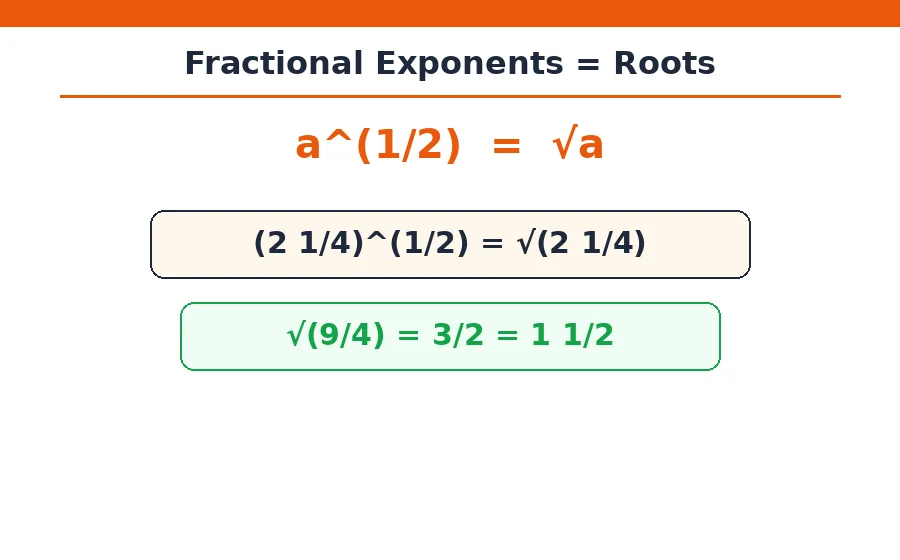
85/2=(8)58^{5/2}=\left(\sqrt{8}\right)^5
This means a mixed-number exponent should first be converted into its equivalent improper fraction before applying the rules for rational exponents.
How to Calculate a Mixed Number Exponent
To calculate a mixed number exponent, first convert the mixed number to an improper fraction. Then rewrite the exponent as a rational exponent, apply the root-and-power rule, and simplify the result. For example, 1611416^{1\frac14} becomes 165/416^{5/4}, which evaluates to 3232.
Step 1 — Convert the mixed number to an improper fraction
For a mixed number
abca\frac{b}{c}
convert it to an improper fraction using:
abc=ac+bca\frac{b}{c}=\frac{ac+b}{c}
For example:
114=1(4)+14=541\frac14=\frac{1(4)+1}{4}=\frac54
This conversion gives the exponent an exact fractional form that can be used with the rules for rational exponents.
Step 2 — Rewrite the exponent
Replace the mixed-number exponent with its equivalent improper fraction.
For example:
16114=165/416^{1\frac14}=16^{5/4}
At this point, the mixed-number exponent has become a standard fractional exponent or rational exponent.
Step 3 — Apply the rational-exponent rule
For a rational exponent, use:
am/n=(an)ma^{m/n}=\left(\sqrt[n]{a}\right)^m
The denominator represents the root, while the numerator represents the power. Thus, in a5/4a^{5/4}, the 44 indicates a fourth root and the 55 indicates raising the result to the fifth power. This is the standard relationship between rational exponents and radicals described by OpenStax. OpenStax — Rational Exponents
For the example:
165/4=(164)516^{5/4}=\left(\sqrt[4]{16}\right)^5
Step 4 — Simplify the answer
Now evaluate the root and then the power:
165/4=(164)5=25=3216^{5/4} =\left(\sqrt[4]{16}\right)^5 =2^5 =32
Therefore:
16114=32\boxed{16^{1\frac14}=32}
The general process is convert → rewrite → apply the rational-exponent rule → simplify. This method works for mixed-number exponents such as 1141\frac14, 2132\frac13, and other positive or negative mixed numbers, provided the resulting expression is mathematically defined.
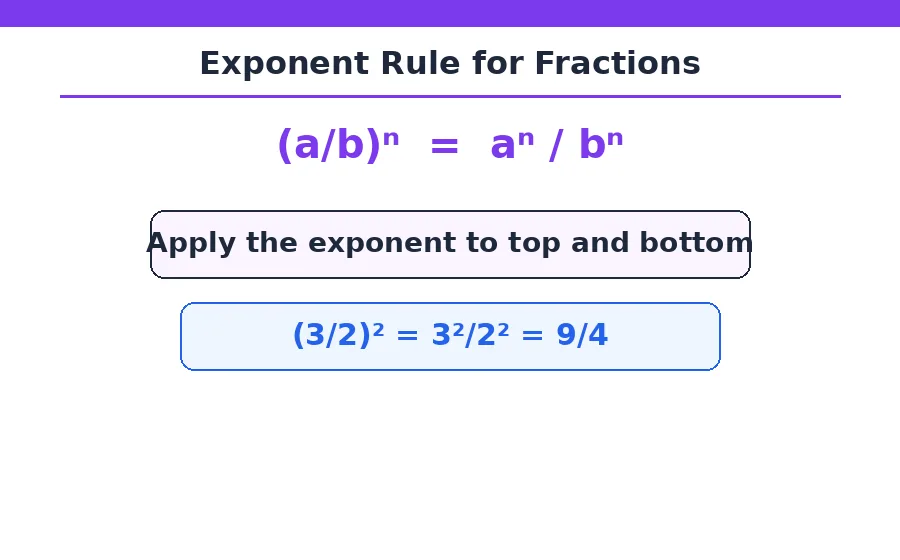
Mixed Number Exponent Examples
Working through examples makes it easier to see how a mixed number exponent calculator converts mixed numbers into rational exponents and evaluates them. The examples below cover whole-number results, fractional results, negative exponents, and the case where the mixed number is the base instead of the exponent.
Example 1 — 1611416^{1\frac14}
First convert the mixed number to an improper fraction:
114=1(4)+14=541\frac14=\frac{1(4)+1}{4}=\frac54
Rewrite the expression:
16114=165/416^{1\frac14}=16^{5/4}
Apply the rational-exponent rule:
165/4=(164)516^{5/4}=\left(\sqrt[4]{16}\right)^5
Since 164=2\sqrt[4]{16}=2:
25=322^5=32
Therefore:
16114=32\boxed{16^{1\frac14}=32}
Example 2 — 82138^{2\frac13}
Convert the mixed-number exponent:
213=2(3)+13=732\frac13=\frac{2(3)+1}{3}=\frac73
So:
8213=87/38^{2\frac13}=8^{7/3}
Using the rational-exponent rule:
87/3=(83)78^{7/3}=\left(\sqrt[3]{8}\right)^7
The cube root of 88 is 22, so:
27=1282^7=128
Therefore:
8213=128\boxed{8^{2\frac13}=128}
Taking the cube root first makes this calculation especially simple because 88 is a perfect cube:
83=2\sqrt[3]{8}=2
You can then raise 22 to the seventh power instead of working with the larger expression directly.
Example 3 — 51125^{1\frac12}
Convert the mixed-number exponent:
112=321\frac12=\frac32
Therefore:
5112=53/25^{1\frac12}=5^{3/2}
Apply the rational-exponent rule:
53/2=(5)35^{3/2}=\left(\sqrt5\right)^3
This can also be written as:
53/2=555^{3/2}=5\sqrt5
So the exact answer is:
55\boxed{5\sqrt5}
Its decimal approximation is:
55≈11.180345\sqrt5\approx11.18034
This example shows why a calculator can provide both an exact answer and a decimal approximation. The radical form is exact, while the decimal is rounded.
Example 4 — Negative mixed exponent
Consider:
16−11416^{-1\frac14}
Convert the mixed number:
−114=−54-1\frac14=-\frac54
Therefore:
16−114=16−5/416^{-1\frac14}=16^{-5/4}
A negative exponent means take the reciprocal of the corresponding positive power:
16−5/4=1165/416^{-5/4}=\frac{1}{16^{5/4}}
From Example 1:
165/4=3216^{5/4}=32
Therefore:
16−114=132\boxed{16^{-1\frac14}=\frac1{32}}
The key rule is:
a−x=1axa^{-x}=\frac1{a^x}
So the negative sign does not make the final answer negative; it changes the power into its reciprocal.
Example 5 — Mixed number as the base
A mixed number can also appear as the base, rather than the exponent. Consider:
(234)2\left(2\frac34\right)^2
Convert the mixed-number base to an improper fraction:
234=2(4)+34=1142\frac34=\frac{2(4)+3}{4}=\frac{11}{4}
Then square it:
(234)2=(114)2=12116\left(2\frac34\right)^2 =\left(\frac{11}{4}\right)^2 =\frac{121}{16}
Convert the improper fraction back to a mixed number:
12116=7916\frac{121}{16}=7\frac9{16}
Therefore:
(234)2=7916\boxed{\left(2\frac34\right)^2=7\frac9{16}}
This is different from a mixed number used as an exponent. In 1611416^{1\frac14}, the mixed number tells you which power to use. In (234)2\left(2\frac34\right)^2, the mixed number is the number being raised to a power. This distinction is important when using a mixed number power calculator because the same input can produce a completely different expression depending on where the mixed number appears.
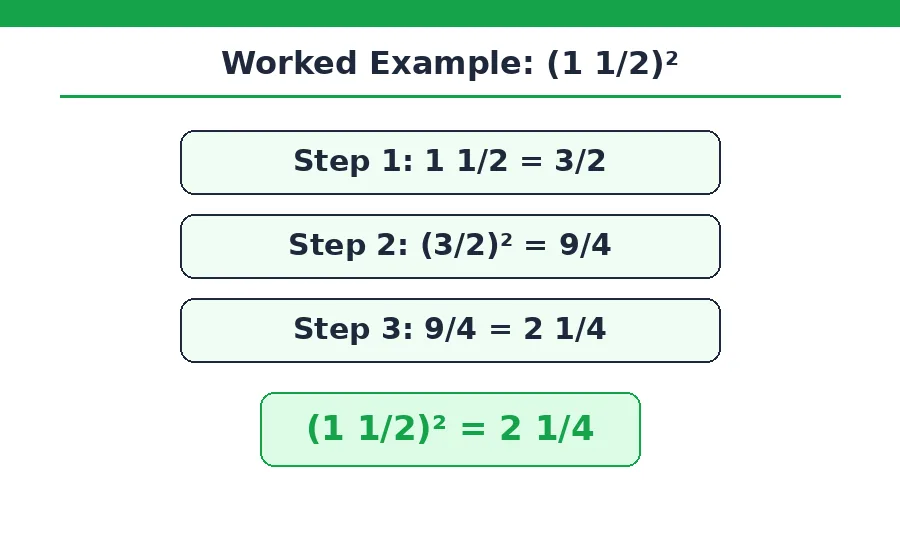
Mixed Number as the Exponent vs. Mixed Number as the Base
A mixed number can appear in two different positions in a power expression: as the exponent or as the base. These positions have different meanings and produce different calculations, so it is important to identify which one you are using before entering the expression into a calculator.
Mixed number as an exponent
Consider:
1611416^{1\frac14}
Here, 1616 is the base, while 1141\frac14 is the exponent.
Convert the mixed number to an improper fraction:
114=541\frac14=\frac54
So the expression becomes:
165/4=3216^{5/4}=32
The mixed number determines the power to which the base is raised.
Mixed number as the base
Now consider:
(234)2\left(2\frac34\right)^2
Here, 2342\frac34 is the base, while 22 is the exponent.
Convert the mixed number to an improper fraction:
234=1142\frac34=\frac{11}{4}
Then:
(114)2=12116=7916\left(\frac{11}{4}\right)^2 =\frac{121}{16} =7\frac9{16}
In this case, the mixed number is the value being squared.
Why the distinction matters
These are two different mathematical operations:
16114≠(234)216^{1\frac14}\neq\left(2\frac34\right)^2
In the first expression, the mixed number is the exponent. In the second, it is the base.
When entering a mixed number as the base, use parentheses so the calculator treats the entire mixed number as one value:
(234)2\left(2\frac34\right)^2
Likewise, when entering a mixed-number exponent, make sure the complete exponent is grouped correctly:
16(114)16^{\left(1\frac14\right)}
This distinction is especially important for a mixed number exponent calculator because the terms “mixed number” and “mixed exponent” can refer to different parts of the same expression. Always enter the complete expression, including parentheses where needed, to make the intended operation unambiguous.
Understanding Rational Exponents
A mixed-number exponent becomes a rational exponent when you convert it to an improper fraction. Understanding what the numerator and denominator do makes fractional powers much easier to calculate.
What does the numerator mean?
For a rational exponent written as:
am/na^{m/n}
the numerator mm represents the power.
For example:
a5/3a^{5/3}
has 55 as the numerator, so the result is raised to the fifth power.
What does the denominator mean?
The denominator nn represents the root. The standard relationship is:
am/n=(an)ma^{m/n}=\left(\sqrt[n]{a}\right)^m
For example:
3432/3343^{2/3}
has 33 as the denominator, so take the cube root. The numerator 22 then tells you to square the result:
3432/3=(3433)2343^{2/3}=\left(\sqrt[3]{343}\right)^2
OpenStax presents this relationship between rational exponents and radicals, while Khan Academy teaches the equivalent connection between radicals and rational exponents. OpenStax — Radicals and Rational Exponents
Root-first vs. power-first
You can interpret a rational exponent using either the root or power relationship, but one order may make the arithmetic much easier.
Consider:
3432/3343^{2/3}
Taking the cube root first is convenient because 343343 is a perfect cube:
3432/3=(3433)2=72=49343^{2/3} =\left(\sqrt[3]{343}\right)^2 =7^2 =49
So:
3432/3=49\boxed{343^{2/3}=49}
You could also think of the expression as taking the square of 343343 and then finding its cube root, but that creates much larger intermediate numbers. When the base is a perfect nnth power, taking the corresponding root first usually keeps the calculation simpler.
This same principle is useful when evaluating mixed-number exponents after converting them to fractional form.
Negative and Fractional Mixed Exponents
Mixed-number exponents can be positive or negative. Once a mixed number is converted to an improper fraction, the standard rules for rational exponents apply.
Negative mixed exponents
A negative rational exponent represents a reciprocal:
a−m/n=1am/na^{-m/n}=\frac{1}{a^{m/n}}
For example:
16−11416^{-1\frac14}
First convert the mixed number:
−114=−54-1\frac14=-\frac54
Then apply the negative-exponent rule:
16−5/4=1165/416^{-5/4}=\frac{1}{16^{5/4}}
Since:
165/4=3216^{5/4}=32
the answer is:
16−114=132\boxed{16^{-1\frac14}=\frac1{32}}
The negative exponent does not make the result negative. It tells you to take the reciprocal of the corresponding positive power.
Improper fractions with negative values
When a mixed exponent is negative, keep the negative sign with the entire rational number. For example:
−112=−32-1\frac12=-\frac32
It should not be interpreted as a positive 1121\frac12 with a separate minus sign applied later. The complete exponent is:
−32-\frac32
So:
8−112=8−3/28^{-1\frac12}=8^{-3/2}
and therefore:
8−3/2=183/2=1168^{-3/2} =\frac{1}{8^{3/2}} =\frac{1}{16}
Keeping the negative sign attached to the converted fraction helps prevent errors when entering a mixed exponent into a calculator.
Why parentheses matter
Parentheses can completely change the meaning of an expression, especially when a negative number is used as a base.
Compare:
(−4)2=16(-4)^2=16
with:
−42=−16-4^2=-16
In (−4)2(-4)^2, the parentheses make −4-4 the entire base, so the negative number is squared:
(−4)(−4)=16(-4)(-4)=16
In −42-4^2, the exponent applies to 44, and the negative sign remains outside the power:
−(42)=−16-(4^2)=-16
Therefore, when entering negative bases or negative mixed-number exponents, use parentheses whenever they are needed to show exactly which number the exponent applies to. This is particularly important for calculator input, where omitting parentheses can produce a mathematically different result.
What Happens With Negative Bases?
A negative base can work with a fractional or mixed-number exponent, but the result depends on the denominator of the exponent after it is reduced to lowest terms. Odd roots can produce real results for negative numbers, while even roots do not produce real-number results.
Negative base with an odd root
Consider:
(−8)1/3(-8)^{1/3}
The denominator 33 means take the cube root:
(−8)1/3=−83(-8)^{1/3}=\sqrt[3]{-8}
Because:
−83=−2\sqrt[3]{-8}=-2
the result is:
(−8)1/3=−2\boxed{(-8)^{1/3}=-2}
This works because an odd root of a negative number is a real number.
Negative base with an even root
Now consider:
(−16)1/2(-16)^{1/2}
The denominator 22 means take the square root:
(−16)1/2=−16(-16)^{1/2}=\sqrt{-16}
There is no real-number result, because no real number multiplied by itself equals −16-16.
A calculator that is restricted to real numbers may therefore reject this expression or report that the result is undefined in the real-number system. OpenStax notes that some rational powers of negative numbers do not produce real numbers. OpenStax — Rational Exponents
Why the calculator may display an error
An error message does not always mean the expression itself is incorrectly typed. With negative bases and fractional exponents, several situations are possible:
- No real-number solution: For example, (−16)1/2(-16)^{1/2} is not real.
- Invalid input: The calculator may not recognize an incorrectly formatted fraction, mixed number, or missing parenthesis.
- Complex-number result not supported: Some calculators work only with real numbers and cannot return complex values.
For example, a calculator designed for real-number exponents may display an error for:
(−16)1/2(-16)^{1/2}
because the expression has no real value. This is different from an input mistake such as entering an incomplete exponent.
When a calculator encounters a negative base, it should therefore explain why the result cannot be returned rather than simply showing “Error.” Checking the base, exponent, parentheses, and whether the calculation is intended to use real or complex numbers can help identify the issue.
Exact Answer vs. Decimal Answer
When evaluating a mixed or fractional exponent, an exact answer is usually preferable because it preserves the full mathematical value. A decimal can make the result easier to read or use in further calculations, but it may involve rounding.
A useful exact exponent calculator can show the exact form first and provide a decimal approximation separately.
Exact fraction
Some powers produce an exact fraction. For example:
(234)2=(114)2=12116\left(2\frac34\right)^2 =\left(\frac{11}{4}\right)^2 =\frac{121}{16}
The fraction
12116\boxed{\frac{121}{16}}
is exact. It represents the value without rounding or loss of precision.
Mixed-number form
An improper fraction can sometimes be rewritten as a mixed number:
12116=7916\frac{121}{16}=7\frac9{16}
Therefore:
7916\boxed{7\frac9{16}}
is another exact representation of the same result.
A calculator may show either the simplified improper fraction or the mixed-number form, depending on the output format.
Radical form
Some fractional powers are best represented with radicals. For example:
53/25^{3/2}
can be rewritten as:
53/2=(5)3=555^{3/2}=\left(\sqrt5\right)^3=5\sqrt5
So the exact answer is:
55\boxed{5\sqrt5}
The radical form keeps the result exact even though it cannot be expressed as a terminating decimal.
Decimal approximation
The same result can be displayed as a decimal:
55≈11.180345\sqrt5\approx11.18034
The decimal value is an approximation because the exact value 555\sqrt5 does not terminate as a decimal.
For this reason, a fractional exponent calculator or fraction power calculator can be more useful when it provides both forms:
Exact: 55\text{Exact: }5\sqrt5 Decimal: ≈11.18034\text{Decimal: }\approx11.18034
Decimal output is exact only when the decimal representation terminates without rounding. Otherwise, the calculator must round the displayed value to a chosen number of decimal places. Keeping the exact form available makes it easier to check work and use the result accurately in later calculations.
Common Mistakes When Calculating Mixed Number Exponents
Mixed-number exponents are easier to solve when you follow the conversion and exponent rules in the correct order. The mistakes below are common when working by hand or entering an expression into a calculator.
Forgetting to convert the mixed number
A mixed number must be converted to an improper fraction before it is used as a fractional exponent.
For example:
213≠232\frac13\neq\frac23
The correct conversion is:
213=2(3)+13=732\frac13=\frac{2(3)+1}{3}=\frac73
Therefore:
8213=87/38^{2\frac13}=8^{7/3}
Treating 2132\frac13 as 23\frac23 changes the exponent and produces a completely different answer.
Confusing the numerator and denominator
For a rational exponent:
am/na^{m/n}
the numerator mm represents the power, while the denominator nn represents the root.
For example:
82/38^{2/3}
means:
(83)2\left(\sqrt[3]{8}\right)^2
The 33 tells you to take the cube root, while the 22 tells you to square the result. This is the standard relationship between rational exponents and radicals. OpenStax — Radicals and Rational Exponents
Omitting parentheses
Parentheses are important when a negative number or a complete fractional expression needs to be treated as one unit.
For example:
(−4)2=16(-4)^2=16
but:
−42=−16-4^2=-16
Similarly, when entering a negative fractional or mixed-number exponent, group the complete exponent when the calculator’s input format requires it:
16(−114)16^{(-1\frac14)}
This helps prevent the calculator from interpreting the negative sign or part of the exponent separately.
Rounding too early
Converting exact values to decimals before finishing the calculation can introduce unnecessary rounding error.
For example, keep:
112=321\frac12=\frac32
instead of immediately replacing it with a rounded decimal. Likewise, keep:
53/2=555^{3/2}=5\sqrt5
as an exact value until the final step.
If a decimal is needed, calculate it after the exact form has been simplified:
55≈11.180345\sqrt5\approx11.18034
Keeping exact fractions and radicals until the end makes the calculation easier to verify and preserves precision.
Confusing a mixed-number base with a mixed-number exponent
A mixed number can be either the base or the exponent, and these positions produce different calculations.
For example:
1611416^{1\frac14}
uses 1141\frac14 as the exponent, while:
(234)2\left(2\frac34\right)^2
uses 2342\frac34 as the base.
Before using a mixed number exponent calculator, identify which part of the expression is the base and which is the exponent. If the mixed number is the base, use parentheses to make the intended operation clear.
Frequently Asked Questions About Mixed Number Exponents
What is a mixed number exponent?
A mixed number exponent is an exponent written as a mixed number, such as 2122\frac12. Convert it to an improper fraction first:
212=522\frac12=\frac52
So:
8212=85/28^{2\frac12}=8^{5/2}
The resulting fraction is a rational or fractional exponent.
How do you convert a mixed number to an exponent fraction?
Use the conversion formula:
abc=ac+bca\frac bc=\frac{ac+b}{c}
For example:
114=1(4)+14=541\frac14=\frac{1(4)+1}{4}=\frac54
Therefore, an expression such as 1611416^{1\frac14} becomes 165/416^{5/4}.
How do you calculate 1611416^{1\frac14}?
First convert the exponent:
114=541\frac14=\frac54
Then:
16114=165/4=(164)5=25=3216^{1\frac14}=16^{5/4} =\left(\sqrt[4]{16}\right)^5 =2^5 =32
Therefore:
16114=32\boxed{16^{1\frac14}=32}
How do you calculate 82138^{2\frac13}?
Convert the mixed-number exponent:
213=732\frac13=\frac73
Then:
8213=87/3=(83)7=27=1288^{2\frac13}=8^{7/3} =\left(\sqrt[3]{8}\right)^7 =2^7 =128
Therefore:
8213=128\boxed{8^{2\frac13}=128}
Can a calculator solve mixed-number exponents?
Yes. A calculator designed to accept mixed numbers or rational exponents can evaluate expressions such as 1611416^{1\frac14}, 82138^{2\frac13}, and negative mixed exponents. A useful calculator can also show the conversion steps, exact result, and decimal approximation.
How do I enter a mixed number exponent into a calculator?
Enter the mixed number as a complete exponent and use parentheses when the calculator requires them. For example:
16(114)16^{(1\frac14)}
If the calculator does not accept mixed-number notation directly, convert it first:
114=541\frac14=\frac54
and enter:
165/416^{5/4}
Always check the calculator’s input format, especially when using negative exponents or negative bases.
What is the difference between a mixed number and a fractional exponent?
A mixed number, such as:
2122\frac12
is a number written using a whole-number part and a fraction. As an exponent, it can be converted to a fractional or rational exponent:
212=522\frac12=\frac52
Thus:
8212=85/28^{2\frac12}=8^{5/2}
The mixed number describes the numerical value, while its position as an exponent determines how that value is used in the power expression.
What does the denominator of a fractional exponent mean?
In:
am/na^{m/n}
the denominator nn indicates the root:
am/n=(an)ma^{m/n}=\left(\sqrt[n]{a}\right)^m
For example:
272/3=(273)2=32=927^{2/3} =\left(\sqrt[3]{27}\right)^2 =3^2 =9
So the denominator tells you which root to take.
What does the numerator of a fractional exponent mean?
The numerator mm indicates the power in:
am/na^{m/n}
For example:
272/3=(273)227^{2/3} =\left(\sqrt[3]{27}\right)^2
The denominator 33 gives the cube root, and the numerator 22 tells you to square the result.
How do negative mixed exponents work?
First convert the mixed number to an improper fraction, keeping the negative sign:
−114=−54-1\frac14=-\frac54
Then use the negative-exponent rule:
a−m/n=1am/na^{-m/n}=\frac1{a^{m/n}}
For example:
16−114=16−5/4=1165/4=13216^{-1\frac14} =16^{-5/4} =\frac1{16^{5/4}} =\frac1{32}
A negative exponent produces a reciprocal; it does not simply make the answer negative.
Can a negative number have a fractional exponent?
Sometimes. It depends on the root represented by the denominator of the exponent.
For example:
(−8)1/3=−2(-8)^{1/3}=-2
because the cube root of a negative number is real.
However:
(−16)1/2(-16)^{1/2}
has no real-number result because it requires the square root of a negative number. A calculator that works only with real numbers may therefore reject the expression.
Why does my exponent calculator show an error?
An error can have several causes. The expression may have no real-number result, the input may be formatted incorrectly, or the calculator may not support complex-number results.
For example:
(−16)1/2(-16)^{1/2}
has no real value. By contrast, a missing parenthesis or incorrectly entered fraction can be an input problem. Check the base, exponent, signs, fractions, and parentheses before assuming the mathematical expression itself is invalid.
Should I use the root first or the power first?
Either order can work when the rational-exponent rules apply, but one may be much easier.
For:
3432/3343^{2/3}
taking the cube root first is convenient:
3432/3=(3433)2=72=49343^{2/3} =\left(\sqrt[3]{343}\right)^2 =7^2 =49
Because 343343 is a perfect cube, taking the root first avoids unnecessarily large intermediate calculations.
Can the calculator give an exact answer instead of a decimal?
Yes, if the calculator supports exact output. Depending on the expression, the exact result may appear as an integer, simplified fraction, mixed number, or radical.
For example:
(234)2=12116=7916\left(2\frac34\right)^2=\frac{121}{16}=7\frac9{16}
and:
53/2=55≈11.180345^{3/2}=5\sqrt5\approx11.18034
The radical 555\sqrt5 is exact, while 11.1803411.18034 is a decimal approximation.