
Mixed Fraction to Whole Number Calculator
Use the mixed fraction to whole number calculator to convert a fraction into its whole-number part, exact mixed-number form, decimal value, or nearest whole number. Enter the numerator and denominator to get a clear result and see how the calculation works.
A fraction does not always convert to an exact whole number. For example, 20/5 = 4 because 20 divides evenly by 5. But 19/5 = 3 4/5 = 3.8, so its whole-number part is 3, while its nearest whole number is 4.
These are different results:
- Exact whole number: The fraction divides evenly, such as 12/4 = 3.
- Whole-number part: The quotient from dividing the numerator by the denominator, such as 19/5 → 3.
- Mixed number: The whole-number part combined with the remaining fraction, such as 19/5 = 3 4/5.
- Nearest whole number: The decimal value rounded to the closest integer, such as 3.8 → 4.
This calculator helps you identify the result you need without confusing exact conversion with rounding.
Enter a fraction to find its whole-number part, exact mixed number, decimal, and nearest whole number.
Results
Steps
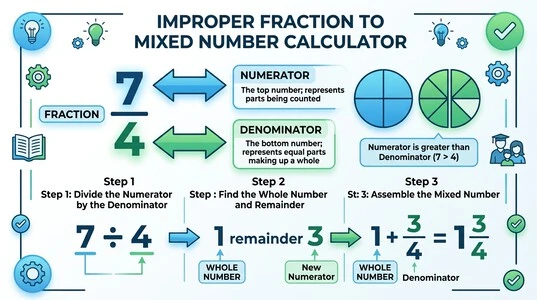
What Does a Fraction to Whole Number Calculator Do?
A fraction to whole number calculator divides the numerator by the denominator and shows the result in the form you need. Depending on the fraction, the result may be an exact whole number, a whole-number part with a remainder, a mixed number, a decimal, or a rounded whole number.
What “Whole Number” Means
A whole number is an integer with no fractional or decimal part. Whole numbers include:
0, 1, 2, 3, 4, 5, 6, …
A whole number cannot contain a remaining fraction. For example, 4 is a whole number, while 4 1/2 and 4.5 are not whole numbers.
Why a Fraction May Not Have an Exact Whole-Number Answer
A fraction becomes an exact whole number only when its numerator divides evenly by its denominator.
For example:
17/5 = 3 remainder 2
The exact mixed-number form is:
17/5 = 3 2/5
So 17/5 does not equal exactly 3. The number 3 is only the whole-number part; the remaining 2/5 is still part of the value.
By comparison:
20/5 = 4
Here, there is no remainder, so the fraction converts exactly to the whole number 4.
Whole-Number Part vs Nearest Whole Number
The whole-number part and the nearest whole number are not always the same.
Consider:
19/5 = 3.8
The results are:
- Whole-number part: 3
- Nearest whole number: 4
- Exact mixed number: 3 4/5
The whole-number part comes from the quotient before the remainder is considered. The nearest whole number comes from rounding the decimal value.
Can every fraction be converted to a whole number? No. A fraction can be converted to an exact whole number only when the numerator is evenly divisible by the denominator. If a remainder remains, the exact result is a fraction, mixed number, or decimal rather than a whole number.
How to Convert a Fraction to a Whole Number
To convert a fraction to a whole-number result, divide the numerator by the denominator. The quotient gives the whole-number part. If there is a remainder, place that remainder over the original denominator to write the exact result as a mixed number. This is the standard method for converting an improper fraction to a mixed number.
Divide the Numerator by the Denominator
Use this basic division pattern:
Numerator ÷ Denominator = Quotient Remainder
The parts have different meanings:
- Quotient: the whole-number part
- Remainder: the amount left after making complete groups
- Denominator: stays the denominator of the remaining fraction
For example, dividing 17 by 5 gives:
17 ÷ 5 = 3 remainder 2
The quotient is 3, and the remainder is 2. Because the original denominator is 5, the remaining fraction is 2/5.
Therefore:
17/5 = 3 2/5
If the Remainder Is Zero
When the numerator divides evenly by the denominator, the fraction converts to an exact whole number.
For example:
20 ÷ 5 = 4
There is no remainder, so:
20/5 = 4
In this case, 4 is the exact value, not just the whole-number part.
If There Is a Remainder
When division leaves a remainder, the fraction does not convert exactly to a whole number.
For example:
17 ÷ 5 = 3 remainder 2
The quotient gives the whole-number part, while the remainder becomes the numerator of the fractional part:
17/5 = 3 2/5
The denominator remains 5 because the original fraction was divided into fifths.
A useful rule to remember is: divide the numerator by the denominator; keep the quotient as the whole-number part, and write any remainder over the original denominator. If the remainder is zero, the result is an exact whole number.
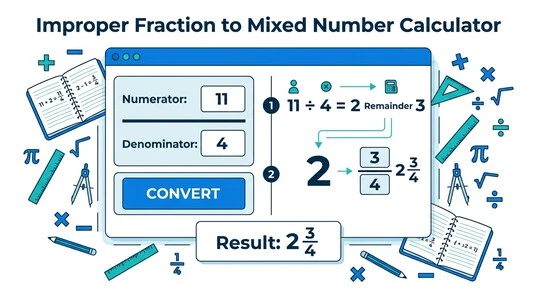
How to Convert an Improper Fraction to a Mixed Number
An improper fraction has a numerator that is greater than or equal to its denominator. To convert one to a mixed number, divide the numerator by the denominator. The quotient becomes the whole-number part, and the remainder becomes the numerator of the fractional part.
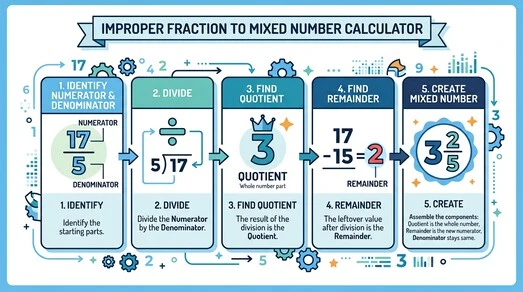
Identify the Numerator and Denominator
Start by identifying the two parts of the fraction. In:
17/5
- 17 is the numerator.
- 5 is the denominator.
Because the numerator is larger than the denominator, 17/5 is an improper fraction.
Divide
Divide the numerator by the denominator:
17 ÷ 5 = 3 R2
The quotient is 3, and the remainder is 2.
Write the Mixed Number
Use the quotient as the whole-number part and place the remainder over the original denominator:
17/5 = 3 2/5
The mixed number 3 2/5 has the same value as the original improper fraction.
Simplify the Fractional Part When Necessary
Sometimes the remainder and denominator can be reduced to lower terms. For example:
22/8 = 2 6/8
The fraction 6/8 can be simplified by dividing both numbers by 2:
6/8 = 3/4
So the simplified mixed number is:
22/8 = 2 3/4
Always simplify the fractional part when possible so the final mixed number is in its simplest form.
What If the Division Has No Remainder?
If the numerator divides evenly by the denominator, there is no fractional part to write.
For example:
15 ÷ 5 = 3
Therefore:
15/5 = 3
This is an exact whole number rather than a mixed number because the remainder is zero.
Mixed Fraction vs Whole Number vs Mixed Number
These terms describe different ways of representing numbers. Understanding the difference helps you avoid confusing an exact whole number with the whole-number part of a mixed number.
What Is a Mixed Fraction?
Mixed fraction is a common phrase for a number made up of a whole number and a proper fraction. In standard mathematical terminology, mixed number is generally the preferred term.
For example:
3 2/5
This means:
3 + 2/5
The fractional part is less than one, while the whole-number part shows the complete groups.
What Is an Improper Fraction?
An improper fraction has a numerator that is greater than or equal to its denominator.
For example:
17/5
The numerator, 17, is greater than the denominator, 5. Dividing 17 by 5 produces a quotient of 3 and a remainder of 2, so the equivalent mixed number is 3 2/5.
What Is a Whole Number?
A whole number is a number with no fractional or decimal part. Examples include:
0, 1, 2, 3, 4, 5, …
For example, 3 is a whole number. However, 3 2/5 is not a whole number because it contains a fractional part.
How the Three Forms Represent the Same Value
An improper fraction, mixed number, and decimal can represent exactly the same quantity:
17/5 = 3 2/5 = 3.4
These forms are equivalent, but they communicate the value differently:
- 17/5 — improper fraction
- 3 2/5 — mixed number
- 3.4 — decimal
- 3 — whole-number part, but not the complete value
This distinction is especially important when using a fraction to whole number calculator. The whole-number part is 3, but the exact value is 3 2/5, not 3.
Examples of Converting Fractions to Whole Numbers
Different fractions can produce different types of results. Some convert exactly to whole numbers, while others produce a remainder, a decimal, or a value that can be rounded. These examples show how to interpret each case.
Exact Whole Number — 12/4
Divide the numerator by the denominator:
12 ÷ 4 = 3
Because there is no remainder:
12/4 = 3
The answer is exactly 3.
Improper Fraction — 17/5
Divide 17 by 5:
17 ÷ 5 = 3 R2
The quotient is 3 and the remainder is 2, so:
17/5 = 3 2/5
Its decimal value is 3.4. The number 3 is the whole-number part, but it is not the exact value of the fraction.
Proper Fraction — 3/5
Here, the numerator is smaller than the denominator:
3/5 = 0.6
The results are:
- Whole-number part: 0
- Exact value: 3/5
- Decimal: 0.6
- Nearest whole number: 1
A proper fraction does not become an exact positive whole number because its value is less than 1.
Rounding Example — 19/5
First convert the fraction to a decimal:
19/5 = 3.8
Now distinguish the two results:
- Whole-number part: 3
- Nearest whole number: 4
The exact mixed-number form is 3 4/5. Rounding changes the value to the nearest integer, while taking the whole-number part does not represent the complete fraction.
Simplification Example — 22/8
Divide 22 by 8:
22 ÷ 8 = 2 R6
This gives:
22/8 = 2 6/8
The fractional part can be simplified because both 6 and 8 are divisible by 2:
6/8 = 3/4
Therefore:
22/8 = 2 3/4
The simplified mixed number has the same exact value as the original fraction.
Negative Fraction — -17/5
For a negative fraction, the negative sign applies to the entire value:
-17/5 = -3.4
Its exact mixed-number form is:
-3 2/5
This represents -(3 + 2/5). The result is negative because the original fraction is negative; the sign should not be treated as part of the numerator alone while ignoring the value of the fraction.
Equal Numerator and Denominator — 7/7
When the numerator and denominator are equal:
7/7 = 1
There is no remainder, so the result is the exact whole number 1.
Denominator of 1 — 9/1
Any number divided by 1 remains unchanged:
9/1 = 9
Therefore, the fraction converts directly to the exact whole number 9, with no remainder or fractional part.
Fraction to Whole Number Conversion Formula
The fraction-to-whole-number method is based on division. When you divide the numerator by the denominator, the quotient shows the whole-number part and the remainder shows what is left as a fraction.
Quotient and Remainder Method
For a fraction written as a/b, divide a by b:
a ÷ b = q remainder r
If the remainder is not zero, write the result as:
a/b = q r/b
For example:
17 ÷ 5 = 3 remainder 2
So:
17/5 = 3 2/5
Here, 3 is the quotient or whole-number part, 2 is the remainder, and 5 remains the denominator of the fractional part.
Exact Whole-Number Condition
A fraction is an exact whole number when its numerator divides evenly by its denominator.
In other words:
numerator ÷ denominator has a remainder of 0
or:
the denominator divides the numerator evenly
For example:
20 ÷ 5 = 4 remainder 0
Therefore:
20/5 = 4
Because there is no remainder, 4 is the exact value of the fraction.
Decimal and Rounded Result
A fraction can have several equivalent or derived representations, but they should not be confused:
- Exact fraction: 17/5
- Mixed number: 3 2/5
- Decimal: 3.4
- Whole-number part: 3
- Nearest whole number: 3
For a different example, 19/5 = 3.8. Its whole-number part is 3, but its nearest whole number is 4. The exact mixed-number form is 3 4/5.
The key difference is that an exact fraction or mixed number preserves the original value, while a rounded whole number is an approximation. The whole-number part also does not represent the complete value when a remainder exists.
Whole Number Part vs Rounding a Fraction
The whole-number part and the nearest whole number can produce different answers for the same fraction. This distinction is especially important when a fraction does not divide evenly.
What Is the Whole-Number Part?
The whole-number part is the integer portion obtained from the division, before including the remaining fractional amount.
For example:
19/5 = 3.8
The whole-number part is 3. The remaining 0.8 is still part of the exact value, so 3 alone does not equal 19/5.
In mixed-number form:
19/5 = 3 4/5
What Is Rounding?
Rounding changes a number to a nearby value, usually an integer when rounding to the nearest whole number.
For example:
3.8 → 4
Because 3.8 is closer to 4 than to 3, its nearest whole number is 4.
Why Are the Answers Different?
The whole-number part and rounding serve different purposes. The whole-number part identifies the complete whole units contained in the value, while rounding selects the closest integer.
For 19/5:
19/5 = 3.8
- Whole-number part = 3
- Exact mixed number = 3 4/5
- Decimal = 3.8
- Nearest whole number = 4
The answer is therefore 3 if the question asks for the whole-number part, but 4 if it asks for the nearest whole number.
| Input | Whole part | Exact mixed number | Decimal | Nearest whole |
| 17/5 | 3 | 3 2/5 | 3.4 | 3 |
| 19/5 | 3 | 3 4/5 | 3.8 | 4 |
| 12/4 | 3 | 3 | 3 | 3 |
In short: the whole-number part is not the same as rounding. For 19/5, the whole-number part is 3, while the nearest whole number is 4. The exact value remains 19/5 = 3 4/5 = 3.8.
When Can a Fraction Be Converted to an Exact Whole Number?
A fraction can be converted to an exact whole number only when the numerator is evenly divisible by the denominator. If division leaves a remainder, the exact result still contains a fractional part.
Numerator Is Divisible by Denominator
For example:
24/6 = 4
Because 24 divides evenly by 6, the remainder is zero. Therefore, 4 is the exact whole-number value.
Fraction Has a Remainder
Consider:
25/6
Dividing gives:
25 ÷ 6 = 4 remainder 1
Therefore:
25/6 = 4 1/6
The result cannot be represented as the exact whole number 4 because the remaining 1/6 is part of the value. The fraction can be rounded to a whole number if requested, but rounding does not produce the exact value.
Proper Fractions
A proper fraction has a numerator smaller than its denominator, so its value is between 0 and 1 when both are positive.
For example:
3/4 = 0.75
It is not an exact whole number because 3 does not divide evenly by 4, and the value is less than 1.
Can every fraction become a whole number? No. A fraction becomes an exact whole number only when its numerator is evenly divisible by its denominator, leaving a remainder of zero. Otherwise, the exact result remains fractional, even if it can be rounded to a whole number.
Common Mistakes When Converting Fractions
Converting a fraction is straightforward when you keep the quotient, remainder, and denominator connected. These common mistakes can lead to an incomplete or incorrect answer.
Treating the Quotient as the Complete Answer
When you divide:
17 ÷ 5 = 3 R2
it may be tempting to write 17/5 = 3. That is only the whole-number part, not the exact answer.
The complete result is:
17/5 = 3 2/5
The remaining 2/5 must be included when an exact value is required.
Dropping the Remainder
The remainder tells you what is left after forming complete groups. In:
17 ÷ 5 = 3 R2
the R2 cannot simply be ignored. It becomes the numerator of the remaining fraction:
3 2/5
Dropping the remainder changes the value of the original fraction.
Changing the Denominator
The remainder is written over the original denominator.
For example:
17/5 = 3 2/5
The denominator remains 5 because the original fraction was divided into fifths. Do not replace it with the quotient or remainder.
Forgetting to Simplify
After converting an improper fraction to a mixed number, the fractional part may still be reducible.
For example:
22/8 = 2 6/8
Since 6 and 8 have a common factor of 2:
6/8 = 3/4
So the simplified result is:
22/8 = 2 3/4
Simplifying puts the fractional part into its lowest terms without changing its value.
Confusing Conversion With Rounding
Converting a fraction and rounding a fraction are different operations.
For example:
19/5 = 3.8
Its whole-number part is 3, while its nearest whole number is 4:
3.8 → 4
The value 4 is a rounded result, not the exact value of 19/5. The exact mixed-number form is 3 4/5.
Misreading a Mixed Number
A mixed number such as:
2 3/4
means:
2 + 3/4
It does not mean multiplication. The whole-number part and fractional part are combined by addition.
Therefore:
2 3/4 = 2.75
Keeping this notation clear helps prevent mistakes when moving between improper fractions, mixed numbers, and decimals.
How the Mixed Fraction to Whole Number Calculator Works
The calculator follows the same division process used to convert an improper fraction into a mixed number. It separates the whole-number part from the remainder, then uses the original denominator to preserve the exact value.
Step 1 — Read the Numerator and Denominator
The calculator first reads the two numbers in the fraction.
For 17/5:
- Numerator: 17
- Denominator: 5
The denominator must not be zero because division by zero is undefined.
Step 2 — Perform Integer Division
The calculator divides the numerator by the denominator and identifies the complete whole units.
For example:
17 ÷ 5 = 3
The quotient is 3, which becomes the whole-number part.
Step 3 — Determine the Remainder
Next, the calculator determines what remains after the complete groups have been removed.
17 ÷ 5 = 3 remainder 2
So the remainder is 2.
Step 4 — Build the Mixed Number
The quotient becomes the whole-number part, and the remainder becomes the numerator of the fractional part. The original denominator stays the same.
Therefore:
17/5 = 3 2/5
This mixed number preserves the exact value of the original fraction.
Step 5 — Simplify
If the remainder and denominator have a common factor, the calculator can reduce the fractional part to its simplest form.
For example:
22/8 = 2 6/8 = 2 3/4
The simplified fraction 3/4 has the same value as 6/8, but it is written in lowest terms.
Step 6 — Calculate Decimal and Rounding Results
The calculator can also express the fraction as a decimal and determine its nearest whole number.
For 17/5:
17/5 = 3.4
The nearest whole number is 3.
These results should remain distinct from the exact mixed number. A decimal may represent the exact value when it terminates, while a rounded whole number is an approximation.
Validate the Answer
A simple reverse check can confirm the mixed-number conversion. For 17/5 = 3 2/5, multiply the whole-number part by the denominator and add the remainder:
3 × 5 + 2 = 17
This reproduces the original numerator. Therefore:
17/5 = 3 2/5
This reverse check provides a simple way to verify the result independently and helps show that the calculator is following the underlying fraction-conversion method rather than simply displaying an unexplained answer.
Special Cases the Calculator Handles
A fraction-to-whole-number calculator needs to handle more than simple improper fractions. Different numerator and denominator combinations can produce exact whole numbers, mixed numbers, simplified fractions, or invalid inputs.
Proper Fractions
A proper fraction has a numerator smaller than its denominator.
For example:
3/5 = 0.6
The whole-number part is 0, but the exact value remains 3/5. The calculator should not incorrectly report 0 as the complete value.
Improper Fractions
An improper fraction has a numerator greater than or equal to its denominator.
For example:
17/5 = 3 2/5
The calculator identifies the quotient as 3 and the remainder as 2, then forms the mixed number using the original denominator.
Exact Whole Numbers
When the numerator divides evenly by the denominator, the result is an exact whole number.
For example:
24/6 = 4
There is no remainder or fractional part, so the calculator can return 4 as the exact result.
Fractions Requiring Simplification
Some fractions produce a fractional part that can be reduced.
For example:
22/8 = 2 6/8
Because 6/8 simplifies to 3/4:
22/8 = 2 3/4
Simplification makes the final fractional part easier to read while preserving the same value.
Negative Fractions
The calculator can also handle negative fractions.
For example:
-17/5 = -3.4
Its exact mixed-number representation is:
-3 2/5
The negative sign applies to the complete value.
Numerator Equals Denominator
When the numerator and denominator are equal, the fraction always equals 1, provided the denominator is not zero.
For example:
7/7 = 1
There is no remainder, so the result is an exact whole number.
Denominator Equals One
Any number divided by 1 equals the original number.
For example:
9/1 = 9
The result is therefore an exact whole number with no fractional part.
Invalid Denominator of Zero
A denominator of 0 is invalid because division by zero is undefined.
For example:
5/0
does not produce a valid fraction-to-whole-number result. The calculator should clearly identify the denominator as invalid rather than displaying a numerical answer.
Why Convert an Improper Fraction to a Mixed Number?
Converting an improper fraction to a mixed number does not change its value. It simply presents the same quantity in a form that makes the complete wholes and remaining fraction easier to see. For example:
17/5 = 3 2/5
Both forms represent exactly the same quantity.
A mixed number can be useful when you want to understand or communicate how many complete units a quantity contains.
- Makes complete wholes visible: The whole-number part immediately shows the number of complete units.
- Easier to interpret measurements: A measurement such as 3 1/2 inches can be easier to read than 7/2 inches.
- Useful for quantities: In a recipe, 3 1/2 cups clearly communicates three complete cups plus another half cup.
- Helpful in construction and measuring: Mixed numbers are commonly used to describe measurements that fall between whole units.
- Shows where a value falls between integers: 3 2/5 makes it clear that the value is greater than 3 but less than 4.
- Provides another exact form: The mixed number is an alternative representation of the original improper fraction, not a rounded approximation.
For example:
17/5 = 3 2/5 = 3.4
The improper fraction, mixed number, and terminating decimal all describe the same exact quantity. The best form depends on how the number will be read, measured, or used.
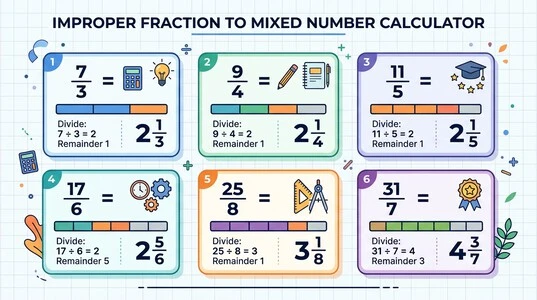
Mixed Fraction to Whole Number Calculator FAQs
How Do You Convert a Mixed Fraction to a Whole Number?
A mixed number can be converted to an improper fraction first, then divided if an exact whole-number result is required. For example, 3 2/5 = 17/5, and 17 ÷ 5 gives 3 remainder 2, so it is not an exact whole number.
How Do You Convert an Improper Fraction to a Mixed Number?
Divide the numerator by the denominator. The quotient becomes the whole-number part, the remainder becomes the new numerator, and the original denominator stays the same. For example, 17/5 = 3 2/5.
Can a Fraction Be Converted Into an Exact Whole Number?
Yes, but only when the numerator is evenly divisible by the denominator. For example, 24/6 = 4. If division leaves a remainder, the fraction does not have an exact whole-number value.
What Is the Whole-Number Part of a Fraction?
The whole-number part is the quotient obtained when the numerator is divided by the denominator, without including the remaining fractional part. For example, 19/5 = 3.8, so the whole-number part is 3.
What Is 17/5 as a Mixed Number?
Divide 17 by 5:
17 ÷ 5 = 3 remainder 2
Therefore:
17/5 = 3 2/5
What Is 19/5 as a Whole Number?
19/5 = 3.8. Its whole-number part is 3, while its nearest whole number is 4. The exact mixed-number form is 3 4/5.
What Is the Difference Between a Whole-Number Part and Rounding?
The whole-number part identifies the complete whole units in the value. Rounding selects the nearest integer. For example, 3.8 has a whole-number part of 3, but rounds to 4.
What Happens if the Numerator Is Smaller Than the Denominator?
The fraction is a proper fraction and has a value between 0 and 1 when both numbers are positive. For example, 3/5 = 0.6, so its whole-number part is 0, but its exact value is still 3/5.
How Do You Find the Remainder of a Fraction?
Divide the numerator by the denominator and identify what remains after the complete groups are counted. For 17/5, the calculation is 17 ÷ 5 = 3 remainder 2, so the remainder is 2.
Does the Denominator Change When Converting an Improper Fraction?
No. The denominator remains the same when the remainder is written as the fractional part. For example, 17/5 = 3 2/5, so the denominator remains 5.
How Do You Simplify the Fraction Left After Division?
Find a common factor shared by the remainder and denominator, then divide both by that factor. For example, 6/8 simplifies to 3/4, so 22/8 = 2 3/4.
Can Negative Fractions Be Converted to Mixed Numbers?
Yes. A negative improper fraction can be expressed as a negative mixed number. For example:
-17/5 = -3 2/5
The negative sign applies to the entire mixed-number value.
What Happens When the Numerator Is Divisible by the Denominator?
The fraction becomes an exact whole number because there is no remainder. For example:
20/5 = 4
There is no fractional part to include.
Can I Use This Calculator for Proper, Improper, and Mixed Numbers?
The calculator can handle fraction values and identify the whole-number part, remainder, mixed-number form, decimal, and nearest whole number. For mixed-number input, convert the mixed number to an improper fraction first if the calculator accepts numerator and denominator fields only.