Mixed Number to Percent Calculator
Mixed Number to Percent Calculator
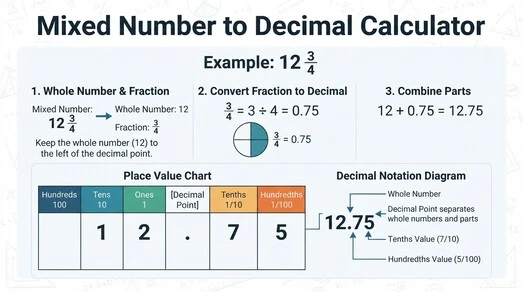
Convert a mixed number to a percentage by converting it to a decimal or improper fraction, then multiplying by 100. For example, 2 3/4 = 2.75 = 275%.
This mixed number to percent calculator makes the conversion easier by showing the decimal, improper fraction, percentage, and calculation steps together. Enter the whole number, numerator, and denominator, then choose the rounding precision if the result is a repeating decimal.
Quick formula:
Percentage = (whole number + numerator ÷ denominator) × 100
For example:
2 3/4 = 2 + 3/4 = 2.75
2.75 × 100 = 275%
The calculator should also validate the denominator before calculating, since a denominator of zero makes the fraction undefined. Clear, transparent calculations and a usable mobile interface are important for a tool page because the calculator itself is the main content users came to access. Google likewise emphasizes useful, user-focused content and a good overall page experience rather than search-engine-only optimization.
How to Use the Mixed Number to Percent Calculator
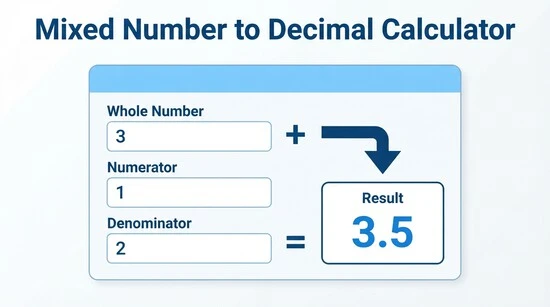
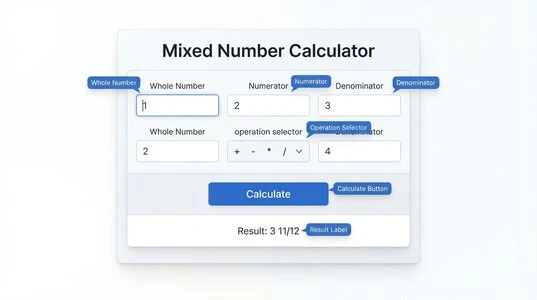
Using the mixed number to percent calculator takes just a few seconds. Enter the whole-number part and the two parts of the fraction, choose how you want the result rounded, and select Calculate. The calculator should then display the conversion in multiple forms so you can verify the answer instead of relying on a single final number.
Enter the Whole Number
The whole-number component is the number of complete units in the mixed number. For example, in:
2 3/4
the whole number is 2. A mixed number combines a whole number with a fraction; in standard notation, it has the form abca\frac{b}{c}.
Enter 2 in the Whole Number field.
Enter the Numerator and Denominator
For 2 3/4:
- Numerator = 3
- Denominator = 4
The numerator tells you how many fractional parts are included, while the denominator tells you how many equal parts make one whole.
Enter 3 in the numerator field and 4 in the denominator field.
Important: The denominator cannot be 0. Division by zero is undefined, so the calculator should reject a zero denominator rather than produce a numerical result.
Choose Your Rounding Precision
Some mixed numbers produce a terminating percentage, while others produce a repeating decimal. For example, 2 3/4 = 275% exactly, but 1 1/3 = 133.333…%.
Use Exact when you want the mathematical value without unnecessary rounding. Use a rounded setting when you need a shorter decimal, such as 133.33%. If the result repeats, the calculator should make that clear rather than presenting a rounded value as exact.
View the Calculation
A useful calculator should show the conversion path, not just the final percentage. For 2 3/4, the result can be displayed as:
2 3/4
→ 11/4
→ 2.75
→ 275%
This makes the calculation easy to check at a glance. Converting a mixed number to an improper fraction follows the standard process of multiplying the whole number by the denominator, adding the numerator, and keeping the original denominator.
Showing these intermediate steps also makes the calculator more transparent: users can see exactly how the percentage was produced instead of treating the result as a black box.
How to Convert a Mixed Number to a Percent
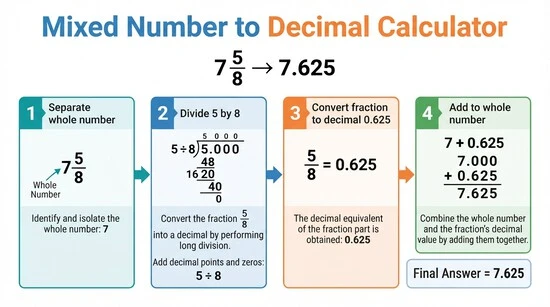
To convert a mixed number to a percentage, first find its numerical value, then multiply by 100.
Percentage = (mixed-number value) × 100
For a mixed number written as abca\frac{b}{c}, you can use the direct formula:
Percentage = [(whole×denominator)+numeratordenominator]×100\left[\frac{(\text{whole} \times \text{denominator})+\text{numerator}}{\text{denominator}}\right]\times100
This works because a mixed number can be rewritten as an improper fraction before being converted to a decimal and then a percent. OpenStax uses this approach when converting mixed numbers such as 2152\frac{1}{5} to percentages, including results greater than 100%.
Method 1 — Convert the Mixed Number to a Decimal
Take 2 3/4:
- Convert the fractional part to a decimal:
3 ÷ 4 = 0.75 - Add the decimal to the whole number:
2 + 0.75 = 2.75 - Multiply by 100:
2.75 × 100 = 275%
So, 2 3/4 = 275%. This method is usually the quickest when you have a calculator available.
Method 2 — Convert to an Improper Fraction
Start with:
2 3/4
Convert the mixed number to an improper fraction:
(2 × 4 + 3) / 4 = 11/4
Then convert the fraction to a decimal:
11 ÷ 4 = 2.75
Finally, convert the decimal to a percentage:
2.75 × 100 = 275%
Therefore:
2 3/4 → 11/4 → 2.75 → 275%
This method is especially useful when you want to keep the fractional form visible throughout the calculation.
Method 3 — Convert the Parts Separately
For quick mental math, convert the whole number and fractional part independently.
For 2 3/4:
2 = 200%
3/4 = 75%
Add them:
200% + 75% = 275%
Therefore:
2 3/4 = 275%
This method makes it especially easy to understand why a mixed number can be greater than 100%. One whole is 100%, so two wholes already equal 200%; the additional 3/4 adds another 75%. OpenStax likewise notes that a value greater than 1 converts to a percentage greater than 100%.
Why Can a Mixed Number Be More Than 100%?
100% represents one whole. In other words, 100%=1100\% = 1. A value greater than 1 therefore represents more than 100%. OpenStax defines 100% as one whole and shows that values such as 2152\frac{1}{5} convert to percentages greater than 100%.
That means:
- 1 = 100%
- 2 = 200%
- 3 = 300%
- 1 1/2 = 150%
- 2 3/4 = 275%
A mixed number can exceed 100% simply because it contains more than one whole. The percentage is describing the mixed number’s value relative to one whole, not limiting the result to a maximum of 100%.
Why 2 3/4 Is 275%, Not 27.5%
Break the mixed number into its whole and fractional parts:
2 wholes = 200%
3/4 = 75%
Total = 275%
So:
2 3/4 = 200% + 75% = 275%
The common mistake is to read 2.75 as though the decimal point should make the answer smaller than 100%. But 2.75 is more than one whole. Multiplying by 100 gives 275%, just as OpenStax’s examples show for decimal and mixed-number values greater than 1.
Why 8 1/3 Is About 833.33%
The same idea applies to larger mixed numbers:
8 = 800%
1/3 = 33.333…%
Add the two parts:
8 1/3 = 800% + 33.333…%
= 833.333…%
Therefore:
8 1/3 = 833 1/3% ≈ 833.33%
The result looks unusually large only if you expect percentages to stay between 0% and 100%. Percentages can be greater than 100% whenever the value being measured is greater than one whole. For repeating fractions such as 1/31/3, the percentage can also be written exactly as 33 1/3% rather than using a rounded decimal.
Mixed Number to Percent Examples
The table below shows common mixed-number conversions. When the fractional part produces a repeating decimal, the percentage is shown with an ellipsis to indicate that the digits continue. OpenStax uses the same decimal-to-percent process for fractions and mixed numbers, including repeating results.
| Mixed Number | Decimal | Percent |
| 1 1/4 | 1.25 | 125% |
| 1 1/2 | 1.5 | 150% |
| 2 1/2 | 2.5 | 250% |
| 2 3/4 | 2.75 | 275% |
| 3 3/4 | 3.75 | 375% |
| 4 1/8 | 4.125 | 412.5% |
| 8 1/3 | 8.333… | 833.333…% |
Example: 1 1/4 as a Percent
Convert the fraction first:
1 1/4 = 5/4 = 1.25
Then multiply by 100:
1.25 × 100 = 125%
So, 1 1/4 = 125%.
Example: 2 3/4 as a Percent
Convert the mixed number to an improper fraction:
2 3/4 = (2 × 4 + 3)/4 = 11/4
Convert to a decimal:
11 ÷ 4 = 2.75
Then multiply by 100:
2.75 × 100 = 275%
Therefore:
2 3/4 = 275%
Example: 8 1/3 as a Percent
Convert the mixed number to an improper fraction:
8 1/3 = (8 × 3 + 1)/3 = 25/3
Now divide:
25 ÷ 3 = 8.333…
Multiply by 100:
8.333… × 100 = 833.333…%
So:
8 1/3 = 833 1/3% ≈ 833.33%
The repeating digits do not mean the calculation is incorrect. They occur because 1/3 produces the repeating decimal 0.333…. You can keep the exact value as 833 1/3% or use a rounded value such as 833.33%, depending on how the result will be used.
Exact vs. Rounded Percentages
A mixed number can produce either a terminating percentage or a repeating one. Knowing whether your result is exact or rounded helps you avoid treating an approximation as the true value. OpenStax notes that when a fraction produces a continuing decimal, the appropriate rounding depends on the situation.
What Is an Exact Percentage?
An exact percentage represents the value without cutting off repeating digits.
For example:
1 1/3 = 4/3
So:
4/3 × 100 = 133 1/3%
The same value can be written as:
133.333…%
The ellipsis means the 3s continue indefinitely. OpenStax gives the equivalent example 1/3 = 33 1/3%, showing how a repeating decimal can be expressed exactly as a fractional percentage.
When Should You Round?
Rounding depends on how you plan to use the answer.
- Exact mathematical answer: Keep the fraction or repeating form when precision matters.
- Nearest whole percent: Use a whole-number result when only an approximate percentage is needed.
- Two decimal places: Useful when a consistent decimal format is required, such as 133.33%.
- Classroom requirements: Follow the rounding instruction given in the problem.
For example, 1/3 = 33 1/3% exactly, but it can be reported as 33.33% when two decimal places are required. OpenStax explains that the number of decimal places used for rounding should depend on the context.
Why 33.33% Is Not Exactly 1/3
These two values are close, but they are not identical:
1/3 = 33.333…%
33.33% = 33.33%
The repeating value 33.333…% continues forever, while 33.33% stops after two decimal places. Therefore, 33.33% is an approximation of 1/3, not its exact percentage.
For a calculator, the clearest approach is to distinguish exact and rounded results. This lets you use 33 1/3% or 33.333…% when precision matters and 33.33% when a two-decimal approximation is appropriate.
Common Mistakes When Converting Mixed Numbers to Percent
Most conversion errors come from treating the mixed number like an ordinary decimal or losing part of its value during the calculation. Use these checks to find the problem quickly.
Forgetting to Multiply by 100
Converting a mixed number to a decimal is only the first step. A decimal must be multiplied by 100 to express it as a percentage.
For example:
2.75 ≠ 2.75%
2.75 × 100 = 275%
So 2 3/4 = 2.75 = 275%. Writing 2.75% would make the result 100 times too small.
Dropping the Whole Number
The fractional part is only part of a mixed number. Do not convert the fraction and ignore the whole-number component.
For example:
3/4 = 75%
But:
2 3/4 = 200% + 75% = 275%
The two wholes contribute 200% on their own. OpenStax similarly explains that 100% represents one whole, so values greater than one produce percentages greater than 100%.
Confusing 8.33% With 8 1/3
These values look similar but represent very different numbers:
8.33% = 0.0833
8 1/3 = 8.333…
The mixed number 8 1/3 is more than eight wholes, so its percentage is:
8 1/3 × 100 = 833.333…%
It is not 8.33%. The percent symbol changes the meaning of a number by expressing it per 100.
Rounding Too Early
Rounding during an intermediate step can change the final percentage. Keep the fraction or as many decimal digits as practical until the final conversion.
For example, 1/3 is exactly 0.333…. If you round it immediately to 0.33, then multiply, you get 33%. Keeping the repeating value gives:
1/3 × 100 = 33.333…%
If the required answer is to two decimal places, round only at the end:
33.333…% → 33.33%
This preserves more accuracy throughout the calculation. OpenStax also demonstrates retaining sufficient precision before rounding a final percentage.
Confusing a Percentage With a Percentage Increase
A percentage and a percentage increase answer different questions.
275% of the original means the resulting amount is 2.75 times the original.
A 275% increase means the original amount increases by 275%, so the new amount becomes 375% of the original.
For example, if the original value is 100:
275% of 100 = 275
275% increase from 100:
100 + 275 = 375
A percentage increase is calculated from the amount of change relative to the original amount, not simply by converting a number to percent form.
Special Cases and Input Rules
A reliable mixed number to percent calculator should handle more than standard inputs. It should also explain unusual or invalid entries clearly so users know whether the result is valid. A standard mixed number has a nonzero denominator, and an improper fraction has a numerator greater than or equal to its denominator. (openstax.org)
What If the Whole Number Is Zero?
A zero whole-number part is valid. For example:
0 3/4 = 3/4 = 75%
In this case, the mixed number is effectively just a proper fraction. The calculator can accept 0 in the whole-number field and calculate the fractional value normally.
What If the Numerator Is Zero?
A zero numerator means the fractional part contributes nothing:
2 0/5 = 2 + 0/5 = 2
Therefore:
2 0/5 = 200%
The denominator still needs to be nonzero, even though the numerator is zero.
What If the Number Is Negative?
A negative sign changes the sign of the entire value when it is placed before the mixed number. For example:
-2 1/4 = -2.25
Then:
-2.25 × 100 = -225%
So:
-2 1/4 = -225%
The negative sign indicates that the value is below zero. In fraction notation, OpenStax likewise shows that a negative sign can apply to the value of a fraction. (openstax.org)
What If the Denominator Is Zero?
Division by zero is undefined.
For that reason, an input such as 2 3/0 must not produce a percentage, decimal, or other numerical result. The calculator should reject the input and display a clear message such as “Denominator cannot be zero.” OpenStax defines a mixed number with the condition that its denominator is not zero. (openstax.org)
Returning 0% or another placeholder as though it were a valid mathematical answer would be misleading.
What If the Fractional Part Is Improper?
A standard mixed number normally has a proper fractional part, where the numerator is smaller than the denominator. For example:
2 5/4
contains an improper fraction because 5/4 > 1. OpenStax distinguishes proper fractions from improper fractions and shows how improper fractions can be converted to mixed numbers. (openstax.org)
A calculator can handle this in one of two clear ways:
Normalize the input:
2 5/4 = 3 1/4 = 325%
Or flag 2 5/4 as non-standard mixed-number notation and ask the user to enter the equivalent 3 1/4.
Whichever behavior the tool uses, it should state it clearly. Transparent input handling prevents users from wondering why a calculator silently changed their numbers or accepted an unusual mixed-number format.
How to Check Your Answer
A quick reverse conversion can confirm that your mixed number to percent result is correct. Since a percentage represents a value per 100, dividing a percentage by 100 converts it back to its decimal form. (openstax.org)
Convert the Percentage Back to a Decimal
Take the result 275%:
275% ÷ 100 = 2.75
The decimal 2.75 matches the original value of 2 3/4, so the percentage is consistent.
Convert the Decimal Back to a Mixed Number
Now convert 2.75 back into a mixed number:
2.75 = 2 + 0.75
0.75 = 3/4
Therefore:
2.75 = 2 3/4
You have returned to the original mixed number, confirming the conversion.
Use the Calculator’s Step-by-Step Result
The calculator can provide a simple verification chain:
2 3/4
→ 11/4
→ 2.75
→ 275%
Each stage represents the same numerical value in a different form. OpenStax uses the same sequence—convert a mixed number to an improper fraction, then to a decimal, and finally to a percent—in its worked examples. (openstax.org)
This makes the result easier to audit: if an answer looks wrong, you can identify whether the error occurred when converting the mixed number, dividing the fraction, or converting the decimal to a percentage.
Mixed Number vs. Mixed-Number Percentage
A mixed number and a mixed-number percentage may look almost identical, but the percent sign changes the value completely. A percent means “per hundred,” so the % symbol is part of the mathematical meaning, not just extra formatting.
2 1/2 vs. 2 1/2%
Without a percent sign:
2 1/2 = 2.5
2.5 × 100 = 250%
So:
2 1/2 = 250%
With a percent sign:
2 1/2% = 2.5%
2.5 ÷ 100 = 0.025
So:
2 1/2% = 0.025
These are not the same value:
| Notation | Decimal value | Equivalent percent |
| 2 1/2 | 2.5 | 250% |
| 2 1/2% | 0.025 | 2.5% |
The easiest way to remember the difference is this: 2 1/2 is a number greater than two, while 2 1/2% means 2.5 parts out of 100. OpenStax likewise defines a percent as a ratio with 100 as its denominator.
When entering a value into a mixed number to percent calculator, enter the mixed number itself—such as 2 1/2—without adding %. The calculator then performs the conversion and returns 250%.
Frequently Asked Questions
How do you convert a mixed number to a percent?
Convert the mixed number to a decimal or improper fraction, then multiply the value by 100. For example, 2 3/4 = 2.75, and 2.75 × 100 = 275%. You can also convert the whole and fractional parts separately: 2 = 200% and 3/4 = 75%, giving 275%.
What is 2 3/4 as a percent?
2 3/4 = 275%. Convert the mixed number to a decimal: 2 3/4 = 2.75. Then multiply by 100: 2.75 × 100 = 275%.
What is 1 1/2 as a percent?
1 1/2 = 150%. The mixed number equals 1.5 as a decimal, and 1.5 × 100 = 150%. You can also see this directly as 100% + 50% = 150%.
What is 1 1/3 as a percent?
1 1/3 = 133.333…%, or exactly 133 1/3%. Since 1 1/3 = 4/3, multiply by 100: (4/3) × 100 = 133 1/3%. The decimal percentage repeats because 1/3 produces the repeating decimal 0.333….
Why can a mixed number be more than 100%?
Because 100% represents one whole. Any value greater than one is therefore greater than 100%. For example, 2 3/4 contains two whole units plus three-fourths of another, so it equals 200% + 75% = 275%. (openstax.org)
Do I have to convert a mixed number to an improper fraction?
No. You can convert the fractional component to a decimal, add it to the whole number, and multiply by 100. For example, 2 3/4 → 2 + 0.75 = 2.75 → 275%. Converting to an improper fraction is simply another valid method.
How do I convert a mixed number to a percent without a calculator?
Use three steps: convert the fractional part to a decimal, add the whole number, and multiply by 100. For 2 3/4, calculate 3 ÷ 4 = 0.75, then 2 + 0.75 = 2.75, and finally 2.75 × 100 = 275%.
How do I handle repeating percentages?
Keep the exact fractional form when precision matters, or round at the end when an approximate answer is appropriate. For example, 1 1/3 = 133 1/3% = 133.333…%. Rounded to two decimal places, this becomes 133.33%. The rounded value should be labeled as an approximation.
What is the difference between 275% and a 275% increase?
275% of an original value means the result is 2.75 times the original. A 275% increase means the original value grows by 2.75 times its original amount, producing a final value of 375% of the original. For an original value of 100, these give 275 and 375, respectively.
Can a negative mixed number be converted to a percent?
Yes. Keep the negative sign when converting the value. For example, -2 1/4 = -2.25, and -2.25 × 100 = -225%. The result is therefore -225%.
What happens if the denominator is zero?
A denominator of zero makes the fraction undefined, so it cannot produce a valid percentage. The calculator should reject the input and display a clear error such as “Denominator cannot be zero” rather than return a numerical result. (openstax.org)
Mixed Number to Percent Conversion Formula
A mixed number can be converted to a percentage by treating the entire mixed number as one numerical value and multiplying by 100. This follows the standard definition of percent as a ratio per 100. OpenStax also demonstrates converting mixed numbers to improper fractions, decimals, and then percentages.
Standard Formula
For a mixed number with whole number WW, numerator NN, and denominator DD:
Percentage = (Whole + Numerator/Denominator) × 100
In symbols:
Percentage = (W+ND)×100(W + \frac{N}{D}) \times 100
For example:
2 3/4 = (2 + 3/4) × 100 = 2.75 × 100 = 275%
Direct Improper-Fraction Formula
You can combine the mixed-number conversion and percentage conversion into one formula:
Percentage = [(Whole×Denominator)+NumeratorDenominator]×100\left[\frac{(\text{Whole} \times \text{Denominator})+\text{Numerator}}{\text{Denominator}}\right]\times100
For 2 3/4:
[(2 × 4 + 3) / 4] × 100
= 11/4 × 100
= 275%
This method is useful when you want an exact fraction-based calculation before converting to a decimal or rounded percentage.
Quick Mental-Math Formula
For simple mixed numbers, convert each part separately:
Whole × 100% + Fraction × 100%
For 2 3/4:
2 × 100% + 3/4 × 100%
= 200% + 75%
= 275%
This mental-math approach is particularly useful for understanding why mixed numbers can produce percentages above 100%. Since 100% equals one whole, every additional whole adds another 100 percentage points.
Why Trust This Calculator?
A trustworthy mixed number to percent calculator should make its math easy to inspect. The goal is not simply to produce a percentage, but to show users where that percentage came from and how the tool handles unusual inputs.
Transparent Calculations
Every result should expose the important intermediate steps. For example:
2 3/4 → 11/4 → 2.75 → 275%
Showing the conversion chain lets users check the result independently and makes calculation errors easier to spot. A calculator that displays only the final percentage gives users less information to verify the answer.
Mathematically Validated Formula
The calculator uses the standard definition of percent: a percent is a ratio per 100. OpenStax explains that 100% represents one whole and demonstrates converting fractions and mixed numbers to percentages, including values greater than 100%.
For a mixed number with whole number WW, numerator NN, and denominator DD, the calculator uses:
Percentage = (W+N/D)×100(W + N/D) × 100
The same calculation can be performed through an improper fraction before converting to a percentage. This provides a straightforward mathematical basis that users can verify from an independent educational source.
Clear Rounding Policy
The calculator should distinguish between exact, repeating, and rounded results.
For example:
- Exact: 1 1/3 = 133 1/3%
- Repeating decimal: 133.333…%
- Rounded to two decimals: 133.33%
Rounding should happen at the final stage whenever practical, and the displayed result should make clear when it is an approximation. OpenStax likewise notes that repeating decimal conversions may need to be rounded according to the context.
Input Validation
Reliable results depend on valid input. The calculator should reject a zero denominator because division by zero is undefined. It should also clearly handle non-standard entries, such as an improper fractional component, rather than silently producing an unexpected result.
Clear validation messages help users correct an input before trusting the output. This is especially important for a calculator because a plausible-looking number can otherwise hide an invalid calculation.
Author/Reviewer Information
Trust should be supported by verifiable information, not broad claims such as “100% accurate” or “the best calculator.” Where appropriate, the page should identify:
- A named author with genuine mathematics or education experience
- A mathematics reviewer when the content has actually been reviewed
- An author profile describing relevant qualifications
- An About page explaining who operates the site
- An editorial methodology describing how formulas and examples are checked
- A last-reviewed or updated date when the content has genuinely been reviewed or substantially updated
Google recommends making accurate authorship information clear and providing background about authors when readers would reasonably expect it. Its guidance also emphasizes clear sourcing, demonstrable expertise, and trustworthiness; E-E-A-T itself is not a single ranking factor.
For this calculator, the strongest trust signal is therefore something users can actually verify: a transparent formula, visible calculation steps, sensible input validation, clear rounding rules, authoritative mathematical sourcing, and genuine information about who created or reviewed the page.
Related Calculators
If you need to convert between different number and percentage formats, these calculators can provide the next step:
- Fraction to Percent Calculator — Convert a proper or improper fraction into a percentage.
- Decimal to Percent Calculator — Convert a decimal value into a percentage quickly.
- Percent to Fraction Calculator — Convert a percentage back into a simplified fraction.
- Mixed Number Calculator — Perform calculations with mixed numbers and fractions.
- Improper Fraction Calculator — Convert between improper fractions and mixed numbers.
- Fraction Simplifier — Reduce a fraction to its simplest form.
- Percent Increase Calculator — Calculate the percentage change when a value increases.
- Percent Decrease Calculator — Calculate the percentage change when a value decreases.
- Fraction to Decimal Calculator — Convert fractions into decimal values for further calculations.
Each related tool should solve a distinct, useful task rather than exist solely to target another keyword. A connected set of genuinely useful calculators also gives visitors a clear path to the next calculation they need. Google recommends a site structure that helps users navigate and understand how pages relate to one another, while warning against creating low-value pages primarily to manipulate search visibility.