Mixed Number Subtraction Calculator
Enter two mixed numbers to calculate their difference with a simplified answer, improper fraction, decimal, and step-by-step solution.
First Mixed Number
Second Mixed Number
Step-by-Step Solution
Use the mixed number subtraction calculator to find the difference between two mixed numbers quickly and accurately. Enter the whole-number and fraction parts, or use a natural expression such as 7 3/4 − 2 1/2. The calculator gives the result in simplified mixed-number form and can also show the equivalent improper fraction and decimal value.
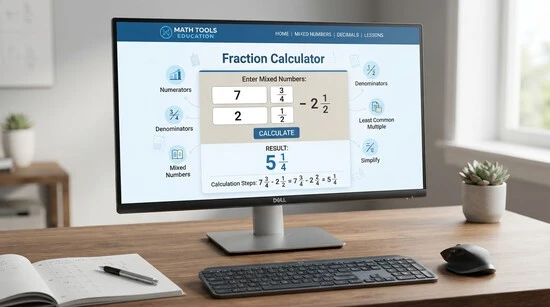
When a subtraction problem requires regrouping, the calculation can show exactly what happens. For example, 5 1/4 can be rewritten as 4 5/4 because one whole is equal to 4/4. This makes it easier to follow the steps instead of relying on an answer alone. Whether the denominators are the same or different, you can use the calculator to check your work and understand how the final difference is obtained.
How to Use the Mixed Number Subtraction Calculator
Using the calculator takes only a few steps:
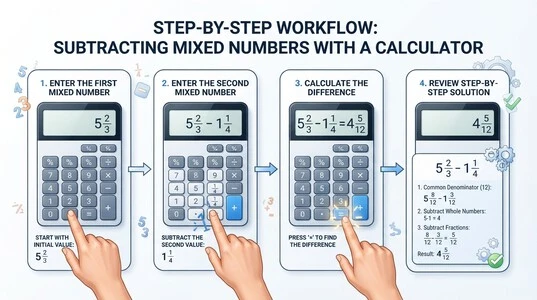
- Enter the first mixed number. Enter its whole number, numerator, and denominator. For example, 7 3/4 has a whole number of 7, numerator of 3, and denominator of 4.
- Enter the second mixed number. Remember that subtraction is directional: the calculator finds first number − second number.
- Choose Calculate. The result displays the difference in simplified form, with other equivalent formats where available.
- Read the step-by-step solution. The calculation may show conversion to improper fractions, finding a common denominator, regrouping when needed, subtraction, and final simplification.
This makes it useful both for checking an answer and following the method used to reach it.
What Is a Mixed Number?
A mixed number is a number made up of a whole number and a proper fraction. For example, 3 2/5 contains three parts: 3 is the whole-number part, 2 is the numerator, and 5 is the denominator. The number represents 3 + 2/5, or three wholes plus two-fifths.
A mixed number may also be called a mixed fraction. The fractional part is a proper fraction because its numerator is smaller than its denominator.
Mixed Number vs. Improper Fraction
A mixed number can be converted to an improper fraction, which has a numerator greater than or equal to its denominator. For example:
3 2/5 = 17/5
Both forms represent exactly the same quantity. The mixed-number form separates the whole and fractional parts, while the improper fraction expresses the entire quantity as one fraction.
How to Subtract Mixed Numbers
Subtracting mixed numbers means finding the difference between their whole-number and fractional parts. A reliable method is to work through the following steps.
Step 1 — Separate the Whole and Fraction Parts
Consider:
7 3/4 − 2 1/4
Subtract the whole numbers and fraction parts separately:
7 − 2 and 3/4 − 1/4
Step 2 — Check the Denominators
If the fractions have like denominators, such as fourths, subtract the numerators directly. With unlike denominators, such as 3/4 and 1/3, you first need equivalent fractions with a common denominator.
Step 3 — Find a Common Denominator When Needed
Find the least common denominator (LCD), often using the least common multiple (LCM) of the denominators. Then rewrite each fraction as an equivalent fraction with that denominator. This makes the fractional parts comparable and ready for subtraction.
Step 4 — Regroup if the First Fraction Is Too Small
If the fraction being subtracted from is smaller, regroup or borrow one whole number. For example:
5 1/4 → 4 5/4
This works because 1 whole = 4/4. The value has not changed; one whole has simply been rewritten as four-fourths so the fractional subtraction can be completed.
Step 5 — Subtract and Simplify
Subtract the fraction parts and whole-number parts, then simplify the resulting fraction. If the fraction is improper, convert it to mixed-number form. This produces the final difference in its simplest useful form.
Subtracting Mixed Numbers With Like Denominators
When two mixed numbers have the same denominator, subtract the whole-number parts and the numerators separately. For example:
7 5/8 − 3 2/8
(7 − 3) + (5/8 − 2/8) = 4 + 3/8 = 4 3/8
When No Regrouping Is Needed
Here, 5/8 is larger than 2/8, so the fractional parts can be subtracted directly. No borrowing or regrouping is necessary.
When Regrouping Is Needed
If the first fraction is smaller, regroup one whole number. For example:
6 1/5 − 2 4/5
Because 1/5 is smaller than 4/5, rewrite 6 1/5 as 5 6/5. Then:
5 6/5 − 2 4/5 = 3 2/5
So, with the same denominator, subtract the numerators directly when possible; otherwise, regroup one whole before subtracting.
Subtracting Mixed Numbers With Unlike Denominators
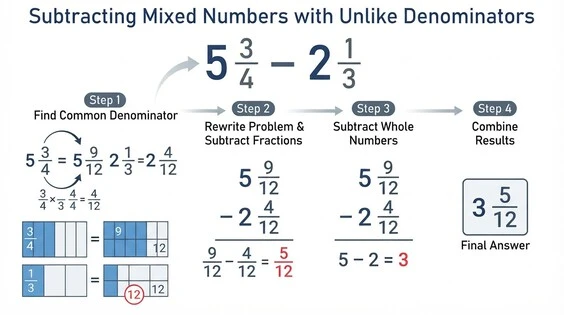
To subtract mixed numbers with different denominators, first rewrite the fractional parts using a common denominator. For example:
5 3/4 − 2 1/3
- Identify the denominators: 4 and 3.
- Find a common denominator: 12.
- Convert the fractions: 3/4 = 9/12 and 1/3 = 4/12.
- Subtract the fractions and whole numbers: (5 − 2) + (9/12 − 4/12).
- Simplify: 3 + 5/12 = 3 5/12.
- The result is already in mixed-number form.
Why You Cannot Simply Subtract the Denominators
The denominator tells you the size of each fractional part, so denominators cannot be subtracted directly. For example:
1/2 − 1/3 ≠ 0/−1
Instead, rewrite both fractions with a common denominator:
1/2 = 3/6
1/3 = 2/6
Therefore:
3/6 − 2/6 = 1/6
The same common-denominator method applies when subtracting mixed numbers with unlike denominators.
How to Regroup or Borrow When Subtracting Mixed Numbers
When Do You Need to Borrow?
You need to regroup when the fractional part of the first mixed number is smaller than the fractional part you need to subtract. For example, in 6 1/5 − 2 4/5, you cannot subtract 4/5 from 1/5 directly. Instead, take one whole from the whole-number part and rewrite it as fifths.
How One Whole Becomes a Fraction
One whole can be written as an equivalent fraction using the denominator of the fractional part:
1 = 4/4
Therefore:
5 1/4 = 4 5/4
The original 1/4 combines with the 4/4 from the regrouped whole, giving 5/4.
Why Regrouping Does Not Change the Number
Regrouping only changes how the same quantity is represented:
5 1/4 = 4 + 4/4 + 1/4 = 4 5/4
Both expressions have exactly the same value. The procedure simply creates enough fractional units to complete the subtraction.
Borrowing vs. Regrouping
“Borrowing” is common classroom terminology, but “regrouping” more precisely describes what happens. You are not permanently taking away a whole; you are rewriting one whole as an equivalent number of fractional units.
Converting Mixed Numbers to Improper Fractions
Converting a mixed number to an improper fraction is another reliable way to perform subtraction, especially when the denominators are different. For a mixed number written as a b/c, use:
(a × c + b) / c
For example:
5 2/3 = (5 × 3 + 2)/3 = 17/3
The denominator stays the same because the whole number is being rewritten in thirds.
Subtract Using Improper Fractions
Consider:
5 2/3 − 2 1/4
First convert both mixed numbers:
17/3 − 9/4
The common denominator is 12:
68/12 − 27/12 = 41/12
Finally, convert the improper fraction back to mixed-number form:
41/12 = 3 5/12
This method can make unlike-denominator problems more systematic, while direct regrouping can be more intuitive when the fractional parts have the same denominator. Using both approaches helps you choose the method that makes the calculation easiest to follow.
Mixed Number Subtraction Examples
These examples cover common cases, including like and unlike denominators, regrouping, whole-number subtraction, and negative results.
Example 1 — Same Denominator, No Regrouping
7 5/8 − 3 2/8
Subtract the whole numbers and fractions:
(7 − 3) + (5/8 − 2/8) = 4 3/8
Example 2 — Same Denominator With Regrouping
6 1/5 − 2 4/5
Because 1/5 is smaller than 4/5, regroup one whole:
6 1/5 = 5 6/5
Then:
5 6/5 − 2 4/5 = 3 2/5
Example 3 — Unlike Denominators
5 3/4 − 2 1/3
The LCD of 4 and 3 is 12:
5 9/12 − 2 4/12 = 3 5/12
Example 4 — Unlike Denominators With Regrouping
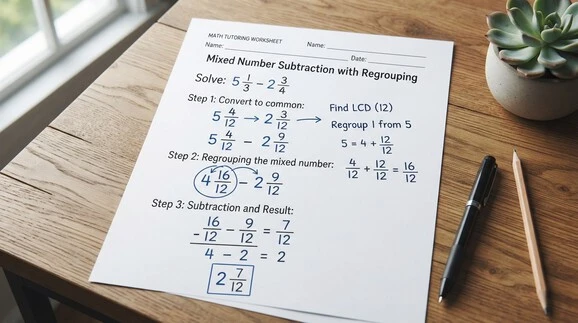
5 1/3 − 2 3/4
The LCD is 12:
5 4/12 − 2 9/12
Regroup one whole:
4 16/12 − 2 9/12 = 2 7/12
Example 5 — Whole Number Minus Mixed Number
8 − 3 1/4
Rewrite 8 as 7 4/4:
7 4/4 − 3 1/4 = 4 3/4
Example 6 — Negative Result
2 1/3 − 5 3/4
Convert to improper fractions:
7/3 − 23/4 = 28/12 − 69/12 = −41/12
So the result is −3 5/12. A negative answer is valid because the second number is greater than the first.
What If the Answer Is Negative?
A mixed number subtraction answer can be negative. This happens when the second number is greater than the first. For example:
2 1/3 − 5 3/4 = −3 5/12
The result is negative because you are subtracting a larger quantity from a smaller one.
Why Does a Negative Answer Occur?
Subtraction finds the difference between two quantities while keeping their order. If the starting number is smaller, the difference falls below zero. A negative result is therefore a valid mathematical answer, not a calculation error.
How to Write a Negative Mixed Number
The expression −2 1/3 means the negative of the entire mixed number:
−(2 1/3)
It is not the same as subtracting only the fractional part. Writing the negative sign before the mixed number makes the intended value clear.
Why the Calculator May Show an Improper Fraction
The same result can appear as an improper fraction. For example:
−3 5/12 = −41/12
These are equivalent representations of the same negative quantity. A calculator may display either form depending on its output settings.
How to Simplify the Result
After subtracting mixed numbers, check whether the fractional part can be reduced. To simplify a fraction, find the greatest common factor (GCF) of its numerator and denominator, then divide both by the same factor.
For example:
8/12 → 2/3
The GCF of 8 and 12 is 4, so:
8 ÷ 4 / 12 ÷ 4 = 2/3
When the result is a mixed number, simplify its fractional part in the same way:
2 8/12 → 2 2/3
If subtraction produces an improper fraction, first reduce it when possible, then convert it to a mixed number if that format is preferred. A simplified answer should have the fraction in its lowest terms, with no common factor greater than 1 between the numerator and denominator.
Mixed Number, Improper Fraction, and Decimal Answers
A mixed-number subtraction result can have several equivalent representations. For example:
31/12 = 2 7/12 ≈ 2.5833
Here, 31/12 is the improper fraction, while 2 7/12 is the equivalent mixed-number form. Both represent the exact same value. The decimal 2.5833 is an approximation because the repeating decimal has been rounded.
For this reason, the fraction or mixed-number result is useful when you need an exact answer. A calculator may also display a decimal equivalent for easier comparison or everyday use. If a decimal is shown, check how many places are displayed and remember that rounding can make it appear slightly different from the exact fraction.
Common Mistakes When Subtracting Mixed Numbers
Knowing common errors can help explain why a mixed-number subtraction answer differs from a calculator or answer key.
Subtracting the Denominators
Do not subtract denominators. For example, 1/2 − 1/3 requires equivalent fractions with a common denominator, not 0/−1.
Forgetting to Find a Common Denominator
With unlike denominators, rewrite both fractions using the same denominator before subtracting the numerators.
Forgetting to Regroup
If the first fractional part is smaller, regroup one whole into fractional units before subtracting.
Subtracting the Whole Number but Not the Fraction
Both parts must be included. Check that you subtract the whole-number parts and the fractional parts.
Forgetting to Simplify
Reduce the final fraction to its lowest terms. For example, 8/12 should become 2/3.
Reversing the Order of Subtraction
7 − 3 is not the same as 3 − 7. Keep the first and second numbers in their original order.
Assuming a Negative Intermediate Fraction Means the Entire Answer Is Wrong
A negative fractional difference may simply indicate that regrouping is needed. If the second mixed number is larger overall, however, the final result can legitimately be negative.
How to Check a Mixed Number Subtraction Answer
You can verify a mixed-number subtraction answer using the inverse operation, addition. If:
A − B = C
then adding B back to C should give A:
C + B = A
For example:
7 5/8 − 3 2/8 = 4 3/8
Check the result:
4 3/8 + 3 2/8 = 7 5/8
Because the original first mixed number is recovered, the subtraction is correct. This simple check is useful for catching errors in regrouping, common denominators, fraction conversion, or simplification before relying on the final answer.
Mixed Number Subtraction Formula
For two mixed numbers,
a b/c − d e/f
the fractional parts must first be written with a common denominator before subtracting. If the denominators already match, subtract the numerators directly; otherwise, convert the fractions to equivalent fractions using a common denominator.
Another method is to convert each mixed number to an improper fraction:
a b/c = (ac + b)/c
Then find a common denominator, subtract, simplify, and convert the result back to a mixed number if needed.
When Should You Use a Mixed Number Subtraction Calculator?
A mixed number subtraction calculator is useful for checking homework, verifying manual calculations, studying fraction operations, and checking worksheet answers. It can also quickly handle problems with unlike denominators, where you need equivalent fractions before subtracting.
You can use the calculator to compare equivalent forms, such as a mixed number and its improper fraction, and confirm that they represent the same value. However, the calculator should verify learning rather than replace it. Understanding regrouping, common denominators, and simplification helps you solve similar problems independently and recognize mistakes when an answer looks incorrect.
Frequently Asked Questions About Mixed Number Subtraction
1. How do you subtract mixed numbers?
Separate the whole-number and fractional parts, then check the denominators. Convert unlike fractions to a common denominator, regroup if the first fraction is too small, subtract, and simplify the result. Another reliable method is to convert both mixed numbers to improper fractions first.
2. How do you subtract mixed numbers with different denominators?
Find a common denominator and rewrite both fractional parts as equivalent fractions. Then subtract the fractions and whole numbers, regrouping if necessary. Finally, simplify the answer and convert an improper fraction to mixed-number form when appropriate.
3. How do you subtract mixed numbers with borrowing?
If the first fractional part is smaller, regroup one whole into denominator-sized fractional units. For example, 3 2/5 becomes 2 7/5 because 1 = 5/5. You can then subtract the fractional parts normally. This process is also called regrouping.
4. Why can’t you subtract the denominators?
The denominator tells you the size of each fractional unit, so denominators are not subtracted. First express both fractions using the same denominator. For example, 1/2 − 1/3 becomes 3/6 − 2/6 = 1/6, not a subtraction of the original denominators.
5. Can a mixed number subtraction answer be negative?
Yes. The result is negative when the second mixed number is larger than the first. For example, 2 1/3 − 5 3/4 = −3 5/12. The negative sign applies to the entire mixed-number value, not just its fractional part.
6. Can I subtract mixed numbers by converting them to improper fractions?
Yes. Convert each mixed number to an improper fraction, find a common denominator, subtract, and simplify. This method can make problems with unlike denominators easier to organize. For example, 5 2/3 becomes 17/3 before the subtraction is performed.
7. How do you convert a mixed number to an improper fraction?
Multiply the whole number by the denominator, add the numerator, and place the result over the original denominator. For example, 4 3/5 becomes (4 × 5 + 3)/5 = 23/5. The resulting improper fraction has the same value as the original mixed number.
8. How do you simplify the answer?
Reduce the fractional part by dividing its numerator and denominator by their greatest common factor (GCF). For example, 8/12 reduces to 2/3 because both numbers are divisible by 4. If the result is an improper fraction, simplify it before converting it to a mixed number.
9. What is the difference between a mixed number and an improper fraction?
They are two ways to represent the same value. A mixed number contains a whole number and a proper fraction, such as 3 2/5. An improper fraction has a numerator greater than or equal to its denominator, such as 17/5. Both represent the same quantity.
10. How can I check my subtraction answer?
Use addition as the inverse operation. If A − B = C, add B back to C. If the result equals A, your subtraction is verified. For example, if 7 5/8 − 3 2/8 = 4 3/8, check that 4 3/8 + 3 2/8 = 7 5/8.
11. What should I do if my answer doesn’t match the calculator?
Check the denominator conversion first, then review any regrouping or borrowing. Make sure you subtracted in the correct order and simplified the final fraction. Also compare the answer as both a mixed number and an improper fraction, since equivalent answers can look different.
12. Can the calculator show the steps?
Yes, if the calculator implementation includes a step-by-step solution. A useful mixed-number subtraction calculator can show operations such as converting fractions, finding a common denominator, regrouping, subtracting, and simplifying. This makes it easier to verify the result and understand how the answer was obtained.