Round Mixed Number Calculator
Enter a mixed number and choose the rounding precision. Halfway cases round away from zero. For a negative mixed number, enter the minus sign with the whole number; it applies to the entire value.
- Original mixed number
- Rounded result
- Exact value as a fraction
Step-by-step solution
Rounding changes the value. Keep the exact fraction when an exact answer is required.
Use the calculator below to round a mixed number quickly and accurately. Enter the whole number, numerator, and denominator, then choose how you want to round it. Nearest whole number is selected by default, with options for the nearest half, quarter, eighth, or a custom fraction.
[Calculator Interface]
Whole Number: [ 7 ]
Numerator: [ 3 ]
Denominator: [ 8 ]
Round To: [ Nearest Whole Number ▼ ]
Calculate | Reset
Result
7 3/8 → 7
Why: 3/8 is less than 1/2, so 7 3/8 rounds down to 7.

The calculator shows the original value, rounded result, and calculation steps so you can verify the answer instead of relying on a black-box result. It also checks your inputs, rejects a denominator of zero, and flags invalid mixed-number entries before calculating. For extra accuracy, the calculation method should be transparent about how fractional values are compared and rounded. Exact arithmetic and browser-local calculation are already used as trust signals by some modern math calculators.
How to Use the Round Mixed Number Calculator
Using the round mixed number calculator takes just a few seconds. Enter the mixed number, select the rounding precision, and review the result with its explanation.
Enter the Mixed Number
A mixed number has three parts:
Whole number + numerator/denominator
For example:
7 3/8
Enter:
- Whole number: 7
- Numerator: 3
- Denominator: 8
The calculator keeps these parts separate so it can evaluate the fractional portion accurately.
Choose How to Round
Select the level of precision that matches your problem:
- Nearest whole number — rounds to the closest integer.
- Nearest half — rounds to the closest 1/2.
- Nearest quarter — rounds to the closest 1/4.
- Nearest eighth — rounds to the closest 1/8.
- Custom fraction — lets you choose another fractional increment.
Keeping the default setting at the nearest whole number makes the calculator simple for common homework and estimation questions, while additional fractional options support more advanced rounding needs.
Read the Result and Steps
The calculator gives both the answer and the reason behind it.
7 3/8 → 7
Why: 3/8 < 1/2, so round down.
This step-by-step result helps you check the calculation and understand the rounding rule at the same time. Educational resources commonly teach mixed-number rounding by comparing the fractional part with 1/2, while more advanced fraction-rounding tools extend the same idea to different fractional increments.
How to Round a Mixed Number to the Nearest Whole Number
To round a mixed number to the nearest whole number, compare its fractional part with 1/2. If the fraction is less than 1/2, round down. If it is equal to or greater than 1/2, round up.
The 1/2 Rule
The easiest way to understand mixed-number rounding is to think about which whole number the value is closest to.
Take:
7 3/8
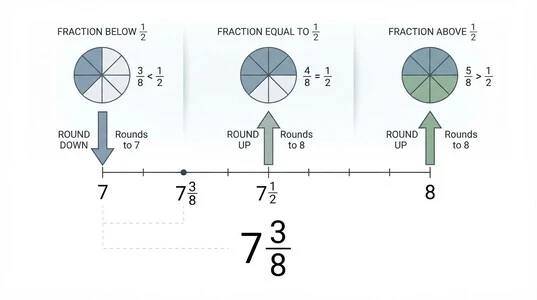
This number lies between 7 and 8. The halfway point between them is 7 1/2.
Because 3/8 is less than 1/2, the number is closer to 7 than to 8.
7 3/8 → 7
This is why the 1/2 rule works. The fractional part tells you whether the mixed number has passed the halfway point toward the next whole number. Educational rounding guides use the same comparison when teaching students how to round mixed numbers.
Compare the Numerator With Half the Denominator
You do not need to convert the fraction to a decimal. A quick method is to find half of the denominator and compare it with the numerator.
For 7 3/8:
- Half of 8 is 4.
- The numerator is 3.
- 3 is less than 4.
- Therefore, 7 3/8 rounds down to 7.
For 14 7/12:
- Half of 12 is 6.
- The numerator is 7.
- 7 is greater than 6.
- Therefore, 14 7/12 rounds up to 15.
For 9 5/10:
- Half of 10 is 5.
- The numerator equals 5.
- That means the fraction is exactly 1/2.
- Therefore, 9 5/10 rounds up to 10.
In simple terms, compare the numerator with half the denominator: below half means round down; half or above means round up. This approach avoids unnecessary decimal conversions and makes the rounding decision easy to verify.
Examples of Rounding Mixed Numbers
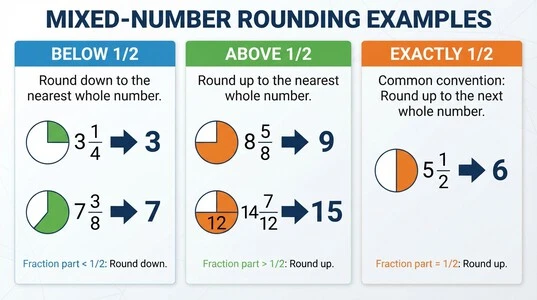
The fastest way to round a mixed number is to compare its fractional part with 1/2. The examples below cover fractions that fall below, above, or exactly at the halfway point.
| Mixed Number | Fraction Compared With 1/2 | Rounded Result |
| 3 1/4 | 1/4 < 1/2 | 3 |
| 7 3/8 | 3/8 < 1/2 | 7 |
| 5 1/2 | 1/2 = 1/2 | 6 |
| 8 5/8 | 5/8 > 1/2 | 9 |
| 12 1/3 | 1/3 < 1/2 | 12 |
| 14 7/12 | 7/12 > 1/2 | 15 |
Examples That Round Down
A mixed number rounds down when its fractional part is less than 1/2.
- 3 1/4 → 3 because 1/4 is less than 1/2.
- 12 1/3 → 12 because 1/3 is less than 1/2.
- 7 3/8 → 7 because 3/8 is less than 1/2.
- 6 2/5 → 6 because 2/5 is less than 1/2.
The fraction does not need to be converted to a decimal. Comparing it with the halfway point is enough to determine the result.
Examples That Round Up
A mixed number rounds up when its fractional part is greater than 1/2.
- 8 5/8 → 9 because 5/8 is greater than 1/2.
- 6 3/4 → 7 because 3/4 is greater than 1/2.
- 14 7/12 → 15 because 7/12 is greater than 1/2.
Here, the fractional part has passed the halfway point, so the next whole number is closer.
Exact Halfway Examples
The most common point of confusion is a fraction that is exactly 1/2. In standard nearest-whole-number rounding, an exact half rounds up.
- 2 1/2 → 3
- 4 3/6 → 5, because 3/6 simplifies to 1/2.
- 7 4/8 → 8, because 4/8 equals 1/2.
- 9 5/10 → 10, because 5/10 equals 1/2.
These examples also show why equivalent fractions must produce the same rounding decision. Whether the fractional part is written as 1/2, 3/6, 4/8, or 5/10, it represents the same halfway point. Educational materials on rounding mixed numbers use the same less-than, equal-to, and greater-than-1/2 comparisons.
Why Does a Mixed Number Round Up or Down?
A mixed number rounds up or down based on its distance from the two nearest whole numbers. The fractional part tells you whether the number is closer to the whole number below it or the whole number above it.
Use a Number Line
Consider the mixed number:
7 3/8
It lies between 7 and 8:
7 —— 7 1/2 —— 8
The point 7 1/2 is exactly halfway between the two whole numbers. Since 7 3/8 comes before 7 1/2, it is closer to 7 than to 8.
So:
7 3/8 → 7
A number line makes the rounding rule easier to understand because it shows that rounding is really a question of which whole number is closest. Interactive math resources also use number lines to teach rounding fractions and mixed numbers.
Why Comparing the Numerator Works
You can determine the same result without drawing a number line or converting the fraction to a decimal.
Take 7 3/8.
The denominator is 8, so half of the denominator is:
8 ÷ 2 = 4
Now compare the numerator, 3, with 4:
3 < 4
That tells us that:
3/8 < 1/2
Therefore, 7 3/8 is below the halfway point and rounds down to 7.
The same method works in the opposite direction. For 14 7/12, half of 12 is 6, and the numerator 7 is greater than 6. Therefore, 7/12 is greater than 1/2, so 14 7/12 rounds up to 15. This numerator-versus-half-the-denominator method is also used in educational explanations of mixed-number rounding.
In general, for a mixed number w a/b:
- If 2a < b, round down.
- If 2a = b, the fraction is exactly 1/2, so round up.
- If 2a > b, round up.
This works because comparing 2a with b is simply another way to compare a/b with 1/2. It gives you a quick, exact way to decide the nearest whole number without using decimal conversion.
Round Mixed Numbers to the Nearest Half, Quarter, or Eighth
Rounding a mixed number does not have to stop at the nearest whole number. You can also round it to a half, quarter, eighth, or another fractional increment. This is useful when a whole number is too rough for the calculation.
Nearest Half
To round to the nearest half, compare the fractional part with the available half-unit marks.
For example:
3 5/8 → 3 1/2
The value 5/8 lies between 1/2 and 1, and its distance from 1/2 is smaller than its distance from 1. Therefore, the nearest half is 3 1/2. The same approach works for other values: identify the two nearest half-unit values, then choose the one that is closer.
Nearest Quarter
When rounding to the nearest quarter, the possible fractional targets are:
0, 1/4, 1/2, 3/4, 1
For example, a value close to 6 1/2 can be rounded to that quarter-unit mark.
One important detail is that some values fall exactly halfway between two quarter marks. For instance, 6 5/8 is halfway between 6 1/2 and 6 3/4. In that situation, the calculator should clearly state which tie-breaking rule it uses rather than giving an unexplained answer. This makes the result predictable and trustworthy.
Nearest Eighth
When rounding to the nearest eighth, the target points are spaced by 1/8:
0, 1/8, 2/8, 3/8, 4/8, 5/8, 6/8, 7/8, 1
If the original mixed number is already expressed in eighths, it may already be at the requested precision.
For example:
4 5/8 → 4 5/8
No rounding is necessary because 5/8 is already an eighth-unit value.
Custom Rounding Increments
A more flexible mixed number rounding calculator can also let you choose a custom fractional increment. Instead of limiting the calculation to whole numbers, halves, quarters, or eighths, you can specify the precision needed for your problem. For example, you might round a measurement to the nearest 1/16 or 1/10. The calculator then compares the original value with the closest permitted increments and returns the nearest result.
This broader approach extends mixed-number rounding beyond basic classroom exercises and is useful for measurements, construction, cooking, and other situations where a particular level of fractional precision matters.
Using Rounded Mixed Numbers for Estimation
Rounding mixed numbers can make addition and subtraction much faster when you only need an approximate answer. A common method is to round each mixed number to the nearest whole number first, then perform the calculation with those rounded values. Math curricula and instructional resources use this strategy to estimate sums and differences of mixed numbers.
Estimate Sums
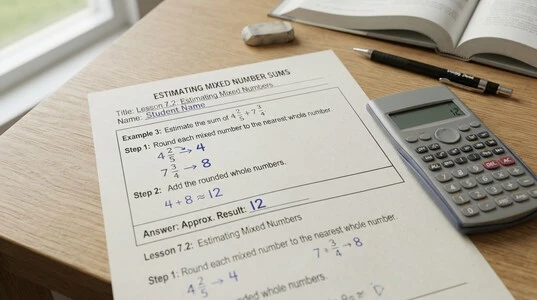
Suppose you need to estimate:
4 2/5 + 7 3/4
First round each mixed number to the nearest whole number:
- 4 2/5 → 4, because 2/5 is less than 1/2.
- 7 3/4 → 8, because 3/4 is greater than 1/2.
Then add the rounded numbers:
4 + 8 = 12
So:
4 2/5 + 7 3/4 ≈ 12
The symbol ≈ means “approximately equal to.” It is important to use it because 12 is an estimate, not the exact sum.
Estimate Differences
The same method works for subtraction.
For example:
13 1/9 − 8 2/3
Round each mixed number first:
- 13 1/9 → 13, because 1/9 is less than 1/2.
- 8 2/3 → 9, because 2/3 is greater than 1/2.
Now subtract:
13 − 9 = 4
Therefore:
13 1/9 − 8 2/3 ≈ 4
This approach is useful when you need to judge the size of an answer quickly or check whether an exact calculation is reasonable.
When Rounding Is Useful—and When It Is Not
Use rounding when an estimate is acceptable, such as mental math, quick comparisons, measurements, or checking an answer. It can simplify a problem without requiring exact fraction arithmetic. Use the exact fractions when precision matters. For example, financial calculations, exact measurements, or a problem that specifically asks for an exact answer should not be replaced with a rounded result.
Most importantly, do not present an estimate as an exact answer. Keep the original calculation separate from the rounded calculation and use ≈ to make the distinction clear. This small detail makes a mixed number rounding calculator more useful for both learning and checking mathematical work.
Common Mistakes When Rounding Mixed Numbers
Rounding a mixed number is simple once you know what to compare, but a few common mistakes can lead to the wrong answer. Avoiding these errors makes your calculation faster and more reliable.
Looking at the Denominator Instead of the Fraction
The denominator tells you how many equal parts make up one whole, but it does not tell you by itself whether to round up or down.
For example, in 7 3/8, the denominator is 8 and the numerator is 3. You need to consider the value of 3/8, not just the number 8.
Because:
3/8 < 1/2
the mixed number rounds down:
7 3/8 → 7
Always Rounding Up
A fraction does not automatically mean that you should move to the next whole number. It only rounds up when it reaches or passes the halfway point.
For example:
4 1/5 → 4
because 1/5 < 1/2.
But:
4 4/5 → 5
because 4/5 > 1/2.
The key question is always: Is the fractional part less than, equal to, or greater than 1/2?
Dropping the Fraction Without Checking It
Some people simply remove the fraction and keep the whole-number part. That is actually truncation, not rounding.
For example:
6 7/8
cannot be rounded to 6 because 7/8 is greater than 1/2. The correct rounded value is:
6 7/8 → 7
Always check the fractional part before deciding which whole number is closest.
Confusing Rounding With Truncation
Rounding chooses the nearest permitted value. Truncation simply cuts off the fractional portion.
For example:
9 3/4
truncated to a whole number becomes 9, but rounded to the nearest whole number it becomes 10.
This distinction matters whenever an estimate is supposed to represent the closest value rather than simply a shortened one.
Converting to Decimals Unnecessarily
You can convert a fraction to a decimal, but you usually do not need to.
For example, to round 11 5/12, compare 5/12 directly with 1/2. Since 5 is less than half of 12, the answer is 11.
Comparing the numerator with half the denominator is exact and avoids extra calculation. It can also prevent mistakes caused by repeating or rounded decimal representations.
Rounding an Exact Calculation Too Early
Rounding can simplify an estimate, but rounding too early can change the final answer when an exact result is required.
Suppose a problem asks you to add or subtract mixed numbers and then give an exact answer. Do the fraction calculation first. Round only when the problem asks for an approximation or when an estimate is useful for checking the result.
For example, treating 4 2/5 as 4 before an exact calculation discards 2/5. That information cannot be recovered later.
A good rule is:
Keep exact values during exact calculations; round only at the point where an approximation is requested.
This distinction is also important when using a mixed number rounding calculator: a rounded result should be clearly labeled as an approximation, while the original fraction remains available for reference.
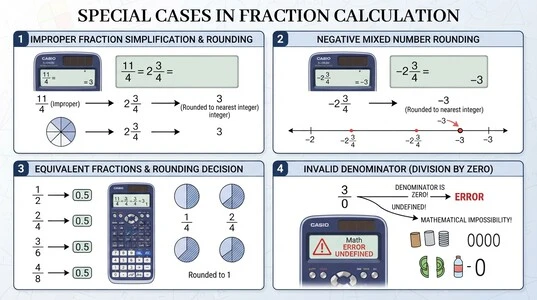
Round Mixed Number Calculator: Special Cases
Most mixed-number rounding problems are straightforward, but a reliable calculator also needs to handle less common inputs correctly. Improper fractions, negative mixed numbers, equivalent fractions, and invalid denominators can all affect how a result should be interpreted.
Improper Fractions
An improper fraction has a numerator that is greater than or equal to its denominator. For example:
11/4
You can convert it to a mixed number:
11/4 = 2 3/4
Then compare the fractional part with 1/2. Since 3/4 > 1/2, the number rounds up:
2 3/4 → 3
The same principle applies when the calculator accepts an improper fraction directly. It can interpret the value, identify the nearest rounding target, and return the appropriate rounded result without requiring you to convert it manually.
Negative Mixed Numbers
Negative mixed numbers need a clear sign convention because the minus sign applies to the entire mixed-number value.
For example:
-2 3/4
represents:
-(2 + 3/4) = -2.75
When rounded to the nearest whole number, -2.75 becomes:
-3
A calculator should make this interpretation clear rather than treating the minus sign as applying only to the whole-number component. Supporting negative mixed numbers is also a useful calculator feature because modern fraction calculators explicitly document how signed values are handled.
Equivalent Fractions
Different fractions can represent exactly the same value, so they should always produce the same rounding decision.
For example:
1/2 = 2/4 = 3/6 = 4/8
Each one represents the same halfway point. Therefore:
5 1/2 → 6
5 2/4 → 6
5 3/6 → 6
5 4/8 → 6
This is why a good mixed number rounding calculator should evaluate the value of the fraction, not simply match a particular numerator or denominator pattern.
Zero and Invalid Denominators
A denominator tells you how many equal parts make up one whole, so it cannot be zero.
For example:
7 3/0
is not a valid mixed number because division by zero is undefined.
A trustworthy calculator should reject this input and clearly explain the problem instead of returning a misleading result. It should also flag other invalid entries, such as a missing denominator, non-numeric values, or improperly formatted fractions.
Clear validation protects users from incorrect answers and makes the calculator easier to trust, especially when it is being used to check homework or mathematical work.
Round Mixed Number Calculator Formula and Method
A round mixed number calculator can determine the nearest whole number by examining only the fractional part. This gives a simple, exact method that does not require converting the mixed number to a decimal.
Basic Formula
Suppose the mixed number is written as:
w a/b
where:
- w = the whole-number part
- a = the numerator
- b = the denominator
To round to the nearest whole number, compare:
a/b with 1/2
A convenient equivalent method is to compare 2a with b. This avoids decimal conversion and works directly with the original numerator and denominator.
For example, consider:
7 3/8
Here, a = 3 and b = 8.
Compare:
2 × 3 = 6
with:
8
Because 6 < 8, the fractional part is less than 1/2, so the result rounds down to:
7
Rounding Logic
The calculator follows three simple cases:
| Comparison | Meaning | Result |
| 2a < b | Fraction is less than 1/2 | Round down to w |
| 2a = b | Fraction is exactly 1/2 | Round up to w + 1 |
| 2a > b | Fraction is greater than 1/2 | Round up to w + 1 |
For example:
7 3/8
2(3) = 6 < 8 → 7
9 5/10
2(5) = 10 = 10 → 10
14 7/12
2(7) = 14 > 12 → 15
This method is mathematically equivalent to comparing the fraction directly with 1/2. It also gives the calculator a clear, deterministic rule for producing a rounded mixed-number result.
Why Trust This Calculator?
A useful math calculator should do more than return a number. It should make the method clear, handle invalid inputs safely, and give users enough information to verify the result.
How Calculations Are Performed
The calculator uses exact integer and fraction arithmetic for mixed-number calculations rather than relying on rounded decimal values during the calculation, using the equivalent 2a versus b test described above.
The calculator on this page runs entirely in your browser. It uses exact integer and fraction arithmetic in JavaScript — the 2a versus b comparison test described above — so the numbers you enter are processed locally on your device and never sent to our servers.
Who Reviewed the Mathematics
Author: Mixed Number Calculator — the editorial team behind mixednumbercalculator.net, which publishes free step-by-step math calculators and worked examples.
Mathematics reviewer: the site’s editorial team. Every worked example and rounding rule on this page is verified against exact fraction arithmetic (the 2a versus b comparison test) before publishing.
Calculation Transparency
The calculator does not simply display a rounded number. It shows the original mixed number, the rounded result, and the reason for the rounding decision.
For example:
7 3/8 → 7
Reason: 3/8 is less than 1/2, so the number rounds down.
Showing the underlying rule lets students, parents, teachers, and other users independently check the result. This also supports Google’s emphasis on helpful, reliable content that provides substantial value and clearly explains who created it and how it was produced.
Privacy
Privacy: the calculator on this page runs entirely in your browser. The numbers you enter are processed locally to compute your result and are never sent to our servers.
Google’s guidance emphasizes clear “Who, How, and Why” information, including accurate authorship and transparency about how content and automated processes are produced.
Frequently Asked Questions About Rounding Mixed Numbers
How do you round a mixed number?
To round a mixed number to the nearest whole number, look at its fractional part and compare it with 1/2. A fraction less than 1/2 rounds down, while a fraction equal to or greater than 1/2 rounds up.
How do you round a mixed number to the nearest whole number?
Keep the whole-number part and check the fraction. For example, 7 3/8 rounds to 7 because 3/8 < 1/2. In contrast, 7 5/8 rounds to 8 because 5/8 > 1/2.
What happens when the fraction is exactly 1/2?
When the fractional part is exactly 1/2, the mixed number is halfway between two whole numbers. Under the standard rule used by this calculator, it rounds to the next whole number.
For example:
5 1/2 → 6
Do you round up when the numerator equals half the denominator?
Yes. When the numerator is exactly half the denominator, the fraction equals 1/2, so it reaches the halfway point and rounds up.
For example, in 9 5/10, 5 is half of 10:
9 5/10 → 10
How do you round 3 5/8?
Compare 5/8 with 1/2. Because 5/8 is greater than 1/2, round up:
3 5/8 → 4
How do you round 7 3/4?
Since 3/4 is greater than 1/2, 7 3/4 is closer to 8 than to 7.
7 3/4 → 8
Can you round a mixed number to the nearest half?
Yes. To round to the nearest half, compare the value with the closest half-unit marks, such as 3, 3 1/2, and 4. Choose the half-unit that is closest to the original mixed number. For values exactly halfway between two targets, use the calculator’s stated tie-breaking rule.
Can you round a mixed number to the nearest quarter?
Yes. Nearest-quarter rounding uses fractional targets separated by 1/4, such as:
2, 2 1/4, 2 1/2, 2 3/4, 3
The calculator compares the input with the nearest available quarter and returns the closest value.
How do you round negative mixed numbers?
Treat the negative mixed number as its complete numerical value. For example:
-2 3/4 = -2.75
Rounded to the nearest whole number, it becomes:
-3
A calculator should clearly state how it handles negative values and halfway cases so the result is predictable.
What is the difference between rounding and truncating?
Rounding selects the nearest value based on distance. Truncating simply removes the fractional part without considering which whole number is closer.
For example:
9 3/4
truncated to a whole number becomes 9, but rounded to the nearest whole number becomes 10.
Should I round a mixed number before doing a calculation?
Only when an estimate is required or acceptable. For an exact calculation, keep the original fraction and round the final result only when the problem calls for it. Rounding too early can change the final answer.