Mixed Number to Whole Number Calculator
Mixed Number to Whole Number Calculator
A mixed number contains a whole number and a fraction. Use the calculator above to enter the whole number, numerator, and denominator and instantly see its whole-number part, decimal value, nearest whole number, rounding direction, and optional improper fraction.
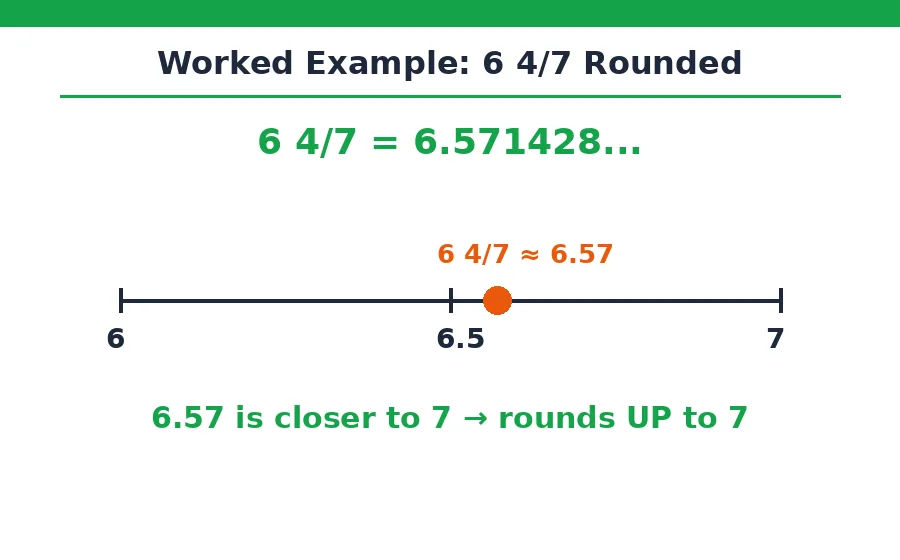
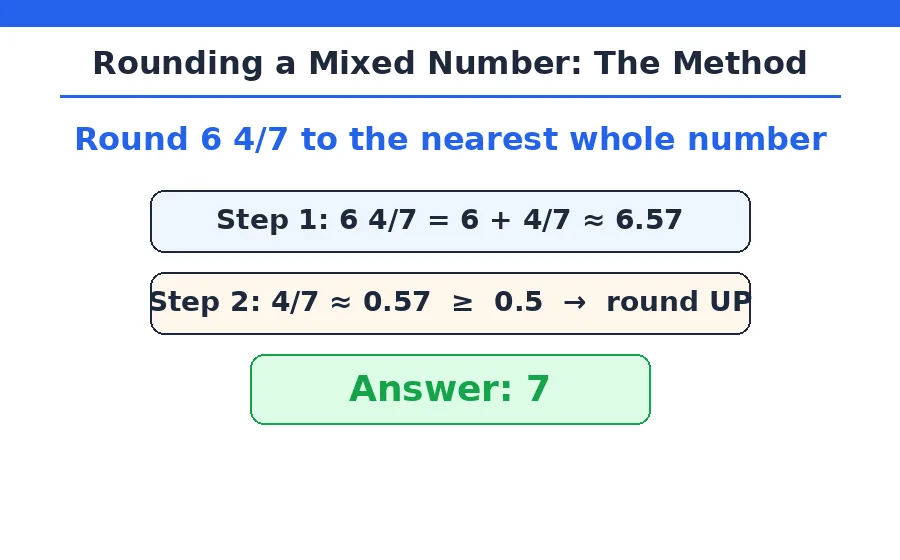
For example, enter 6 4/7:
- Whole-number part: 6
- Decimal: 6.571428…
- Nearest whole number: 7
- Rounded: Up
- Reason: 4/7 > 1/2
What does “mixed number to whole number” mean?
The phrase mixed number to whole number can mean two different things:
- Find the whole-number part: For 6 4/7, the whole-number part is 6.
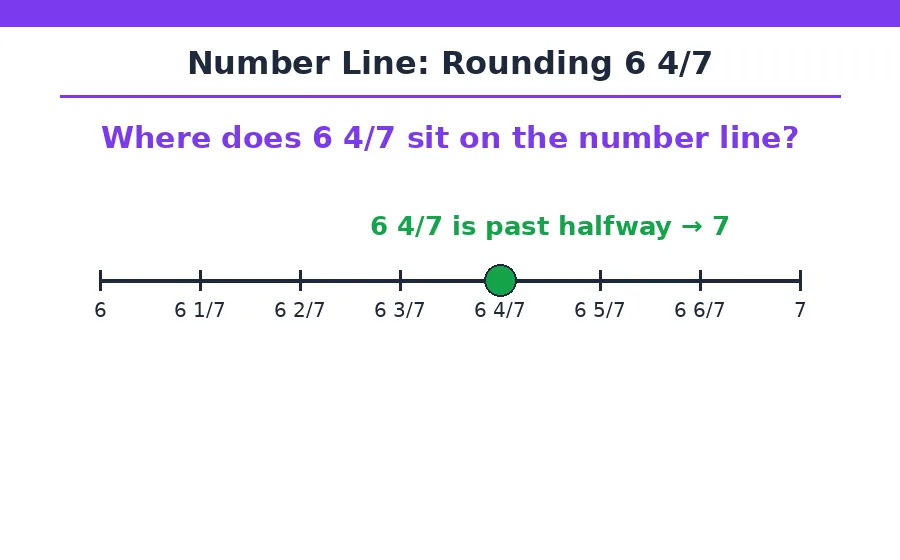
- Round to the nearest whole number: For 6 4/7, the nearest whole number is 7 because 4/7 is greater than 1/2.
The calculator shows both results so you can use the answer that matches your calculation.
How to Use the Mixed Number to Whole Number Calculator
Using the mixed number to whole number calculator takes just a few steps:
- Enter the whole number from your mixed number.
- Enter the numerator and denominator of the fraction.
- Calculate the value to display the results.
- Choose the result you need: use the whole-number part if you only need the integer portion, or use the nearest whole number if you need to round.
For example, enter 4 3/5. The calculator gives:
- Whole-number part: 4
- Decimal: 4.6
- Nearest whole number: 5
The decimal value makes it easy to verify the calculation. The denominator must also be greater than zero; a denominator of zero is not valid because division by zero is undefined.
What Does “Convert a Mixed Number to a Whole Number” Mean?
The phrase “convert a mixed number to a whole number” can describe different calculations. The correct result depends on whether you want the whole-number part, the nearest whole number, or the decimal value.
Finding the whole-number part
A mixed number already contains a whole-number component. For example:
7 2/3 → 7
Here, 7 is the whole-number part, while 2/3 is the fractional part. No rounding is needed.
Rounding to the nearest whole number
If the goal is to round the entire mixed number, the result can be different:
7 2/3 → 8
Because 2/3 is greater than 1/2, the number rounds up to 8.
Converting to a decimal
You can also convert the mixed number to decimal form:
7 2/3 = 7.666…
This is a conversion to a decimal, not a conversion to a whole number. Keeping these three operations separate helps prevent confusion when using a mixed number calculator.
| Mixed number | Whole-number part | Decimal | Nearest whole |
| 3 1/4 | 3 | 3.25 | 3 |
| 3 1/2 | 3 | 3.5 | 4 |
| 3 3/4 | 3 | 3.75 | 4 |
If you only need the integer already contained in the mixed number, use the whole-number part. If you need an estimated integer, use the nearest whole result.
How to Round a Mixed Number to the Nearest Whole Number
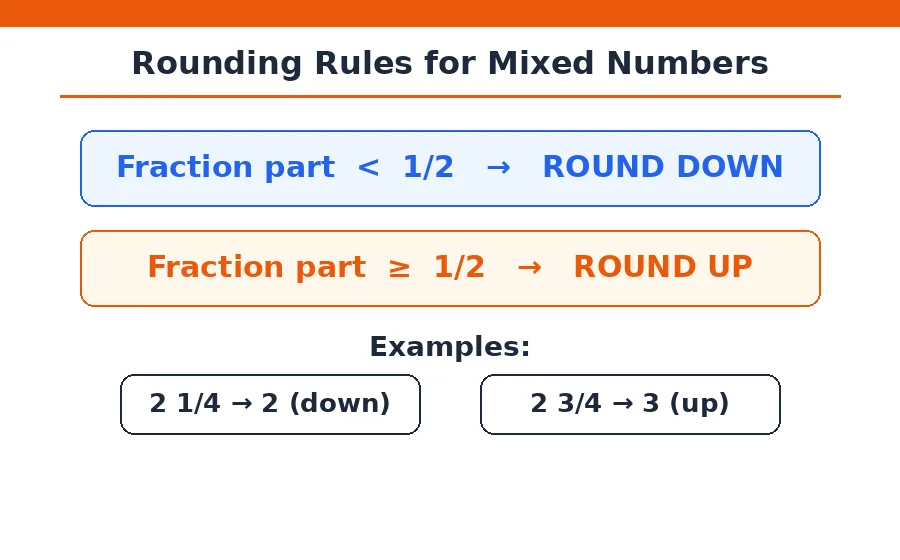
To round a mixed number to the nearest whole number, compare its fractional part with 1/2. If the fraction is less than 1/2, round down. If it is 1/2 or greater, round up. This approach identifies which whole number is closest to the mixed number.
If the fraction is less than 1/2, round down
Consider:
5 1/4
Because:
1/4 < 1/2
the mixed number is closer to 5 than to 6. Therefore:
5 1/4 → 5
If the fraction is 1/2, round up
For a fraction exactly equal to 1/2:
5 1/2 → 6
This calculator uses the standard half-up rounding convention, where a value exactly halfway between two whole numbers is rounded up.
If the fraction is greater than 1/2, round up
Consider:
5 3/4
Since:
3/4 > 1/2
the number is closer to 6, so:
5 3/4 → 6
Quick rule: Compare the fractional part with 1/2. Less than 1/2 means round down; 1/2 or greater means round up.
How the Calculator Converts a Mixed Number to a Whole Number
The calculator separates the whole-number and fractional parts, then applies the appropriate calculation based on the result you need. This makes the process easy to verify instead of treating the answer as a black box.
Formula for the decimal value
For a positive mixed number:
Mixed number = whole number + numerator ÷ denominator
For example:
6 3/4 = 6 + 3 ÷ 4 = 6.75
The decimal value provides an exact way to check the mixed number before rounding.
Formula for the nearest whole number
Let W be the whole-number part, N the numerator, and D the denominator. The calculator compares N/D with 1/2:
- If N/D < 1/2, the result rounds to W.
- If N/D ≥ 1/2, the result rounds to W + 1.
Why you don’t always need a decimal conversion
For 8 4/7, you can compare the fraction directly:
4/7 > 1/2
So the nearest whole number is immediately 9. There is no need to convert 4/7 to a decimal first.
Mixed Number to Whole Number Examples
These examples show how the same mixed number can produce different results depending on whether you need its whole-number part, decimal value, or nearest whole number.
Example below 1/2
2 1/4 → 2
Because 1/4 is less than 1/2, the number rounds down to 2. Its whole-number part is also 2.
Example exactly 1/2
2 1/2 → 3
The fractional part equals 1/2, so standard half-up rounding gives 3. The whole-number part, however, remains 2.
Example above 1/2
2 3/4 → 3
Since 3/4 is greater than 1/2, the mixed number rounds up to 3.
Example where the whole-number part differs from the rounded answer
For 8 5/7:
- Whole-number part: 8
- Decimal: 8.714285…
- Nearest whole: 9
This clearly shows why “convert to a whole number” needs clarification. The whole-number component is 8, while the rounded result is 9.
Example with a repeating decimal
For 3 1/3:
- Decimal: 3.333…
- Whole-number part: 3
- Nearest whole: 3
The repeating decimal does not change the rounding result because 1/3 is less than 1/2.
Mixed Number to Whole Number vs. Other Conversions
A mixed number can be changed into several different forms, but each calculation has a different purpose. For example, 4 2/5 can produce several valid results depending on what you need:
Mixed number → whole-number part
4 2/5 → 4
This keeps only the whole-number component already contained in the mixed number.
Mixed number → nearest whole number
4 2/5 → 4
Because 2/5 is less than 1/2, the mixed number rounds down to 4.
Mixed number → decimal
4 2/5 → 4.4
Here, the fraction is converted to decimal form rather than rounded to a whole number.
Mixed number → improper fraction
4 2/5 → 22/5
The whole number and fraction are combined into a single fraction with the same value.
These are different representations or operations, so the correct calculator depends on your goal. Related tools can include a Mixed Number to Decimal Calculator, Mixed Number to Improper Fraction Calculator, Fraction Calculator, and Nearest Whole Number Calculator.
Common Mistakes When Converting or Rounding Mixed Numbers
Small misunderstandings can produce a different answer even when the arithmetic is simple. Watch for these common errors.
Confusing the whole-number part with the rounded answer
For 7 5/7, the whole-number part is 7, but the nearest whole number is 8 because 5/7 is greater than 1/2.
Automatically rounding every fraction up
A fraction does not always make the number round up. For example, 2 1/4 → 2 because 1/4 is less than 1/2.
Treating the numerator as a decimal
The numerator and denominator work together. 3/4 means three fourths; it does not mean 0.4.
Ignoring the denominator
The denominator determines the size of each fractional part. Changing it can change whether a fraction is below, equal to, or above 1/2.
Misreading negative mixed numbers
A negative mixed number such as −2 3/4 equals −2.75, not −1.25. The negative sign applies to the entire mixed-number value.
Mixed Number to Whole Number Calculator Rules
When rounding a mixed number to the nearest whole number, compare its fractional part with 1/2. Use these rules:
| Fractional part | Nearest whole |
| Less than 1/2 | Round down |
| Exactly 1/2 | Round up |
| Greater than 1/2 | Round up |
For example, 6 1/4 rounds to 6, while 6 3/4 rounds to 7. A value such as 6 1/2 rounds to 7 under the standard half-up convention.
The calculator does not change the original mixed number. It calculates its exact value and, when requested, determines the nearest whole number. If you only need the whole-number component, the fractional part is not rounded; for example, the whole-number part of 6 3/4 is simply 6.
Frequently Asked Questions
How do you convert a mixed number to a whole number?
It depends on what you mean by “whole number.” To find the whole-number part, use the integer already shown in the mixed number. To find the nearest whole number, compare the fractional part with 1/2 and round accordingly.
How do you round a mixed number to the nearest whole number?
Compare the fractional part with 1/2. If it is less than 1/2, round down. If it is equal to or greater than 1/2, round up.
What is the whole number in 6 3/5?
The whole-number part of 6 3/5 is 6. If you round the entire mixed number, however, the result is 7 because 3/5 is greater than 1/2.
What is 3 1/2 rounded to the nearest whole number?
3 1/2 rounds to 4 under the standard half-up rounding convention. The value is exactly halfway between 3 and 4, so it rounds up.
Do I need to convert a mixed number to a decimal before rounding?
No. You can compare the fractional part directly with 1/2. For example, 8 4/7 rounds up because 4/7 > 1/2, without first calculating its decimal value.
What happens when the fraction is exactly 1/2?
Under the standard half-up convention used by this calculator, a fractional part of exactly 1/2 rounds the mixed number up to the next whole number. For example, 5 1/2 → 6.
What is the difference between a mixed number and an improper fraction?
They are two representations of the same value. For example, 4 2/5 = 22/5. The mixed number displays the whole and fractional parts separately, while the improper fraction uses one numerator over the denominator.
Can the calculator handle improper fractions?
If the calculator includes improper-fraction input, enter the numerator and denominator to calculate the value. An improper fraction can then be expressed as a mixed number, decimal, or whole-number result when applicable.
Can I calculate a negative mixed number?
Yes, when negative input is supported. The sign applies to the entire mixed-number value. For example, −2 3/4 = −2.75. This is not the same as subtracting 3/4 from 2.
Why is my answer different when I use decimal form?
The difference may come from rounding a repeating or truncated decimal too early. For example, 3 1/3 = 3.333…. For the most reliable nearest-whole result, compare the original fractional part with 1/2 instead of relying on a shortened decimal.
Why Use This Mixed Number Calculator?
This mixed number calculator gives the main results you may need in one place. It shows the whole-number part, decimal equivalent, and nearest whole number, along with the rounding direction when applicable. You can also use it to check your work and reduce common arithmetic errors. By comparing the fractional part with 1/2, the calculator makes the rounding decision clear without requiring unnecessary conversion steps. It is useful for quick calculations, homework checks, and learning how mixed numbers work.
Summary
A mixed number already contains a whole-number part, so you do not need to round it when you only want that component. If you need the nearest whole number, compare the fractional part with 1/2: less than 1/2 rounds down, while 1/2 or greater rounds up. Enter your mixed number into the calculator above to quickly check the whole-number part, decimal value, and nearest whole result.