
Mixed Number to Improper Fraction Calculator (Free and Step-by-Step)
A Mixed Number to Improper Fraction Calculator helps you convert a mixed number into an improper fraction within seconds. It gives accurate results and shows each step clearly. You can also simplify the final answer when possible. This improper fraction calculator works well for students, teachers, parents, and anyone checking homework. It saves time and reduces calculation mistakes. The step-by-step solution also helps you understand the conversion process instead of only showing the answer.
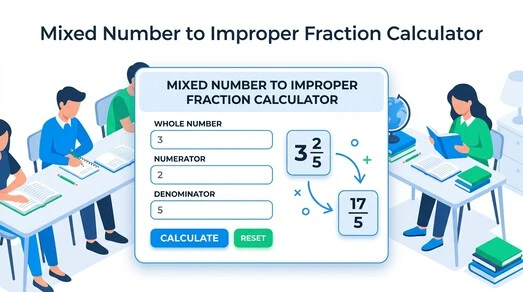
To convert a mixed number to an improper fraction, the calculator multiplies the whole number by the denominator. Next, it adds the numerator. The denominator stays the same. This simple method produces the correct improper fraction every time. Unlike manual calculations, a mixed fraction calculator performs the math instantly. You can verify homework, prepare for tests, or practice fraction problems with confidence. Whether you need a quick answer or want to learn the process, this fraction conversion calculator provides both. It delivers accurate results, explains each step, and simplifies the fraction whenever possible.
Mixed Number to Improper Fraction Calculator
Use this Mixed Number to Improper Fraction Calculator to convert any mixed number into an improper fraction in seconds. Enter your values below and click Calculate to see the answer with a clear explanation.
Enter Your Values
Whole Number : [ Input Field ]
Numerator : [ Input Field ]
Denominator : [ Input Field ]
Buttons
- Calculate
- Reset
Results
After you click Calculate, the calculator displays:
- Improper Fraction
- Simplified Result (when the fraction can be reduced)
- Step-by-Step Solution
The calculator follows the standard fraction conversion method. It multiplies the whole number by the denominator, adds the numerator, and keeps the denominator unchanged. This process gives an accurate result every time.
What Is a Mixed Number?
A mixed number combines a whole number and a proper fraction. It represents a value greater than one. This format makes fractions easier to read and understand in everyday math.
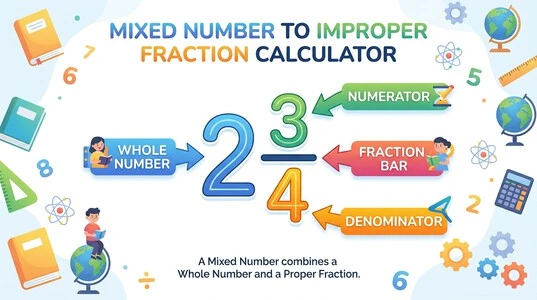
A mixed number has two parts:
- A whole number shows complete units.
- A proper fraction shows the remaining part of a whole.
The proper fraction always has a numerator smaller than its denominator. Together, they form a single mathematical value.
Mixed Number Definition
A mixed number is a mathematical representation of a whole number and a proper fraction written together. This form uses standard fraction notation to show complete and partial quantities in one expression.
For example:
- 2 ¾ = 2 whole units and 3/4 of another unit.
- 5 ⅖ = 5 whole units and 2/5 of another unit.
- 9 ⅛ = 9 whole units and 1/8 of another unit.
In each example:
- The whole number appears first.
- The numerator sits above the fraction bar.
- The denominator sits below the fraction bar.
- The proper fraction represents the fractional part of the mixed number.
Understanding mixed numbers makes it easier to use a Mixed Number to Improper Fraction Calculator. In the next section, you’ll learn what an improper fraction is and how it differs from a mixed number.
What Is an Improper Fraction?
An improper fraction is a fraction where the numerator is greater than or equal to the denominator. This means the fraction represents a value of one or more.
For example:
- 7/4
- 12/5
- 17/8
In each example, the numerator is larger than the denominator. As a result, the fraction has a value greater than one. An improper fraction uses standard mathematical notation. The numerator appears above the fraction bar, while the denominator appears below it. This notation clearly shows how many equal parts you have compared to the total parts in one whole.
Improper fractions play an important role in mathematics. They make calculations more consistent and help represent values greater than one in a single fraction. The Mixed Number to Improper Fraction Calculator uses this format to provide accurate and easy-to-read results.
Mixed Number to Improper Fraction Formula
The Mixed Number to Improper Fraction Calculator uses a simple formula. This method follows the standard approach taught in mathematics. Educational resources such as the Khan Academy and CK-12 Foundation also use this conversion method.
Standard Formula
To find the improper fraction, multiply the whole number by the denominator. Then add the numerator. Keep the denominator unchanged.
Formula:
Improper Numerator = (Whole Number × Denominator) + Numerator
Improper Fraction = Improper Numerator / Denominator
Understanding Each Variable
Whole Number
The whole number represents the complete units in the mixed number. It appears before the fraction.
Numerator
The numerator is the top number of the proper fraction. It shows how many parts you have.
Denominator
The denominator is the bottom number of the fraction. It shows the total number of equal parts in one whole. The denominator stays the same during the conversion.
Final Improper Numerator
The final improper numerator is the new top number of the fraction. Calculate it by multiplying the whole number by the denominator and then adding the original numerator. This value creates the improper fraction while preserving the original amount.
How to Convert a Mixed Number into an Improper Fraction
You can convert a mixed number into an improper fraction using four simple steps. This method works for any mixed number and gives accurate results every time. The Mixed Number to Improper Fraction Calculator follows the same process automatically.
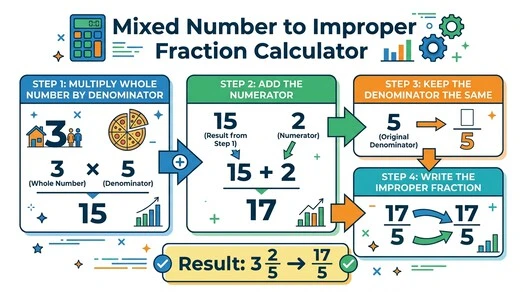
Step 1 — Multiply the Whole Number by the Denominator
Start by multiplying the whole number by the denominator. This step converts the whole number into an equivalent fraction with the same denominator. It creates a common base for the final fraction.
Example:
For 3 2/5
- Whole Number = 3
- Denominator = 5
3 × 5 = 15
Step 2 — Add the Numerator
Next, add the original numerator to the result from Step 1. This sum becomes the new numerator of the improper fraction. It combines the whole units and the fractional part into one fraction.
Example:
- Result from Step 1 = 15
- Original Numerator = 2
15 + 2 = 17
The new numerator is 17.
Step 3 — Keep the Same Denominator
Do not change the denominator. The denominator represents the size of each equal part. Since those parts stay the same, the denominator remains unchanged throughout the conversion.
Example:
The denominator stays 5.
Step 4 — Write the Final Improper Fraction
Place the new numerator over the original denominator.
Final Answer:
17/5
If the final fraction can be reduced, simplify it to its lowest terms. The Mixed Number to Improper Fraction Calculator checks this automatically and displays the simplified result when applicable.
Numerator Calculation Explained
Many learners ask how the new numerator is calculated. Once you understand this step, converting a mixed number becomes much easier. The numerator changes because a mixed number combines a whole number and a proper fraction. First, you must express both parts with the same denominator. This creates one equivalent fraction.
Why Multiply First?
Multiply the whole number by the denominator first. This converts the whole number into an equivalent fraction. It ensures both values use the same denominator before you combine them.
Visual Example 1
Mixed Number: 2 ¾
| Step | Calculation | Result |
| Multiply | 2 × 4 | 8 |
| Add numerator | 8 + 3 | 11 |
| Final fraction | 11/4 | ✓ |
Why Add Afterward?
After multiplication, add the original numerator. The numerator represents the extra fractional part. Adding it combines the whole units and the fraction into one value.
Visual Example 2
Mixed Number: 5 ⅖
| Step | Calculation | Result |
| Multiply | 5 × 5 | 25 |
| Add numerator | 25 + 2 | 27 |
| Final fraction | 27/5 | ✓ |
Why Does the Denominator Stay the Same?
The denominator shows the size of each equal part. The size of those parts never changes during conversion. Only the number of parts changes. That is why the numerator changes, while the denominator remains the same.
Visual Example 3
Mixed Number: 9 ⅛
| Step | Calculation | Result |
| Multiply | 9 × 8 | 72 |
| Add numerator | 72 + 1 | 73 |
| Final fraction | 73/8 | ✓ |
Remember this simple rule:
- Multiply the whole number by the denominator.
- Add the original numerator.
- Keep the same denominator.
- Write the final equivalent fraction.
This calculation forms the foundation of every Mixed Number to Improper Fraction Calculator and ensures accurate results every time.
Step-by-Step Worked Examples
The following examples show how to convert a mixed number into an improper fraction. Each example follows the same method used by the Mixed Number to Improper Fraction Calculator.
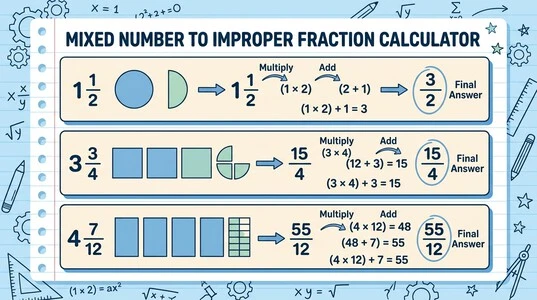
Example 1: Easy
Given Mixed Number: 1 ½
Step 1: Multiply
1 × 2 = 2
Step 2: Add the Numerator
2 + 1 = 3
Step 3: Keep the Same Denominator
Denominator = 2
Final Improper Fraction
3/2
Simplified Result: Already in simplest form.
Example 2: Medium
Given Mixed Number: 3 ¾
Step 1: Multiply
3 × 4 = 12
Step 2: Add the Numerator
12 + 3 = 15
Step 3: Keep the Same Denominator
Denominator = 4
Final Improper Fraction
15/4
Simplified Result: Already in simplest form.
Example 3: Larger Denominator
Given Mixed Number: 4 7/12
Step 1: Multiply
4 × 12 = 48
Step 2: Add the Numerator
48 + 7 = 55
Step 3: Keep the Same Denominator
Denominator = 12
Final Improper Fraction
55/12
Simplified Result: Already in simplest form.
Example 4: Large Whole Number
Given Mixed Number: 15 5/9
Step 1: Multiply
15 × 9 = 135
Step 2: Add the Numerator
135 + 5 = 140
Step 3: Keep the Same Denominator
Denominator = 9
Final Improper Fraction
140/9
Simplified Result: Already in simplest form.
Example 5: Simplification After Calculation
Given Mixed Number: 2 3/6
Step 1: Multiply
2 × 6 = 12
Step 2: Add the Numerator
12 + 3 = 15
Step 3: Keep the Same Denominator
Denominator = 6
Final Improper Fraction
15/6
Simplified Result
Divide the numerator and denominator by 3.
15 ÷ 3 = 5
6 ÷ 3 = 2
Simplified Fraction: 5/2
These examples show that the conversion steps never change. Multiply the whole number by the denominator, add the numerator, and keep the same denominator. If the final fraction shares a common factor, simplify it to its lowest terms.
Common Mistakes When Converting Mixed Numbers
Small mistakes can lead to the wrong answer, even when you know the conversion method. Review these common errors before solving a problem by hand. The Mixed Number to Improper Fraction Calculator helps you avoid these mistakes automatically.
Forgetting to Multiply First
Many students add the numerator to the whole number right away. This approach gives the wrong numerator.
Correct order:
- Multiply the whole number by the denominator.
- Add the numerator.
Always multiply before adding.
Adding the Denominator by Mistake
Some learners add the denominator instead of the numerator.
Incorrect:
For 3 2/5
3 × 5 + 5 = 20 ✗
Correct:
3 × 5 + 2 = 17 ✓
Only add the numerator after multiplication.
Changing the Denominator
The denominator never changes during the conversion. It represents the size of each equal part. Since the part size stays the same, the denominator also stays the same.
Correct Example:
3 2/5 → 17/5
Not 17/7 or 17/10.
Incorrect Multiplication
A multiplication error affects every step that follows.
Example:
For 4 3/8
Correct multiplication:
4 × 8 = 32
If you calculate 4 × 8 = 28, the final answer becomes incorrect.
Take a moment to check your multiplication.
Incorrect Addition
After multiplication, add the original numerator carefully.
Example:
For 5 4/7
5 × 7 = 35
35 + 4 = 39 ✓
Avoid calculation mistakes, especially with larger numbers.
Forgetting to Simplify the Final Answer
Some improper fractions share a common factor. Reduce them to their lowest terms whenever possible.
Example:
15/6 → 5/2
Simplifying makes your answer easier to read and follows standard mathematical practice. By avoiding these common mistakes, you can convert mixed numbers accurately and confidently. If you want a faster solution, use the Mixed Number to Improper Fraction Calculator to calculate and simplify the result automatically.
Why Improper Fractions Are Useful
Improper fractions do more than represent values greater than one. They provide a consistent way to write and work with fractions across many areas of mathematics.
Here are some common uses:
- Mathematics: Improper fractions express values as a single fraction. This format keeps calculations clear and consistent.
- Algebra: Many algebra problems use improper fractions because they fit easily into mathematical expressions and equations.
- Fraction Calculations: Writing a value as one fraction helps maintain a standard fraction format before solving a problem.
- Educational Exercises: Teachers often use improper fractions in worksheets, quizzes, and classroom activities to build fraction skills.
- Standardized Tests: School and competitive exams frequently include questions that require identifying or using improper fractions.
Organizations such as Khan Academy and the National Council of Teachers of Mathematics teach improper fractions as a core concept in elementary mathematics. Understanding them builds a strong foundation for more advanced math topics.
Real-Life Applications
Mixed numbers and improper fractions appear in many learning situations. Knowing how to convert between these formats helps you solve problems faster and with greater accuracy.
Classroom Assignments
Teachers often include mixed numbers in daily math lessons. Converting them into improper fractions helps students complete assignments correctly and understand fraction concepts.
Homework
Homework questions frequently ask students to convert mixed numbers. A Mixed Number to Improper Fraction Calculator lets students check their work and learn the correct method step by step.
Exams
Many school exams include fraction conversion questions. Understanding this skill improves speed and reduces calculation errors during tests.
Worksheets
Fraction worksheets provide regular practice with mixed numbers and improper fractions. Repeating these exercises strengthens problem-solving skills and builds confidence.
Teaching Fractions
Teachers and parents use mixed numbers to explain how whole numbers and fractions work together. Converting them into improper fractions helps students see the same value written in a different mathematical form.
Math Practice
Regular practice improves fraction skills over time. Students who solve different examples become more comfortable with numerators, denominators, and fraction notation. This confidence carries into higher-level mathematics and algebra. Learning this simple conversion prepares students for classroom success, homework, quizzes, and standardized tests. It also builds a strong foundation for future math topics.
Benefits of Using This Calculator
A Mixed Number to Improper Fraction Calculator makes fraction conversion faster and easier. It provides accurate results while helping you understand each step.

Saves Time
Manual calculations take time, especially with larger numbers. The calculator converts mixed numbers into improper fractions instantly.
Reduces Mistakes
Simple errors in multiplication or addition can lead to the wrong answer. The calculator follows the correct conversion formula every time, reducing calculation mistakes.
Step-by-Step Learning
The calculator does more than display the answer. It explains each step clearly, making it easier to understand the conversion process and improve your fraction skills.
Free Online Calculator
You can use this calculator anytime without installing software. It works directly in your web browser, making it a convenient tool for students, teachers, and parents.
Mobile Friendly
The calculator works smoothly on smartphones, tablets, laptops, and desktop computers. You can solve fraction problems wherever you study.
Homework Verification
Students can compare their manual work with the calculator’s result. This helps identify mistakes, build confidence, and reinforce the correct conversion method before submitting assignments. Whether you are learning fractions for the first time or checking your answers, this fraction conversion calculator provides a fast, reliable, and easy-to-use solution.
Frequently Asked Questions (FAQ)
What is a mixed number?
A mixed number combines a whole number and a proper fraction. For example, 3 1/2 means three whole units and one-half of another unit.
What is an improper fraction?
An improper fraction has a numerator greater than or equal to the denominator. It represents a value of one or more. For example, 9/4 is an improper fraction.
How do you convert a mixed number into an improper fraction?
Multiply the whole number by the denominator. Add the numerator to the result. Keep the same denominator. This method gives the correct improper fraction.
Why does the denominator stay the same?
The denominator shows the size of each equal part. The part size does not change during conversion, so the denominator remains the same.
How is the numerator calculated?
Multiply the whole number by the denominator first. Then add the original numerator. The result becomes the new numerator of the improper fraction.
Can the final improper fraction be simplified?
Yes. If the numerator and denominator share a common factor, divide both by that factor. This reduces the fraction to its simplest form.
Is this calculator free?
Yes. You can use this Mixed Number to Improper Fraction Calculator online at no cost.
Can students use this calculator for homework?
Yes. Students can solve problems, check answers, and learn the conversion method with the step-by-step solution.
Why are improper fractions important?
Improper fractions provide a standard way to represent values greater than one. They are widely used in mathematics, algebra, educational exercises, and standardized tests.
Is this calculator accurate?
Yes. The calculator follows the standard mixed number to improper fraction formula taught in mathematics. It performs each calculation automatically and simplifies the result when possible.
Conclusion
A Mixed Number to Improper Fraction Calculator helps you convert mixed numbers into improper fractions quickly and accurately. It follows the standard mathematical formula, making every calculation simple and reliable. The process is easy to remember. Multiply the whole number by the denominator, add the numerator, and keep the denominator the same. The new numerator forms the improper fraction. If the result can be reduced, simplify it to its lowest terms.
Understanding this conversion builds a strong foundation in mathematics. It also prepares students for algebra, classroom assignments, homework, worksheets, and standardized tests. Whether you are learning fractions or checking your answers, this calculator saves time and reduces mistakes. Use the Mixed Number to Improper Fraction Calculator whenever you need a fast, accurate, and step-by-step solution.