
Mixed Number Division Calculator
Divide mixed numbers, fractions, and whole numbers in seconds. Enter your values below and select Calculate to get the result.
Mixed Number Division Calculator
First number
- Whole number
- Numerator
- Denominator
Operation: ÷
Second number
- Whole number
- Numerator
- Denominator
Calculate
The calculator should accept mixed numbers, proper fractions, improper fractions, and whole numbers. Current calculator tools commonly support these formats and return results in several forms.
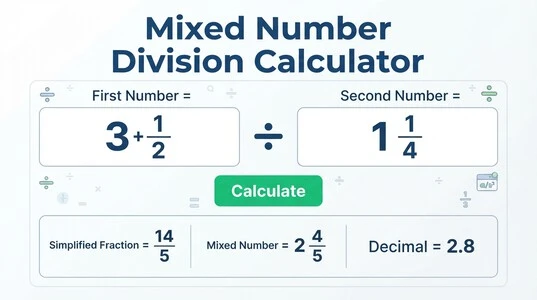
Your Results
After you calculate, the tool should show:
- Simplified fraction
- Mixed number
- Decimal
- Step-by-step solution
The simplified fraction gives the exact result. The mixed number makes the answer easier to read. The decimal gives a quick numerical value. Khan Academy also uses simplified fractions and mixed numbers when practicing mixed-number division.
Step-by-Step Solution
The calculator should show how it reached the answer. It can convert mixed numbers into improper fractions, divide using the reciprocal, and simplify the result.
This makes the tool useful for both quick calculations and learning.
How to Use the Mixed Number Division Calculator
Use the calculator in four simple steps. Enter your numbers, calculate, and check the result.
Enter the First Mixed Number
Enter the whole number, numerator, and denominator in the first set of fields. This number acts as the dividend.
Enter the Second Mixed Number
Enter the second mixed number using its whole number, numerator, and denominator. This number acts as the divisor.
Click Calculate
Select Calculate to solve the problem. The calculator converts, divides, simplifies, and converts the result when needed.
Read the Answer
Check the quotient in several formats. You can view the simplified fraction, mixed number, or decimal answer.
How to Divide Mixed Numbers
To divide mixed numbers, convert them to improper fractions first. Then multiply by the second fraction’s reciprocal and simplify.
Step 1 — Convert Each Mixed Number to an Improper Fraction
Convert each mixed number to an improper fraction before dividing.
Use this formula: (Whole number × Denominator + Numerator) / Denominator
For example: 3 1/2 = (3 × 2 + 1) / 2 = 7/2
The whole number becomes part of the numerator. Keep the original denominator.
Step 2 — Keep the First Fraction
Keep the first improper fraction unchanged. It represents the dividend.
For example: 7/2 ÷ 5/4
Keep 7/2 as it is.
Step 3 — Change Division to Multiplication
Change the division symbol into multiplication.
÷ → ×
So: 7/2 ÷ 5/4 → 7/2 × 5/4
Step 4 — Flip the Second Fraction
Find the reciprocal of the second fraction. Swap its numerator and denominator.
For example: 5/4 → 4/5
Now the problem becomes: 7/2 × 4/5
Only the second fraction is flipped.
Step 5 — Multiply the Fractions
Multiply the numerators together. Then multiply the denominators together.
7/2 × 4/5 = 28/10
You can cross-cancel common factors before multiplying. This can make the calculation easier.
Step 6 — Simplify the Result
Reduce the fraction to its lowest terms.
Find the greatest common factor (GCF) of the numerator and denominator.
For our example: 28/10 = 14/5
The fraction 14/5 is now in simplest form.
Step 7 — Convert the Improper Fraction to a Mixed Number
If the result is an improper fraction, convert it to a mixed number.
Divide the numerator by the denominator: 14 ÷ 5 = 2 remainder 4
So: 14/5 = 2 4/5
Therefore: 3 1/2 ÷ 1 1/4 = 2 4/5
Mixed Number Division Formula
The division formula becomes simple after you convert mixed numbers into fractions.
For two fractions: a/b ÷ c/d
Change division into multiplication and use the reciprocal of the second fraction: a/b × d/c
So the complete formula becomes: a/b ÷ c/d = (a × d)/(b × c)
The second fraction changes because division by a nonzero number equals multiplication by its reciprocal.
Why Do You Flip the Second Fraction?
The reciprocal swaps the numerator and denominator.
For example: 5/4 → 4/5
The first fraction stays unchanged. Only the divisor, or second fraction, becomes its reciprocal. Khan Academy uses this same method when explaining mixed number division.
This works because a number multiplied by its reciprocal equals 1. That relationship lets division become multiplication.
Example
Consider: 3/2 ÷ 5/4
Replace division with multiplication: 3/2 × 4/5
Then multiply: (3 × 4)/(2 × 5) = 12/10
Simplify: 12/10 = 6/5
So: 3/2 ÷ 5/4 = 6/5 = 1 1/5
This formula also explains why the Keep, Change, Flip method works. It describes the mathematical rule behind the shortcut rather than asking you to memorize it.
Mixed Number Division Example
Let’s work through a complete example from start to finish. This method converts both mixed numbers before dividing.
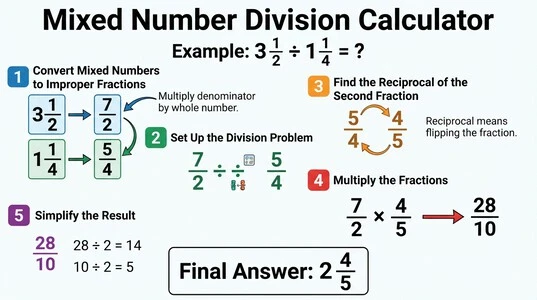
Example: 3 1/2 ÷ 1 1/4
We want to find the quotient of 3 1/2 and 1 1/4.
Step 1: Convert to Improper Fractions
Convert each mixed number separately.
3 1/2 = 7/2
1 1/4 = 5/4
The problem now becomes: 7/2 ÷ 5/4
Step 2: Apply Keep, Change, Flip
Keep the first fraction. Change division to multiplication. Flip the second fraction.
7/2 ÷ 5/4
becomes: 7/2 × 4/5
The second fraction becomes its reciprocal.
Step 3: Multiply the Fractions
Multiply the numerators and denominators.
7/2 × 4/5 = 28/10
Step 4: Simplify the Result
Reduce 28/10 to its lowest terms.
Divide both numbers by their greatest common factor, 2.
28/10 = 14/5
Step 5: Convert to a Mixed Number
Convert 14/5 into a mixed number.
14 ÷ 5 = 2 remainder 4
Therefore: 14/5 = 2 4/5
Final Answer
3 1/2 ÷ 1 1/4 = 2 4/5
You can use the Mixed Number Division Calculator above to verify the result and view the working steps.
Keep Change Flip for Dividing Mixed Numbers
The Keep, Change, Flip method gives you a simple way to divide fractions. First convert mixed numbers into improper fractions.
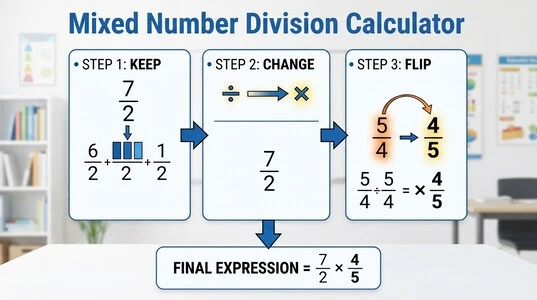
What Does Keep, Change, Flip Mean?
Keep the first fraction unchanged.
Change the division sign to multiplication.
Flip the second fraction to find its reciprocal.
For example: 7/2 ÷ 5/4
becomes: 7/2 × 4/5
This method turns fraction division into fraction multiplication.
Why Do You Flip the Second Fraction?
The second fraction is the divisor. Its reciprocal lets you replace division with multiplication.
For example: 5/4 → 4/5
The numerator becomes the denominator. The denominator becomes the numerator.
The reciprocal has this property: 5/4 × 4/5 = 1
That relationship explains why dividing by a fraction equals multiplying by its reciprocal.
Common Keep Change Flip Mistake
Do not flip the first fraction.
Keep the first fraction exactly as it appears.
Only the second fraction becomes its reciprocal.
For example: 3/2 ÷ 4/5
correctly becomes: 3/2 × 5/4
Not: 2/3 × 5/4
Keeping the first fraction unchanged prevents one of the most common errors in fraction division.
Divide Mixed Numbers Step by Step
Different problems need slightly different setups. The same core method works each time: convert, use the reciprocal, multiply, and simplify.
Mixed Number ÷ Mixed Number
Example: 2 1/4 ÷ 1 1/2
Convert both mixed numbers: 2 1/4 = 9/4 1 1/2 = 3/2
Now divide: 9/4 ÷ 3/2
Use the reciprocal: 9/4 × 2/3
Multiply and simplify: 18/12 = 3/2
Convert the answer: 3/2 = 1 1/2
Answer: 1 1/2
Mixed Number ÷ Whole Number
Example: 3 1/2 ÷ 2
Convert the mixed number: 3 1/2 = 7/2
Write the whole number as a fraction: 2 = 2/1
Now divide: 7/2 ÷ 2/1
Multiply by the reciprocal: 7/2 × 1/2 = 7/4
Convert to a mixed number: 7/4 = 1 3/4
Answer: 1 3/4
A whole number can act as a fraction with a denominator of 1.
Mixed Number ÷ Proper Fraction
Example: 2 1/3 ÷ 3/4
Convert the mixed number: 2 1/3 = 7/3
Now divide: 7/3 ÷ 3/4
Flip the second fraction: 7/3 × 4/3
Multiply: 28/9
Convert to a mixed number: 28/9 = 3 1/9
Answer: 3 1/9
Mixed Number ÷ Improper Fraction
Example: 4 1/2 ÷ 7/3
Convert the mixed number: 4 1/2 = 9/2
Now divide: 9/2 ÷ 7/3
Use the reciprocal of 7/3: 9/2 × 3/7
Multiply: 27/14
Convert to a mixed number: 27/14 = 1 13/14
Answer: 1 13/14
Fraction ÷ Mixed Number
Example: 3/4 ÷ 1 1/2
Convert the mixed number: 1 1/2 = 3/2
Now divide: 3/4 ÷ 3/2
Flip the second fraction: 3/4 × 2/3
Simplify: 6/12 = 1/2
Answer: 1/2
The second fraction always becomes its reciprocal during fraction division.
Whole Number ÷ Mixed Number
Example: 5 ÷ 2 1/2
Convert the mixed number: 2 1/2 = 5/2
Write 5 as 5/1: 5/1 ÷ 5/2
Flip the second fraction: 5/1 × 2/5
Simplify: 10/5 = 2
Answer: 2
These examples cover the most common mixed-number division formats. They also show how the same reciprocal method works across fractions and whole numbers.
Dividing Negative Mixed Numbers
Negative mixed numbers follow the same division steps as positive ones. First, determine the sign of the answer. Then divide the absolute values.
Negative ÷ Positive
A negative number divided by a positive number gives a negative quotient.
Example: −2 1/2 ÷ 1 1/4
Convert the mixed numbers: −2 1/2 = −5/2 1 1/4 = 5/4
Now divide: −5/2 ÷ 5/4
Multiply by the reciprocal: −5/2 × 4/5 = −2
Answer: −2
Positive ÷ Negative
A positive number divided by a negative number also gives a negative quotient.
Example: 2 1/2 ÷ −1 1/4
Convert the mixed numbers: 2 1/2 = 5/2 −1 1/4 = −5/4
Now divide: 5/2 ÷ −5/4
Multiply by the reciprocal: 5/2 × −4/5 = −2
Answer: −2
Negative ÷ Negative
A negative number divided by another negative number gives a positive quotient.
Example: −2 1/2 ÷ −1 1/4
Convert the mixed numbers: −5/2 ÷ −5/4
Multiply by the reciprocal: −5/2 × −4/5 = 2
Answer: 2
Remember the Sign Rules
The signs follow two simple rules:
- Same signs → positive
- Different signs → negative
So:
+ ÷ + = +
− ÷ − = +
+ ÷ − = −
− ÷ + = −
Khan Academy includes dividing mixed numbers with negatives in its Grade 7 rational-number lessons. The key is to handle the sign separately. Then apply the usual mixed-number division steps.
How to Simplify the Answer
After dividing, you may get an improper fraction. Simplify it before converting it to a mixed number.
Find the GCF
The greatest common factor (GCF) is the largest number that divides both values evenly.
For example, the GCF of 28 and 10 is 2.
Divide the numerator and denominator by the GCF: 28/10 = 14/5
This puts the fraction in its lowest terms. A fraction reaches simplest form when its numerator and denominator share no factor besides 1.
Reduce the Numerator and Denominator
Always divide both parts by the same factor.
For example: 18/12 = 3/2
Do not change only the numerator or denominator. That would change the value of the fraction.
Proper vs. Improper Fractions
A proper fraction has a numerator smaller than its denominator.
Example: 3/5
An improper fraction has a numerator equal to or larger than its denominator.
Example: 7/5
After division, your calculator may show an improper fraction first.
Convert an Improper Fraction to a Mixed Number
Divide the numerator by the denominator.
For example: 14/5
Divide: 14 ÷ 5 = 2 remainder 4
So: 14/5 = 2 4/5
The denominator stays the same. The quotient becomes the whole number, and the remainder becomes the numerator.
Cross-Cancellation
You can simplify fractions before multiplying. This method is called cross-cancellation or cross-reduction.
For example: 24/5 × 2/3
The 24 and 3 share a factor of 3.
Reduce them: 24 ÷ 3 = 8 3 ÷ 3 = 1
Now multiply: 8/5 × 2/1 = 16/5
Convert the result: 16/5 = 3 1/5
Cross-cancellation keeps numbers smaller and can make calculations easier. Khan Academy demonstrates this approach when dividing mixed numbers.
Mixed Number Division Calculator Results Explained
The calculator can show the result in several useful formats. Each format serves a different purpose. Current mixed-number calculators commonly provide simplified fractions, mixed numbers, and decimals.
Exact Fraction
The exact fraction keeps the result in fractional form. It avoids rounding and preserves the precise value.
For example: 14/5
This form works well for further calculations. It also makes the exact quotient clear.
Simplified Fraction
The calculator reduces the fraction to its lowest terms.
For example: 28/10 → 14/5
The numerator and denominator share no common factor other than 1. This makes the answer easier to use and verify.
Mixed Number
An improper fraction can become a mixed number when its numerator exceeds its denominator.
For example: 14/5 = 2 4/5
The calculator uses the whole-number part and remainder to create the mixed number.
This format often feels more natural for everyday measurements and quantities.
Decimal
The decimal answer expresses the same value in decimal form.
For example: 14/5 = 2.8
A decimal can help you compare values or use the result in another calculation.
The fraction remains the exact form. The decimal simply provides another way to represent the same quotient. Current calculator tools also present mixed-number results alongside decimal values.
Special Cases and Calculator Errors
Some inputs need special handling. Knowing these cases helps you avoid incorrect results.
What Happens When the Second Number Is Zero?
Division by zero is undefined. A calculator should not return a numerical answer for it.
For example: 5 ÷ 0 = undefined
The same rule applies to mixed numbers. If the second number equals zero, the division cannot continue.
What If the Denominator Is Zero?
A fraction cannot have 0 as its denominator.
For example: 3/0
This expression is undefined because it requires division by zero. A reliable calculator should flag this input instead of producing a misleading result.
What If the Numerator Is Larger Than the Denominator?
A numerator larger than the denominator creates an improper fraction.
For example: 7/4
You can convert it to a mixed number: 7/4 = 1 3/4
Khan Academy defines an improper fraction as one where the numerator is greater than or equal to the denominator. An improper fraction is not an error. It simply uses a different format.
What If the Result Is Negative?
The sign follows the normal division rules.
- Positive ÷ positive = positive
- Negative ÷ negative = positive
- Positive ÷ negative = negative
- Negative ÷ positive = negative
For example: −6/4 ÷ 3/2 = −1
The calculator should keep the negative sign when it simplifies the answer.
What If the Answer Is a Whole Number?
Sometimes the fractional part disappears after simplification.
For example: 5/2 ÷ 5/4
Change division to multiplication: 5/2 × 4/5 = 20/10
Simplify: 20/10 = 2
So the final answer is simply: 2
The calculator does not need to display an unnecessary fractional part. It should show the simplified whole-number result.
Mixed Numbers vs. Improper Fractions
Mixed numbers and improper fractions can represent the same value. The main difference lies in how you write that value.
What Is a Mixed Number?
A mixed number combines a whole number with a proper fraction.
For example: 2 3/4
Here, 2 is the whole number. 3/4 is the fractional part. Mixed numbers make values above one easy to read.
What Is an Improper Fraction?
An improper fraction has a numerator greater than or equal to its denominator. For example: 11/4
This fraction represents the same value as: 2 3/4
Improper fractions often make calculations easier. They work especially well when multiplying or dividing fractions.
How to Convert a Mixed Number to an Improper Fraction
Use three simple steps:
- Multiply the whole number by the denominator.
- Add the numerator to that product.
- Keep the same denominator.
For example: 2 3/4
Multiply: 2 × 4 = 8
Add the numerator: 8 + 3 = 11
Keep the denominator: 11/4
Therefore: 2 3/4 = 11/4
This conversion method also supports mixed-number multiplication and division.
How to Convert an Improper Fraction to a Mixed Number
Divide the numerator by the denominator.
For example: 11/4
Calculate:
11 ÷ 4 = 2 remainder 3
The quotient becomes the whole number. The remainder becomes the numerator. The denominator stays the same.
Therefore: 11/4 = 2 3/4
So, both forms represent the same value: 11/4 = 2 3/4
Khan Academy teaches both conversions as core fraction skills.
Common Mistakes When Dividing Mixed Numbers
Small mistakes can change the entire quotient. Check each step before accepting your answer.
Flipping the Wrong Fraction
Only the second fraction becomes its reciprocal.
For example: 3/4 ÷ 2/5 → 3/4 × 5/2
Do not flip 3/4. The first fraction stays unchanged.
Flipping Both Fractions
Do not flip both fractions.
Incorrect: 3/4 ÷ 2/5 → 4/3 × 5/2
Correct: 3/4 × 5/2
The divisor provides the reciprocal used in the multiplication step.
Forgetting to Convert Mixed Numbers
Convert each mixed number into an improper fraction before dividing.
For example: 2 1/3 → 7/3
Skipping this step can produce an incorrect quotient. Khan Academy uses this conversion when teaching mixed-number division.
Multiplying Before Changing Division
Do not multiply the original fractions immediately.
First change: ÷ → ×
Then flip the second fraction.
For example: 7/3 ÷ 2/5 → 7/3 × 5/2
This order keeps the calculation correct.
Forgetting to Simplify
Always check whether you can reduce the final fraction.
For example: 18/12 → 3/2
A simplified answer uses the lowest terms. Khan Academy lists forgetting to simplify as a common fraction-division mistake.
Using the Wrong Denominator
Keep the denominator during mixed-number conversion.
For example: 3 2/5
becomes: 17/5
Not 17/3.
The denominator remains 5 because it represents the size of each fractional part.
Ignoring Negative Signs
Track the signs throughout the calculation.
Remember:
- Positive ÷ positive = positive
- Negative ÷ negative = positive
- Positive ÷ negative = negative
- Negative ÷ positive = negative
Do not remove a negative sign when converting a mixed number.
Dividing by Zero
Never divide by zero.
For example: 5/2 ÷ 0
has no defined numerical answer. A calculator should flag this input rather than return a misleading result.
Quick Check Before You Finish
Before accepting your answer, ask:
- Did I convert every mixed number?
- Did I keep the first fraction?
- Did I flip only the second fraction?
- Did I multiply the fractions correctly?
- Did I simplify the result?
- Did I check the signs?
- Did I avoid division by zero?
These checks catch many common errors in fraction division.
Mixed Number Division Practice Problems
Practice helps you apply the same steps without relying on the calculator. Khan Academy also provides dedicated mixed-number division practice. Try each problem first. Then check your answer below.
Practice 1
2 1/2 ÷ 1 1/4 = ?
Practice 2
4 2/3 ÷ 1 1/3 = ?
Practice 3
5 1/4 ÷ 2 1/2 = ?
Practice 4
3 3/5 ÷ 1 1/5 = ?
Practice 5
7/8 ÷ 2 1/3 = ?
Answers
Check your work after solving each problem.
- 2 1/2 ÷ 1 1/4 = 2
- 4 2/3 ÷ 1 1/3 = 3 1/2
- 5 1/4 ÷ 2 1/2 = 2 1/10
- 3 3/5 ÷ 1 1/5 = 3
- 7/8 ÷ 2 1/3 = 3/8
Khan Academy’s practice format asks learners to give the quotient in lowest terms. It accepts proper fractions, improper fractions, and mixed numbers.
Frequently Asked Questions
Here are quick answers to common questions about dividing mixed numbers.
What Is a Mixed Number Division Calculator?
A mixed number division calculator divides mixed numbers and shows the quotient. It can also provide simplified fractions, mixed numbers, decimals, and working steps.
How Do You Divide Mixed Numbers?
Convert both mixed numbers into improper fractions. Then multiply the first fraction by the second fraction’s reciprocal. Finally, simplify the result.
How Do You Divide Two Mixed Fractions?
Convert both mixed fractions into improper fractions first. Change division to multiplication and flip the second fraction. Then multiply and simplify.
What Is the Keep Change Flip Method?
Keep, Change, Flip is a shortcut for fraction division:
- Keep the first fraction.
- Change division to multiplication.
- Flip the second fraction.
This method uses the reciprocal of the divisor.
Why Do You Flip the Second Fraction?
You flip the second fraction because division by a fraction equals multiplication by its reciprocal. The reciprocal swaps the numerator and denominator.
Do You Flip the First Fraction When Dividing?
No. Keep the first fraction unchanged. Only the second fraction becomes its reciprocal.
For example: 3/4 ÷ 2/5 = 3/4 × 5/2
Can I Divide a Mixed Number by a Whole Number?
Yes. Convert the mixed number into an improper fraction. Write the whole number as a fraction with a denominator of 1. Then divide normally.
Can I Divide a Mixed Number by a Fraction?
Yes. Convert the mixed number into an improper fraction. Then multiply it by the reciprocal of the fraction.
How Do I Turn a Mixed Number Into an Improper Fraction?
Multiply the whole number by the denominator. Add the numerator to that result. Keep the original denominator.
For example: 2 3/4 = (2 × 4 + 3)/4 = 11/4
How Do I Simplify a Mixed Number Division Answer?
Reduce the numerator and denominator by their greatest common factor. Then convert an improper fraction into a mixed number if needed.
For example: 14/5 = 2 4/5
Can Mixed Number Division Produce a Decimal?
Yes. A calculator can convert the exact fraction into decimal form.
For example: 5/4 = 1.25
The fraction remains the exact representation. The decimal gives another form of the same value.
What Happens If I Divide by Zero?
Division by zero has no defined numerical result. A calculator should flag the input instead of displaying a misleading answer.
Mixed Number Division Calculator vs. Doing It by Hand
Both methods have value. Your choice depends on whether you need speed, practice, or both.
| Method | Best For |
| Calculator | Getting a quick answer and checking your work |
| Manual calculation | Learning and practicing the division process |
| Step-by-step calculator | Learning the method while verifying your answer |
A calculator saves time when you need a quick result. Manual work helps you understand each step. A step-by-step calculator combines both benefits. It gives the answer while showing how the calculation works. Use the calculator as a learning aid, not as a replacement for understanding the math.
Why Use This Mixed Number Division Calculator?
This calculator helps you solve mixed-number division with less manual work. It also shows the steps behind the answer.
Fast Calculations
Enter your numbers and calculate the quotient in seconds. This saves time when checking several problems.
Exact Fraction Results
The calculator can show the answer as a fraction. This keeps the exact mathematical value without decimal rounding.
Simplified Answers
The result can appear in lowest terms. You do not need to reduce the fraction manually.
Mixed-Number Results
If the answer is an improper fraction, the calculator can convert it into a mixed number.
Decimal Results
You can also view the quotient as a decimal. This helps when you need a decimal value for another calculation.
Step-by-Step Working
The calculator can show each calculation step. You can see the conversion, reciprocal, multiplication, and simplification.
Supports Different Fraction Formats
You can work with:
- Mixed numbers
- Proper fractions
- Improper fractions
- Whole numbers
This makes the calculator useful for different division problems.
Helps Check Homework
Solve the problem yourself first. Then use the calculator to verify your answer and review any incorrect steps.
Reduces Calculation Errors
Manual fraction calculations involve several steps. A calculator can help catch mistakes in conversion, multiplication, or simplification.
The best use is simple: solve, check, and understand the result.
Related Fraction Calculators
Need help with another fraction problem? These related calculators can handle common fraction tasks.
Fraction Calculator
Solve fraction problems involving addition, subtraction, multiplication, and division.
Mixed Number Calculator
Calculate with mixed numbers and convert between different fraction forms.
Fraction Addition Calculator
Add two or more fractions and simplify the final result.
Fraction Subtraction Calculator
Subtract fractions and reduce the answer to its simplest form.
Fraction Multiplication Calculator
Multiply fractions, mixed numbers, and other fraction values with ease.
Fraction Division Calculator
Divide fractions using the reciprocal method and simplify the quotient.
Improper Fraction Calculator
Work with improper fractions and convert them into mixed numbers when needed.
Mixed Number to Improper Fraction Calculator
Convert a mixed number into an improper fraction using a simple calculation.
Improper Fraction to Mixed Number Calculator
Convert an improper fraction into a mixed number using the quotient and remainder.
Simplifying Fractions Calculator
Reduce fractions to their lowest terms using common factors.
Together, these tools can form a useful fraction-calculation cluster. Each calculator solves a specific task while supporting the broader topic of fraction mathematics.