Negative Mixed Number Calculator: Calculate Mixed Numbers Step by Step
Use this negative mixed number calculator to add, subtract, multiply, or divide mixed numbers that include negative values. The calculator converts mixed numbers as needed, simplifies the result, and can present the answer as a mixed number, improper fraction, or decimal. A negative mixed number is a mixed number with a negative value, such as −2 1/3. In fraction form, −2 1/3 = −7/3 because the negative sign applies to the entire mixed number. Enter your values and choose the operation to check your calculation quickly and clearly.
Negative Mixed Number Calculator
Add, subtract, multiply, or divide mixed numbers with negative values.
First Mixed Number
Example: −2 1/3
Second Mixed Number
Example: +1 1/6
Step-by-Step Solution
What Is a Negative Mixed Number?
A negative mixed number is a rational number written as a whole number and a proper fraction with a negative sign. For example, −2 1/3 represents a value less than zero and can be converted to the equivalent improper fraction −7/3.
Understanding the Negative Sign
In standard mixed-number notation, the negative sign applies to the entire value, not only the whole-number part:
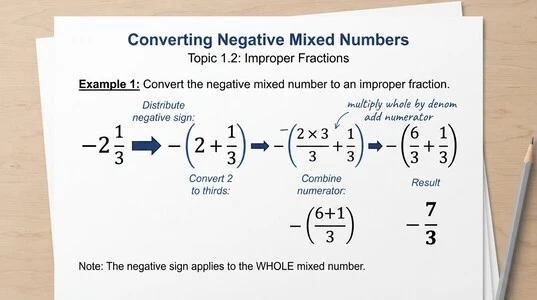
−2 1/3 = −(2 + 1/3) = −7/3
So, −2 1/3 does not mean the same thing as −2 + 1/3. The first equals −7/3, while the second equals −5/3.
Negative Mixed Number vs. Negative Fraction
A mixed number combines a whole number with a fractional part, while an improper fraction has a numerator whose absolute value is greater than or equal to its denominator. Thus, −2 1/3 and −7/3 are equivalent forms of the same rational number. However, −2 + 1/3 is a separate expression with a different value. The numerator and denominator describe the fraction itself, while the whole number and fractional part form the mixed-number representation.
Does the negative sign apply to the whole mixed number? Yes. Under standard notation, it applies to the entire mixed-number value.
How to Use the Negative Mixed Number Calculator
Using the negative mixed number calculator is straightforward. Enter each value in the correct order, select the operation, and review the calculated result.
Enter the Mixed Numbers
For a negative mixed number, enter the sign → whole number → numerator → denominator. For example, −3 2/5 contains a negative sign, whole number 3, numerator 2, and denominator 5. Check that the denominator is not zero before calculating.
Choose an Operation
Select the mathematical operation you need:
- + for addition
- − for subtraction
- × for multiplication
- ÷ for division
Read the Result
After calculating, review the simplified result and its equivalent form shown by the calculator. For example:
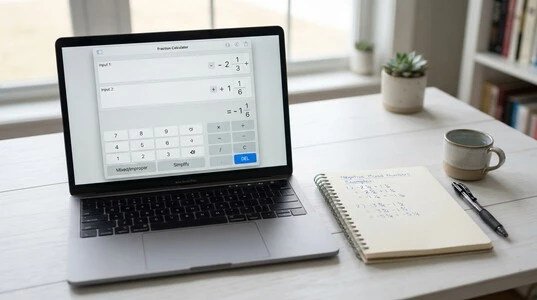
−2 1/3 + 1 1/6 = −1 1/6
This lets you quickly check a negative mixed-number calculation and compare the result with your own work.
How to Convert a Negative Mixed Number to an Improper Fraction
To convert a negative mixed number to an improper fraction, multiply the whole number by the denominator, add the numerator, and place the negative sign before the resulting fraction.
Conversion Formula
For a negative mixed number:
−a b/c = −(a × c + b)/c
The denominator stays the same, while the new numerator is the whole number multiplied by the denominator plus the original numerator. The result is an equivalent improper fraction and can then be reduced to its simplest form when necessary.
Example: Convert −2 1/3
Start with:
−2 1/3
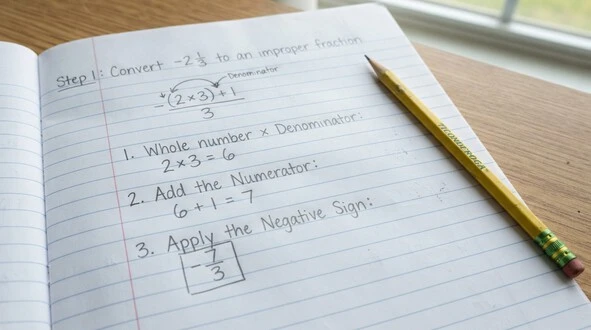
Step 1: Multiply the whole number by the denominator:
2 × 3 = 6
Step 2: Add the numerator:
6 + 1 = 7
Step 3: Keep the denominator and apply the negative sign:
−7/3
Therefore:
−2 1/3 = −7/3
The negative mixed fraction and its improper fraction form have the same value.
How to Calculate Negative Mixed Numbers
The easiest way to calculate negative mixed numbers is to convert them to improper fractions first. Then perform the required operation, simplify the result, and convert it back to a mixed number when appropriate.
Adding Negative Mixed Numbers
To add negative mixed numbers, follow these steps:
- Convert each mixed number to an improper fraction.
- Find a common denominator if needed.
- Add the numerators.
- Simplify the fraction.
- Convert it to a mixed number.
Example:
−2 1/3 + 1 1/6
becomes:
−7/3 + 7/6 = −14/6 + 7/6 = −7/6 = −1 1/6
So, the answer is −1 1/6.
Subtracting Negative Mixed Numbers
When subtracting a negative mixed number, remember that subtracting a negative changes the operation to addition.
Example:
−2 1/3 − (−1 1/2)
Convert to improper fractions:
−7/3 − (−3/2)
Then:
−14/6 + 9/6 = −5/6
The result is −5/6. Parentheses make the negative sign easier to read correctly.
Multiplying Negative Mixed Numbers
Convert both mixed numbers to improper fractions, multiply the numerators and denominators, and simplify. Remember:
Negative × Negative = Positive
Example:
−2 1/4 × −1 1/2
becomes:
−9/4 × −3/2 = 27/8 = 3 3/8
So, the answer is 3 3/8.
Dividing Negative Mixed Numbers
For division, convert the mixed numbers to improper fractions, keep the first fraction, multiply by the reciprocal of the second, and simplify.
Example:
−3 1/2 ÷ −1 3/4
becomes:
−7/2 ÷ −7/4 = −7/2 × −4/7 = 2
Because Negative ÷ Negative = Positive, the final answer is 2.
Negative Mixed Number Examples
These examples show how different operations work with negative mixed numbers. The exact result is shown as an improper fraction when applicable, followed by the equivalent mixed-number form. Each calculation should be checked carefully for sign handling and fraction simplification.
| Problem | Exact Result | Mixed Number |
| −2 1/3 + 1 1/6 | −7/6 | −1 1/6 |
| −3 1/4 − 1 1/2 | −19/4 | −4 3/4 |
| −2 1/4 × 1 1/2 | −27/8 | −3 3/8 |
| −3 1/2 ÷ −1 3/4 | 2 | 2 |
For example, −2 1/3 + 1 1/6 converts to −7/3 + 7/6, which gives −7/6, or −1 1/6. The examples cover addition, subtraction, multiplication, and division, including calculations with both negative and positive mixed numbers.
How to Simplify a Negative Mixed Number
Simplifying a negative mixed number means reducing its fractional part to the simplest form without changing its value. When an improper fraction contains a common factor in its numerator and denominator, divide both by their greatest common factor (GCF).
Simplifying the Improper Fraction
For example:
−14/8 → −7/4 → −1 3/4
Here, 14 and 8 have a greatest common factor of 2, so divide both by 2 to get the reduced fraction −7/4. Converting that improper fraction to a mixed number gives −1 3/4.
These are equivalent fractions and mixed-number representations of the same rational value. Simplification changes how the number is written, not the underlying value. Always check that the final numerator and denominator have no common factors.
Common Mistakes With Negative Mixed Numbers
Working with negative mixed numbers can lead to small sign or fraction errors. Knowing the most common mistakes makes it easier to check your answer.
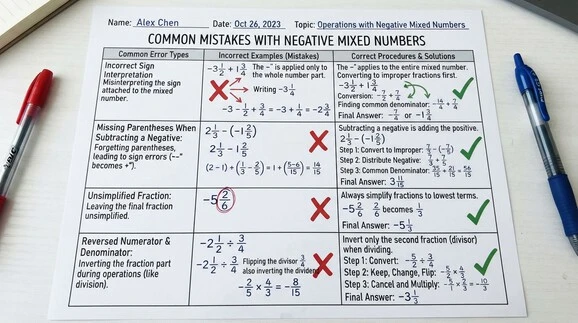
Applying the Negative Sign Only to the Whole Number
In standard notation, −2 1/3 means −(2 + 1/3) = −7/3. It is not the same as −2 + 1/3, which equals −5/3.
Forgetting Parentheses When Subtracting a Negative
Keep the second negative value clear:
−3 − (−2) = −3 + 2 = −1
The two negative signs do not remain a subtraction; subtracting a negative is equivalent to adding its positive value.
Forgetting to Reduce the Answer
Always simplify the final fraction when possible:
−8/4 = −2
A fraction is in simplest form when its numerator and denominator have no common factor other than 1.
Mixing Up the Numerator and Denominator
The numerator is the top number, while the denominator is the bottom number. Reversing them changes the value of the fraction.
Forgetting Sign Rules
For multiplication and division, same signs produce a positive result, while different signs produce a negative result. A negative exponent can be evaluated using our exponents calculator.
Negative Mixed Number vs. Positive Mixed Number
A positive mixed number has a value greater than zero, such as 2 1/3. Its equivalent improper fraction is 7/3. A negative mixed number, such as −2 1/3, has the same magnitude but a negative sign. Its equivalent improper fraction is −7/3. The magnitude describes how large the number is without considering its sign, while the sign shows whether the value is positive or negative. Therefore, 2 1/3 and −2 1/3 have the same magnitude but opposite signs.
Can a Mixed Number Be Negative?
Yes. A mixed number can represent a negative value when a negative sign is placed before the entire mixed number, such as −4 2/5.
Negative Mixed Number Calculator vs. Regular Fraction Calculator
A negative mixed number calculator is designed for entering values in the format people commonly use, with separate fields for the positive or negative sign, whole number, numerator, and denominator. This makes calculations such as −3 2/5 + 1 1/4 easier to enter and check. A regular calculator may require you to first convert each mixed number into an improper fraction before performing the calculation. A dedicated tool simplifies that process by working directly with mixed-number values and reducing the need for manual fraction conversion.
Why Use a Negative Mixed Number Calculator?
A negative mixed number calculator can make fraction calculations faster and easier to check. It handles mixed-number conversion for you, reduces fractions to their simplest form, and helps minimize common sign and arithmetic mistakes. Step-by-step results can help students verify their homework and understand where an answer comes from. When supported by the calculator, a decimal result also provides another way to check the same value. For best results, always review the displayed steps and verify important calculations.
Frequently Asked Questions About Negative Mixed Numbers
What is a negative mixed number?
A negative mixed number combines a negative sign with a whole number and proper fraction, such as −2 1/3. It represents a value less than zero and equals −7/3 as an improper fraction.
What is −2 1/3 as an improper fraction?
−2 1/3 = −7/3. Multiply the whole number by the denominator, add the numerator, and keep the denominator: (2 × 3 + 1)/3 = 7/3, then apply the negative sign.
Can a mixed number be negative?
Yes. A mixed number can represent a negative value when a negative sign precedes the entire number. For example, −4 2/5 is a valid negative mixed number.
How do you add negative mixed numbers?
Convert the mixed numbers to improper fractions, find a common denominator when necessary, add the numerators, simplify the result, and convert it back to a mixed number if appropriate.
How do you subtract negative mixed numbers?
Convert both values to improper fractions and pay close attention to the signs. Subtracting a negative changes to addition, so −3 − (−2) becomes −3 + 2 = −1.
How do you multiply negative mixed numbers?
First convert the mixed numbers to improper fractions, then multiply the numerators and denominators. Remember that negative × negative = positive, while opposite signs produce a negative result.
How do you divide negative mixed numbers?
Convert the mixed numbers to improper fractions, keep the first fraction, and multiply by the reciprocal of the second. Then simplify the result. Negative ÷ negative = positive.
How do you simplify a negative mixed number?
Convert it to an improper fraction when needed, find common factors of the numerator and denominator, and divide by their greatest common factor. Then convert the reduced fraction back to a mixed number.
Is −2 1/3 the same as −7/3?
Yes. −2 1/3 and −7/3 are equivalent representations of the same rational number. The mixed-number form shows a whole number and fraction, while the improper fraction uses a single numerator over a denominator.
Does the calculator show the answer as a mixed number?
The calculator works with mixed-number inputs and provides a simplified result. When a mixed-number representation is applicable, it can be used to interpret the exact fraction result alongside its equivalent form.