Mixed Number Proportion Calculator
This mixed number proportion calculator solves proportions containing mixed numbers, fractions, whole numbers, or decimals and finds the missing value with clear step-by-step working. Enter three known values, leave one value unknown, and get the exact answer, mixed-number form where applicable, decimal approximation, and cross-product verification.
Mixed Number Proportion Calculator
Enter three values in the proportion and leave the value you want to find blank. Get the exact answer, mixed-number form, decimal, and a cross-product check.
Solution
How to Use the Mixed Number Proportion Calculator
A proportion has the form ab=cd\frac{a}{b}=\frac{c}{d}, meaning two ratios are equal. The calculator lets you enter three known terms and leave the fourth term blank. It then solves for the missing value. The denominators must be nonzero.
Enter the three known values
Enter the values you already know into the proportion:
ab=cd\frac{a}{b}=\frac{c}{d}
For example:
1123=x8\frac{1\frac{1}{2}}{3}=\frac{x}{8}
Here, 1121\frac{1}{2}, 3, and 8 are the three known values. Leave the position containing xx blank, and the calculator finds the missing value.
Enter a mixed number correctly
Type a mixed number using a space between the whole number and fraction, such as:
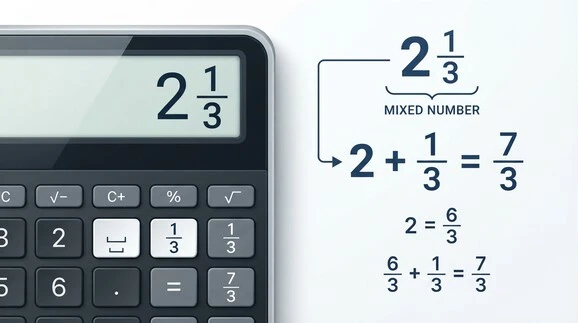
2 1/3
This means:
2+13=732+\frac{1}{3}=\frac{7}{3}
It does not mean 2×132\times\frac{1}{3}. A mixed number combines a whole number with a fraction. When calculations require fraction operations, the mixed number can be converted to an equivalent improper fraction.
You can also enter ordinary fractions such as 3/4, whole numbers such as 5, or decimal values such as 2.5, depending on the calculator’s supported input format.
Choose the missing position
The unknown can appear in any one of the four positions:
- First numerator: xb=cd\frac{x}{b}=\frac{c}{d}
- First denominator: ax=cd\frac{a}{x}=\frac{c}{d}
- Second numerator: ab=xd\frac{a}{b}=\frac{x}{d}
- Second denominator: ab=cx\frac{a}{b}=\frac{c}{x}
Enter the other three terms and leave only the value you want to find blank. This lets you solve different types of missing-term proportion problems without rearranging the equation yourself.
Read the exact answer and verify it
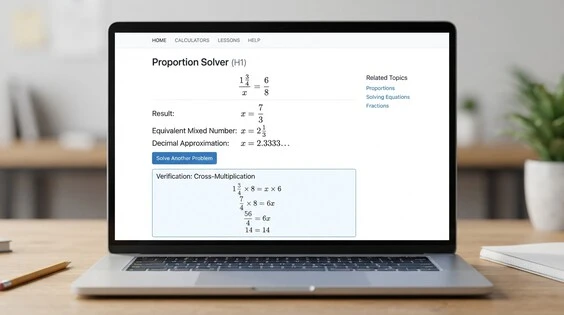
After solving, check the result in three forms when available:
- Exact fraction: keeps the mathematical value precise, such as 73\frac{7}{3}.
- Mixed number: displays an improper fraction in mixed-number form, such as 2132\frac{1}{3}.
- Decimal approximation: shows the value as a decimal, such as 2.3333…2.3333\ldots.
The exact fraction is useful when you need an answer without rounding. The mixed-number form can be easier to read in measurements or everyday quantities, while the decimal form can be convenient for calculations.
The calculator can also verify the result by comparing the two cross products. For a proportion ab=cd\frac{a}{b}=\frac{c}{d}, a correct solution satisfies a×d=b×ca\times d=b\times c.
How to Solve a Proportion With Mixed Numbers
To solve a proportion with mixed numbers, convert the mixed number to an improper fraction, write the proportion in the correct order, cross multiply, solve for the unknown, and check the result. A proportion has the form ab=cd\frac{a}{b}=\frac{c}{d}, where the denominators are not zero.
Convert the mixed number to an improper fraction
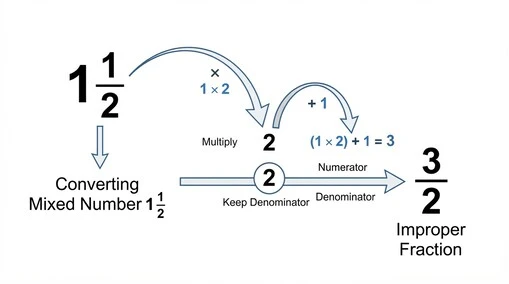
A mixed number contains a whole number and a fraction. To convert it to an improper fraction, multiply the whole number by the denominator, add the numerator, and place the result over the original denominator.
The formula is:
abc=ac+bca\frac{b}{c}=\frac{ac+b}{c}
For example:
112=(1×2)+12=321\frac{1}{2}=\frac{(1\times2)+1}{2}=\frac{3}{2}
So, 1121\frac{1}{2} and 32\frac{3}{2} represent the same value.
Write the proportion
Suppose you need to solve:
1123=x8\frac{1\frac{1}{2}}{3}=\frac{x}{8}
First, convert the mixed number:
3/23=x8\frac{3/2}{3}=\frac{x}{8}
The order of the quantities matters. A proportion compares two equal ratios, so corresponding quantities should stay in the same position on both sides.
Cross multiply
Multiply the numerator of each fraction by the denominator on the opposite side:
32×8=3x\frac{3}{2}\times8=3x
This gives:
12=3×12=3x
Cross multiplication works because the cross products of a true proportion are equal.
Solve and simplify
Now isolate xx by dividing both sides by 3:
12=3×12=3x x=123x=\frac{12}{3} x=4x=4
Therefore, the missing value is 4.
Check the answer
Substitute x=4x=4 into the original proportion:
1123=48\frac{1\frac{1}{2}}{3}=\frac{4}{8}
Convert the mixed number again:
3/23=48\frac{3/2}{3}=\frac{4}{8}
Both sides equal 12\frac{1}{2}, so the proportion is correct.
You can also check using cross products:
32×8=12\frac{3}{2}\times8=12
and
3×4=123\times4=12
Because both cross products equal 12, the solution is verified. This final check makes the calculation transparent rather than relying on a black-box result.
Mixed Number Proportion Formula
The standard proportion formula is:
ab=cd\frac{a}{b}=\frac{c}{d}
It states that two ratios are equal, with b≠0b\neq0 and d≠0d\neq0.
Basic proportion formula
In a proportion, aa and cc are the numerators, while bb and dd are the denominators:
ab=cd\frac{a}{b}=\frac{c}{d}
For mixed-number proportions, convert any mixed numbers to equivalent improper fractions before performing the calculation.
Cross-product rule
For a valid proportion:
ad=bcad=bc
In other words, multiply each numerator by the denominator on the opposite side. If the two cross products are equal, the two ratios are equivalent.
This rule also provides a direct way to solve for an unknown.
Formula for finding the missing term
Depending on where xx appears, use the corresponding formula:
| Missing term | Proportion | Formula |
| First numerator | xb=cd\frac{x}{b}=\frac{c}{d} | x=bcdx=\frac{bc}{d} |
| First denominator | ax=cd\frac{a}{x}=\frac{c}{d} | x=adcx=\frac{ad}{c} |
| Second numerator | ab=xd\frac{a}{b}=\frac{x}{d} | x=adbx=\frac{ad}{b} |
| Second denominator | ab=cx\frac{a}{b}=\frac{c}{x} | x=bcax=\frac{bc}{a} |
These formulas come directly from the cross-product equation ad=bcad=bc. For example, if ab=xd\frac{a}{b}=\frac{x}{d}, cross multiplication gives ad=bxad=bx, so dividing by bb gives x=adbx=\frac{ad}{b}.
When the known values include mixed numbers, first convert them to equivalent fractions, then apply the appropriate formula. Keep the result as an exact fraction when possible and convert it to a mixed number or decimal afterward.
Examples of Proportions With Mixed Numbers
Working through different forms of proportions makes it easier to see how mixed numbers, fractions, and missing terms fit together. In each example, convert mixed numbers to improper fractions before solving.
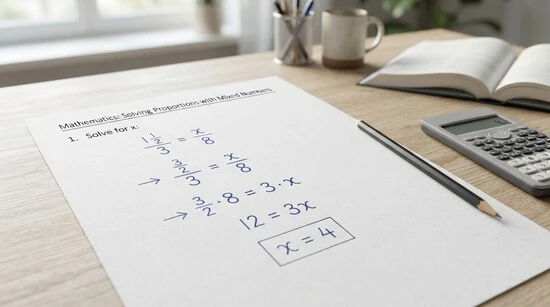
Example 1 — One mixed number
Solve:
1123=x8\frac{1\frac12}{3}=\frac{x}{8}
Step 1: Convert the mixed number.
112=321\frac12=\frac32
So:
3/23=x8\frac{3/2}{3}=\frac{x}{8}
Step 2: Cross multiply.
32×8=3x\frac32\times8=3x 12=3×12=3x
Step 3: Solve for xx.
x=4x=4
Answer:
x=4\boxed{x=4}
Check:
1123=48=12\frac{1\frac12}{3}=\frac48=\frac12
Both sides are equal.
Example 2 — Mixed numbers on both sides
Solve:
112214=x334\frac{1\frac12}{2\frac14}=\frac{x}{3\frac34}
Step 1: Convert both mixed numbers.
112=321\frac12=\frac32
and
214=94,334=1542\frac14=\frac94,\qquad 3\frac34=\frac{15}{4}
The proportion becomes:
3/29/4=x15/4\frac{3/2}{9/4}=\frac{x}{15/4}
Step 2: Simplify the left ratio.
Dividing by a fraction means multiplying by its reciprocal:
32×49=23\frac32\times\frac49=\frac23
So:
23=x15/4\frac23=\frac{x}{15/4}
Step 3: Cross multiply.
2×154=3×2\times\frac{15}{4}=3x 152=3x\frac{15}{2}=3x
Step 4: Solve.
x=156=52x=\frac{15}{6}=\frac52
Convert to a mixed number:
x=212x=2\frac12
Answer:
x=212\boxed{x=2\frac12}
Example 3 — Missing denominator
The unknown does not have to be a numerator. Consider:
34=112x\frac34=\frac{1\frac12}{x}
Step 1: Convert the mixed number.
112=321\frac12=\frac32
So:
34=3/2x\frac34=\frac{3/2}{x}
Step 2: Cross multiply.
3x=4×323x=4\times\frac32 3x=63x=6
Step 3: Solve for xx.
x=2x=2
Answer:
x=2\boxed{x=2}
Check:
34=1122=3/22=34\frac34=\frac{1\frac12}{2}=\frac{3/2}{2}=\frac34
The two ratios are equivalent.
Example 4 — Check whether two ratios form a proportion
Check whether these ratios are proportional:
1123and48\frac{1\frac12}{3} \quad\text{and}\quad \frac48
First convert the mixed number:
112=321\frac12=\frac32
So the ratios are:
3/23and48\frac{3/2}{3} \quad\text{and}\quad \frac48
Use cross products to verify them:
32×8=12\frac32\times8=12
and
3×4=123\times4=12
The cross products are equal:
12=1212=12
Therefore, the two ratios form a valid proportion. This is the same cross-product test used to verify a solved proportion.
Mixed Number vs. Improper Fraction
A mixed number and an improper fraction can represent the same value. The main difference is their notation. Mixed numbers are often convenient for measurements and everyday quantities, while improper fractions are usually easier to use in fraction calculations.
What is a mixed number?
A mixed number combines a whole number with a proper fraction. For example:
213=2+132\frac13=2+\frac13
The whole-number part is 2, and the fractional part is 13\frac13. The space between them indicates that the two parts are being added, not multiplied.
What is an improper fraction?
An improper fraction has a numerator that is greater than or equal to its denominator. The same value can be written as:
213=732\frac13=\frac73
To convert 2132\frac13 to 73\frac73, multiply the whole number by the denominator, add the numerator, and keep the same denominator:
(2×3)+13=73\frac{(2\times3)+1}{3}=\frac73
Both forms represent exactly the same quantity.
Why convert mixed numbers before solving?
Converting mixed numbers to improper fractions makes multiplication, division, and cross multiplication more direct.
For example:
2134\frac{2\frac13}{4}
is easier to work with after conversion:
7/34\frac{7/3}{4}
You can then apply ordinary fraction rules without separately handling the whole-number and fractional parts. This is why algebraic calculations commonly use improper fractions even though mixed-number notation may be easier to read in practical situations.
Are mixed numbers and improper fractions equivalent?
Yes. A mixed number and an improper fraction are equivalent when they represent the same value.
For example:
312=723\frac12=\frac72
Neither form is mathematically “wrong.” They are two ways to write the same number. Use the form that best fits the task: an improper fraction is often convenient during calculations, while a mixed number can be easier to interpret when describing quantities such as measurements, ingredients, or lengths.
When solving a mixed-number proportion, the calculator may convert mixed-number inputs to improper fractions internally, then present the final result as an exact fraction, mixed number, or decimal as appropriate.
Common Mistakes When Solving Mixed Number Proportions
Mixed-number proportions become much easier when you keep the number format, ratio order, and calculation steps consistent. These are some of the most common errors to watch for.
Treating the mixed number as multiplication
A mixed number combines a whole number and a fraction through addition. For example:
314=3+143\frac14=3+\frac14
It does not mean:
3×143\times\frac14
Confusing these two meanings changes the value completely. When entering a mixed number into a calculator, make sure the whole number and fractional part are treated as one mixed number.
Forgetting to convert the mixed number
Before using fraction operations, convert the mixed number to an equivalent improper fraction.
For example:
112=321\frac12=\frac32
The conversion is:
(1×2)+12=32\frac{(1\times2)+1}{2}=\frac32
Once converted, you can use standard multiplication, division, and cross multiplication rules.
Reversing the ratio
The order of a ratio matters. If a proportion compares one quantity with another, keep the corresponding quantities in the same positions.
For example:
23=812\frac{2}{3}=\frac{8}{12}
If you reverse only one side:
23≠128\frac{2}{3}\neq\frac{12}{8}
This mistake is especially common in word problems. If a problem compares miles to hours, for example, keep miles in the numerator and hours in the denominator on both sides unless the problem specifically asks for the inverse ratio.
Rounding too early
Avoid converting fractions to decimals before the calculation is complete. Early rounding can introduce small errors into the final answer.
For example, keep:
73\frac73
as an exact fraction instead of immediately changing it to a rounded decimal such as 2.332.33.
Calculate with the exact fraction first, then convert the final answer to a decimal if needed. This is particularly important when a proportion contains several fractions or mixed numbers.
Using zero as a denominator
A denominator cannot be zero because division by zero is undefined.
For example:
50\frac{5}{0}
has no defined value. Likewise, a proportion such as:
a0=cd\frac{a}{0}=\frac{c}{d}
is not a valid ordinary proportion.
When solving for a missing denominator, check that the resulting value is not zero before treating the proportion as a valid ratio.
Giving the wrong answer format
The same result can often be written in different equivalent forms.
For example:
52=212=2.5\frac52=2\frac12=2.5
These are equal, but the most useful format depends on the situation:
- Exact fraction: useful for further calculations.
- Mixed number: often easier to read as a quantity.
- Decimal: useful when a decimal measurement or comparison is required.
A mixed number proportion calculator should preserve the exact result when possible and allow the answer to be understood in the appropriate form rather than introducing unnecessary rounding.
Mixed Number Proportion Word Problems
Mixed-number proportions also appear in everyday problems involving recipes, measurements, scale drawings, and quantities. The main challenge is often setting up the proportion correctly before solving it. For rate problems, our unit rate calculator finds the amount for a single unit.
Recipe and batch proportions
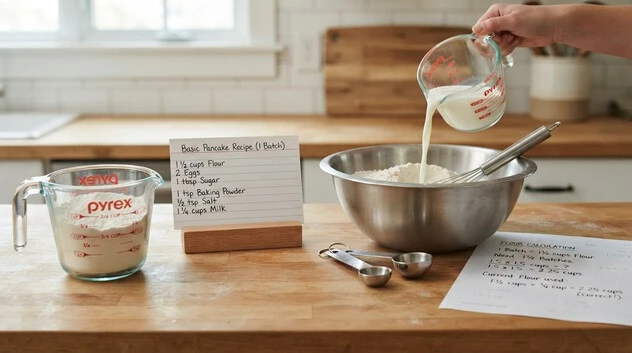
Suppose a recipe uses 34\frac34 cup of an ingredient for one batch. How much of the ingredient is needed for 1121\frac12 batches?
Set up the proportion with corresponding quantities in the same order:
34 cup1 batch=x cups112 batches\frac{\frac34\text{ cup}}{1\text{ batch}} = \frac{x\text{ cups}}{1\frac12\text{ batches}}
Convert the mixed number:
112=321\frac12=\frac32
Now solve:
34=x3/2\frac34=\frac{x}{3/2}
Cross multiply:
34×32=x\frac34\times\frac32=x x=98x=\frac98
Convert the improper fraction to a mixed number:
x=118x=1\frac18
Answer:
118 cups\boxed{1\frac18\text{ cups}}
The key step is converting the mixed number before applying the proportion rules.
Measurement and scale problems
The same method works for proportional measurements. Examples include:
- map distances and actual distances
- lengths in scale drawings
- ingredient quantities
- material needed for different project sizes
- unit rates and production quantities
- time, distance, or quantity comparisons
For example, if a scale drawing shows a certain length for 1121\frac12 meters in real life, a second measurement can be found by setting up a proportion and keeping the corresponding measurements in the same positions.
How to set up the proportion
Before calculating, identify the two quantities being compared and keep their order consistent.
For example, if the first ratio is:
cupsbatches\frac{\text{cups}}{\text{batches}}
the second ratio should also be:
cupsbatches\frac{\text{cups}}{\text{batches}}
Do not switch the order on only one side. A useful rule is:
Put corresponding quantities in the same order on both sides of the proportion.
Once the proportion is set up correctly, convert any mixed numbers to equivalent improper fractions and solve for the missing value.
A calculator can solve the arithmetic, but it cannot always determine which quantities should correspond in a word problem. Setting up the ratio correctly is therefore an important part of solving a mixed-number proportion.
How to Check a Mixed Number Proportion
You can check whether two ratios form a valid proportion by comparing their cross products.
Compare the cross products
For a proportion:
ab=cd\frac{a}{b}=\frac{c}{d}
multiply across the diagonals:
adad
and:
bcbc
If the two products are equal, the ratios are equivalent, provided the denominators are valid and nonzero.
For example:
1123=48\frac{1\frac12}{3}=\frac48
Convert the mixed number:
112=321\frac12=\frac32
Then compare the cross products:
32×8=12\frac32\times8=12
and:
3×4=123\times4=12
Because:
12=1212=12
the two ratios form a valid proportion.
Use the calculator’s verification
If all four values are entered, a mixed number proportion calculator can compare the two cross products and indicate whether the proportion is true or false.
This verification feature is useful when you already have a completed proportion and want to check the result. It also provides a quick way to confirm calculations involving mixed numbers without manually converting and comparing both ratios.
Exact Fraction, Mixed Number, or Decimal?
A proportion can produce the same answer in several formats. The best format depends on whether you need exact calculations, an easy-to-read quantity, or a decimal for practical use.
Exact fraction
An exact fraction keeps the full value without rounding.
For example:
283\frac{28}{3}
This form is useful when the answer will be used in another calculation because no precision is lost.
Mixed-number form
An improper fraction can be converted to a mixed number when the result is easier to read as a whole quantity plus a fraction.
For example:
283=913\frac{28}{3}=9\frac13
The mixed-number form is often useful for measurements, recipes, lengths, and other quantities that naturally contain a whole number and a fractional part.
Decimal form
The same result can also be written as a decimal:
283=9.333…\frac{28}{3}=9.333\ldots
The digits continue indefinitely, so a displayed decimal may need to be rounded, such as:
9.3339.333
The rounded decimal is an approximation, while 283\frac{28}{3} remains exact.
For this reason, a mixed number proportion calculator should preserve the exact fraction during its calculations and clearly distinguish an exact result from a rounded decimal display.
Frequently Asked Questions
What is a mixed number proportion calculator?
A mixed number proportion calculator solves proportions that contain mixed numbers, fractions, or whole numbers. It can find a missing value, show the calculation steps, and return the result as an exact fraction, mixed number, or decimal.
How do you solve a proportion with mixed numbers?
Convert each mixed number to an equivalent improper fraction, set up the proportion, cross multiply, solve for the missing value, and simplify the result. You can then verify the answer by checking that both ratios are equivalent.
Can mixed numbers be used in proportions?
Yes. Mixed numbers can be used in proportions. When solving, they are often converted to equivalent improper fractions so that standard fraction and cross-multiplication rules can be applied.
How do you convert a mixed number to an improper fraction?
Multiply the whole number by the denominator, add the numerator, and place the result over the original denominator. For example:
213=(2×3)+13=732\frac13=\frac{(2\times3)+1}{3}=\frac73
Does 2132\frac13 mean 2×132\times\frac13?
No. A mixed number means addition between the whole number and fraction:
213=2+132\frac13=2+\frac13
It does not mean 2×132\times\frac13.
Can both sides of a proportion contain mixed numbers?
Yes. Both ratios can contain mixed numbers. Convert the mixed numbers to equivalent improper fractions before applying cross multiplication or another proportion-solving method.
Can I solve for a missing denominator?
Yes. A proportion can have its unknown in either a numerator or denominator. The resulting denominator must be nonzero because division by zero is undefined.
Should my answer be a fraction or mixed number?
Use the format requested by the problem. An improper fraction and mixed number can represent the same exact value. For example:
52=212\frac52=2\frac12
A decimal may also represent the value, but it can require rounding.
How do I check if two ratios are proportional?
Compare their cross products. For:
ab=cd\frac ab=\frac cd
calculate adad and bcbc. If the products are equal and the denominators are valid, the two ratios are proportional.
Why does my decimal answer look different?
The decimal may be a rounded representation of an exact fractional value. For example:
283=9.333…\frac{28}{3}=9.333\ldots
The fraction is exact, while a displayed value such as 9.3339.333 is rounded. Keep the fraction when exact precision is important.