
Mixed Number Addition Calculator
Add mixed numbers quickly and get a simplified answer with clear, step-by-step working. Enter two or more mixed numbers, choose Add, and the calculator will show the exact result in mixed-number form. You can also view the equivalent improper fraction and decimal answer.
The calculator is designed for common problems involving like or unlike denominators, fractional regrouping, and multiple addends. Use Show Steps to see how the calculation reaches the final answer, or Reset to start a new problem.
Enter two mixed numbers to get their sum as a simplified mixed number, with the improper-fraction form, decimal value, and step-by-step working.
Results
Steps
How to Use This Calculator
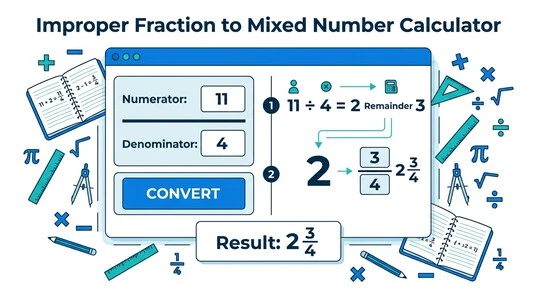
Enter the whole-number and fraction parts of your first mixed number, then enter the second one. Add more rows when you need to calculate three or more mixed numbers. Select Add to calculate the sum, then use Show Steps to see the full working.
What the Calculator Shows
The result explains the calculation rather than showing only a final number. Depending on the problem, it can show the original expression, the common denominator and equivalent fractions, the addition of the whole-number and fraction parts, and any regrouping needed when the fractional sum reaches 1 or more.
The final result is simplified and can be displayed as a mixed number, improper fraction, and decimal equivalent. This makes it easier to check your work and compare different answer formats.
What Is a Mixed Number?
Mixed Number Definition
A mixed number combines a whole number with a proper fraction. For example, 3 2/5 contains 3 as the whole-number part and 2/5 as the proper-fraction part. It represents a value greater than 3 but less than 4.
A mixed number can be converted to an improper fraction without changing its value. To convert 3 2/5, multiply the whole number by the denominator and add the numerator:
(3 × 5 + 2) / 5 = 17/5
Mixed Number vs. Improper Fraction
3 2/5 and 17/5 are two forms of the same number. Mixed numbers are often easier to read in everyday or measurement problems, while improper fractions can make fraction calculations more direct. When adding mixed numbers, either form can be used as long as the calculation is done correctly and the final answer is simplified.
How to Add Mixed Numbers
There are two reliable ways to add mixed numbers. You can add the whole-number and fraction parts separately, or convert the mixed numbers to improper fractions first. Both methods produce the same exact result when used correctly. OpenStax teaches both approaches and notes that mixed-number addition may require simplifying or regrouping the fractional result. (OpenStax)
Method 1 — Add the Whole Numbers and Fractions Separately
For mixed numbers with the same denominator, the process is straightforward:
- Add the whole-number parts.
- Add the fractional parts.
- Simplify the fraction if possible.
- If the fraction is 1 or greater, regroup it as a whole number plus a proper fraction.
- Add that extra whole number to the whole-number total.
For example:
2 3/8 + 1 2/8
Add the whole numbers:
2 + 1 = 3
Add the fractions:
3/8 + 2/8 = 5/8
So the answer is:
3 5/8
When the denominators are different, first convert the fractions to equivalent fractions with a common denominator, then continue with the same process.
Method 2 — Convert Mixed Numbers to Improper Fractions
Another method is to convert each mixed number into an improper fraction before adding.
For example:
3 7/8 + 4 3/8
Convert the first mixed number:
(3 × 8 + 7) / 8 = 31/8
Convert the second:
(4 × 8 + 3) / 8 = 35/8
Now add:
31/8 + 35/8 = 66/8
Convert the result back to a mixed number:
66/8 = 8 2/8 = 8 1/4
So:
3 7/8 + 4 3/8 = 8 1/4
Which Method Should You Use?
Neither method is universally required. Adding the parts separately can be easy to understand, especially when the denominators already match. Converting to improper fractions gives you a systematic process that works well for more complicated fraction calculations.
Your teacher or assignment may require a specific method or answer format, so follow those instructions when applicable. In either method, the final value should be simplified.
Adding Mixed Numbers With Different Denominators
When mixed numbers have unlike denominators, you cannot add the fractional parts directly. First, rewrite the fractions as equivalent fractions with a common denominator. The least common denominator (LCD) is usually the smallest common multiple of the denominators. OpenStax uses this approach when adding mixed numbers with different denominators. (OpenStax)
Find the Least Common Denominator
Start by identifying the denominators of the fractional parts. Find their LCD, then multiply each fraction by the factor needed to reach that denominator. This creates equivalent fractions without changing their values.
For example, with denominators 2 and 3, the LCD is 6:
1/2 → 3/6
2/3 → 4/6
Once the fractions have the same denominator, you can add them normally.
Example With Unlike Denominators
Consider:
2 1/2 + 5 2/3
The LCD of 2 and 3 is 6.
Convert the fractions:
1/2 = 3/6
2/3 = 4/6
Add the whole-number parts:
2 + 5 = 7
Then add the fractions:
3/6 + 4/6 = 7/6 = 1 1/6
The extra whole is regrouped with 7:
7 + 1 1/6 = 8 1/6
So the final answer is:
2 1/2 + 5 2/3 = 8 1/6
Why You Cannot Add the Denominators
Denominators tell you the size of the equal parts in a fraction, so they are not added when finding a sum. For example:
1/2 + 1/3 ≠ 2/5
Instead, convert both fractions to a common denominator:
1/2 = 3/6 and 1/3 = 2/6
Therefore:
3/6 + 2/6 = 5/6
The denominator stays the same after the fractions have been rewritten as equivalent fractions.
Adding Mixed Numbers With Regrouping
Sometimes the fractional parts of two mixed numbers add up to 1 or more. When that happens, the fractional result contains an extra whole number. This process is called regrouping. You move the extra whole number into the whole-number part of the answer and keep the remaining fraction. This is an important step when adding mixed numbers because the final fraction should normally be a proper fraction. (OpenStax)
What Is Regrouping in Mixed Number Addition?
Regrouping occurs when the fraction portion of a sum is an improper fraction. For example, if the fractional parts add to 14/12, that is more than one whole. Instead of leaving the answer as an improper fraction, convert it into a mixed number and carry the extra whole to the whole-number portion.
The key idea is:
Improper fraction → 1 or more whole numbers + remaining fraction
Example of Regrouping
Add:
2 3/4 + 1 2/3
First, add the whole-number parts:
2 + 1 = 3
Now add the fractions. The LCD of 4 and 3 is 12:
3/4 = 9/12
2/3 = 8/12
So:
9/12 + 8/12 = 17/12
Since 17/12 is greater than 1, regroup it:
17/12 = 1 5/12
Now add that extra whole to 3:
3 + 1 5/12 = 4 5/12
Therefore:
2 3/4 + 1 2/3 = 4 5/12
Why 14/12 Becomes 1 1/6
An improper fraction such as 14/12 means there are 14 parts of size 1/12. Twelve of those parts make one whole, leaving 2 parts:
14/12 = 12/12 + 2/12
Since 12/12 = 1 and 2/12 = 1/6:
14/12 = 1 1/6
This is why a mixed-number addition calculator needs to handle regrouping correctly rather than simply displaying an improper fraction as the final mixed-number answer.
How to Add 3 or More Mixed Numbers
Adding three or more mixed numbers follows the same basic process as adding two. Add the whole-number parts, find a common denominator for the fractions, add the fractional parts, and regroup if the fractional sum is 1 or greater.
Adding Multiple Mixed Numbers
For example:
1 1/2 + 2 3/4 + 3 2/3
Add the whole numbers:
1 + 2 + 3 = 6
The LCD of 2, 4, and 3 is 12:
1/2 = 6/12
3/4 = 9/12
2/3 = 8/12
Now add the fractions:
6/12 + 9/12 + 8/12 = 23/12 = 1 11/12
Add the extra whole number to 6:
6 + 1 11/12 = 7 11/12
So the answer is 7 11/12.
Use the Calculator for Multiple Addends
For longer problems, enter each mixed number in its own row and add another row whenever needed. The calculator can process two, three, or more mixed numbers in one calculation, then show the combined result and working steps. This is useful for checking longer homework problems without having to calculate each pair separately.
Mixed Number Addition Examples
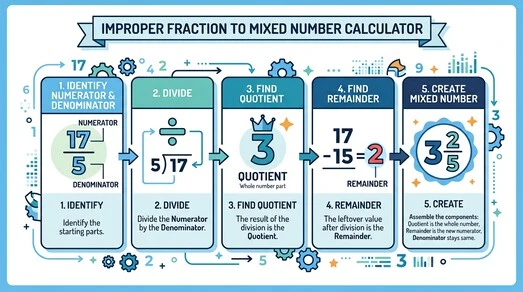
Different mixed-number addition problems can require slightly different steps. These examples show how the final result changes depending on the denominators and the type of numbers being added.
Like Denominators
3 4/9 + 2 2/9 = 5 6/9 = 5 2/3
Because both fractions already have denominator 9, their numerators can be added directly. The resulting fraction is then simplified.
Unlike Denominators
2 1/2 + 5 2/3 = 8 1/6
The fractional parts use different denominators, so they must first be expressed using a common denominator. After addition and simplification, the result is 8 1/6.
Regrouping
9 5/9 + 5 7/9 = 16 1/3
Here, the fractional parts total 12/9, which is more than one whole. That extra whole is added to the whole-number total, leaving 1/3.
Mixed Number + Fraction
2 1/3 + 3/4 = 3 1/12
A mixed number can also be added directly to a proper fraction. The fractional parts are rewritten with a common denominator before the final result is simplified.
Multiple Mixed Numbers
1 1/2 + 2 3/4 + 3 2/3 = 7 11/12
When three or more mixed numbers are added, combine all the whole-number parts and fractional parts systematically. Finding a common denominator across all fractional terms helps avoid calculation errors.
Mixed Number Addition: Common Mistakes
Even when the basic steps seem simple, a small mistake with denominators, regrouping, or conversion can change the entire answer. Knowing the most common errors makes it easier to check your work.
Adding the Denominators
Do not add the denominators when adding fractions. For example:
1/3 + 1/4 ≠ 2/7
First find a common denominator:
1/3 = 4/12
1/4 = 3/12
Therefore:
4/12 + 3/12 = 7/12
Forgetting to Find a Common Denominator
Fractions with different denominators cannot be added directly. Rewrite them as equivalent fractions with the same denominator before adding.
For example:
1/2 + 1/3 → 3/6 + 2/6 = 5/6
Forgetting to Regroup
A fractional part greater than 1 must be regrouped.
5 3/4 + 2 2/4 = 7 5/4
Since 5/4 = 1 1/4, the correct answer is:
8 1/4
Not Simplifying
Always reduce the fractional part when possible:
6 6/8 → 6 3/4
The value stays the same, but 6 3/4 is the simplified form.
Converting a Mixed Number Incorrectly
To convert 3 2/5 to an improper fraction, multiply the whole number by the denominator, add the numerator, and keep the same denominator:
(3 × 5 + 2) / 5 = 17/5
Writing the Wrong Answer Form
A mixed number and an improper fraction can represent the same value. For example:
4 1/4 = 17/4
Use the form required by your assignment or calculator. A reliable calculator should make the relationship clear instead of leaving you to guess which format is correct.
Mixed Number Addition Formula
For two mixed numbers written as:
a b/c + d e/f
the general process is to add the whole-number parts and fractional parts while making the denominators match when necessary. The fractional terms are rewritten as equivalent fractions, then added. Simplify the resulting fraction, and regroup it if it is equal to or greater than 1.
A simple process is:
- Add the whole-number parts.
- Find a common denominator for unlike fractions.
- Add the fractional parts.
- Simplify the fraction.
- Regroup any whole number from the fraction and combine it with the whole-number total.
To convert a mixed number to an improper fraction, use:
a b/c = (a × c + b) / c
For example:
3 2/5 = (3 × 5 + 2)/5 = 17/5
This conversion is useful when you prefer to perform the entire addition using improper fractions.
Mixed Number Addition vs. Fraction Addition
Mixed number addition and proper fraction addition follow the same basic fraction rules, but mixed numbers contain an additional whole-number part. Understanding the difference helps you choose the right calculation steps.
Adding Two Proper Fractions
When adding proper fractions, work with the fractional parts only. If the denominators match, add the numerators and keep the denominator. With different denominators, first create equivalent fractions with a common denominator.
For example:
1/4 + 2/4 = 3/4
Adding Mixed Numbers
Mixed numbers contain both a whole number and a fraction. Add the whole-number parts and fractional parts separately, then simplify and regroup when the fractional result is at least 1.
For example:
2 1/4 + 1 2/4 = 3 3/4
Adding a Mixed Number and a Fraction
A proper fraction can be added to the fractional part of a mixed number after finding a common denominator.
For example:
2 1/3 + 3/4 = 2 + 4/12 + 9/12 = 3 1/12
The same fraction rules apply; the main difference is handling the whole-number part.
How to Check Your Mixed Number Addition Answer
Checking your result can catch errors before you submit your work. A few quick methods can confirm whether your mixed number addition is reasonable.
Convert the Result to a Decimal
Convert the mixed-number answer to a decimal and compare it with the original values. For example, 4 1/4 = 4.25. This gives you a quick numerical check and can reveal an obvious calculation error.
Estimate Before Calculating
Estimate the sum before doing the exact calculation. For example:
2 1/2 + 1 3/4
is:
2.5 + 1.75 = 4.25
So the exact answer should be a little above 4. If your result were 3 1/4, the estimate would immediately show that something went wrong.
Check With Improper Fractions
You can also convert the original mixed numbers into improper fractions and recalculate. If both methods produce the same value, your answer has been independently verified. Estimation and checking whether a fraction result is reasonable are also part of the mathematical reasoning emphasized in fraction standards and instructional materials. (OpenStax)
Frequently Asked Questions About Adding Mixed Numbers
How do you add mixed numbers?
Add the whole-number parts, find a common denominator for the fractions when needed, add the fractional parts, then simplify and regroup if the fraction is 1 or greater.
How do you add mixed numbers with different denominators?
Find the least common denominator (LCD), convert each fraction into an equivalent fraction with that denominator, and then add the whole and fractional parts.
Do you have to convert mixed numbers to improper fractions?
No. Converting to improper fractions is one standard method, but you can also add the whole-number and fractional parts separately.
Can you add mixed numbers without converting them?
Yes. Add the whole numbers and fractions separately. When the denominators differ, first rewrite the fractions with a common denominator.
What happens when the fractional answer is greater than 1?
Convert the improper fraction into a whole number and a proper fraction, then add the extra whole number to the whole-number part of the answer.
Why can’t you add the denominators?
Denominators show how many equal parts make one whole. When adding fractions, the denominators must represent the same-sized parts, so they are not added together.
How do you add three mixed numbers?
Add all the whole-number parts and find a common denominator for all fractional parts. Add the fractions, simplify, and regroup any extra whole numbers.
Should the answer be a mixed number or improper fraction?
Both forms can represent the same value. Use the format requested by your teacher, assignment, or calculator.
How do I add a mixed number and a fraction?
Add the proper fraction to the mixed number’s fractional part after finding a common denominator. Then simplify and regroup if necessary.
Can a mixed number addition calculator show the steps?
A calculator with a Show Steps feature can display the original problem, equivalent fractions, fraction addition, regrouping, simplification, and final result, making it easier to check your work.
About This Mixed Number Addition Calculator
How the Calculator Works
This mixed number addition calculator follows standard fraction arithmetic. It processes the whole-number and fractional parts, finds a common denominator when needed, converts fractions to equivalent values, adds them, and simplifies the result. When the fractional total is 1 or greater, the calculator regroups the extra whole number before displaying the final mixed number. The same result can also be shown as an improper fraction and decimal.
Accuracy and Testing
A reliable calculator should be checked with different types of problems, including like and unlike denominators, reducible fractions, regrouping, multiple addends, whole-number results, and mixed-number results. Edge cases should also be tested according to the calculator’s supported input range and features.
Mathematical Review
For added transparency, any mathematical review should identify the actual reviewer, their qualifications, the review date, and the parts of the calculator or mathematical method they examined. No reviewer information should be displayed unless it has been genuinely verified.
Last Updated / Reviewed
Keep the last updated or mathematically reviewed date current whenever the calculation method, supported inputs, or calculator functionality changes. This helps readers understand when the information and tool were last checked.