Percentage to Mixed Number Calculator
A percentage to mixed number calculator converts a percentage into its equivalent fraction and, when appropriate, a mixed number. Since a percentage means a value out of 100, the first step is to write it as a fraction over 100. The calculator can show the fraction over 100, simplified fraction, mixed number, decimal equivalent, and step-by-step working. For example, 125% becomes 125/100, then 5/4, and finally 1 1/4. Not every percentage needs a mixed-number form: values below 100% usually produce proper fractions, while values above 100% may produce an improper fraction that can be rewritten as a mixed number.
How do you convert a percentage to a mixed number?
To convert a percentage to a mixed number, use x% = x/100. Simplify the resulting fraction to lowest terms. If it is improper, divide the numerator by the denominator to find the whole-number part and remainder, then write the remainder over the original denominator.
Percentage to Mixed Number Calculator
Enter a percentage below to see its equivalent fraction, simplified fraction, mixed number, and decimal value in one place. You can enter a whole percentage such as 125%, a decimal percentage such as 37.5%, or a negative value where supported. The % sign is optional, so entering 125 or 125% produces the same calculation.
Percentage to Mixed Number Calculator
Your Result
The percentage to mixed number calculator presents the answer in this order:
Original percentage: 125%
Fraction over 100: 125/100
Simplified fraction: 5/4
Mixed number: 1 1/4
Decimal: 1.25
It also shows the step-by-step calculation, making it easier to verify how the answer was obtained rather than relying on a single final number.
The calculator calculates each result directly from the value you enter. For decimal percentages, the exact fraction depends on the digits provided. For example, 33.33% is not exactly the same as 1/3, because 33.33% is a rounded value. The mixed-number result is displayed only when the simplified fraction is improper and has a whole-number part; a proper fraction such as 3/4 remains 3/4 rather than being shown as an unnecessary mixed number.
What Does a Percentage-to-Mixed-Number Calculator Do?
A percentage-to-mixed-number calculator converts a percentage into an equivalent fraction and then expresses that fraction as a mixed number when appropriate. It first uses x% = x/100, simplifies the fraction, and converts an improper fraction into a whole number plus a proper fraction.
How to Convert a Percentage to a Mixed Number
Converting a percentage to a mixed number follows a simple four-step process. First, turn the percentage into a fraction by placing it over 100. Next, simplify the fraction. If the simplified fraction is improper, convert it into a mixed number using division. Finally, check the result by converting it back to a decimal or percentage. For example, 125% = 125/100 = 5/4 = 1 1/4.
Step 1 — Write the Percentage Over 100
The word percent means “per hundred.” This means a percentage can be written as a fraction with 100 as the denominator. Remove the percent sign and use the number as the numerator.
For example:
125% = 125/100
This is the starting point for converting a percentage into a fraction and, when necessary, a mixed number.
Step 2 — Simplify the Fraction
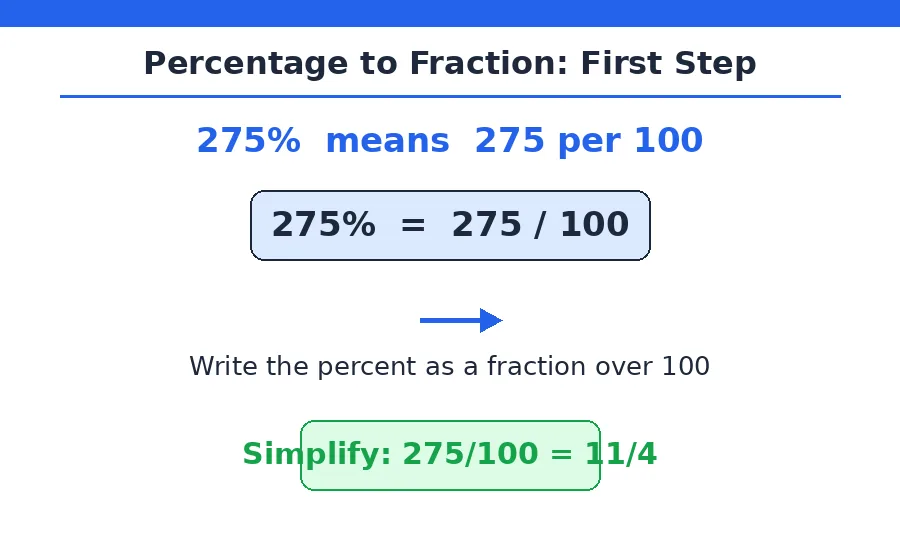
Next, reduce the fraction to its lowest terms. Find the greatest common factor (GCF) or greatest common divisor (GCD) of the numerator and denominator, then divide both by that same number.
For 125/100, the greatest common factor is 25:
125 ÷ 25 = 5
100 ÷ 25 = 4
So:
125/100 = 5/4
The simplified fraction is now easier to convert into a mixed number.
Step 3 — Convert the Improper Fraction to a Mixed Number
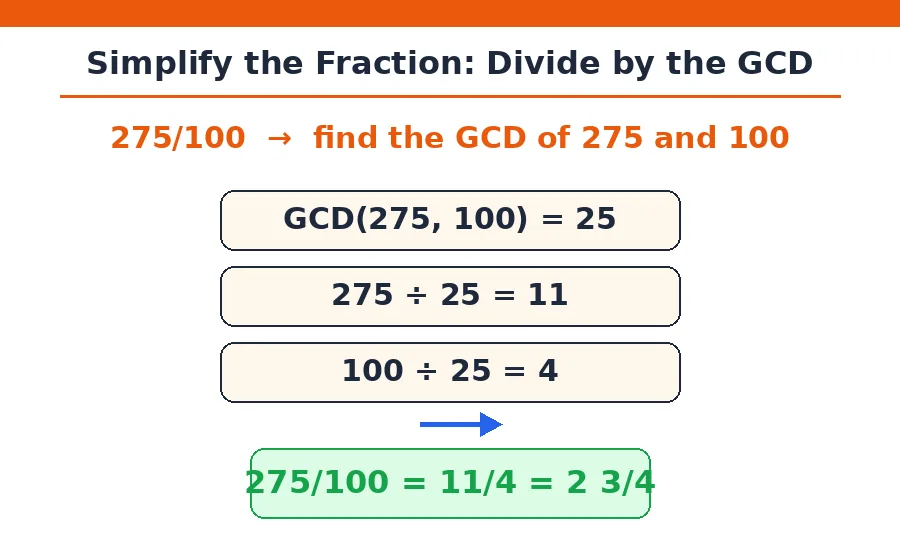
A fraction such as 5/4 is called an improper fraction because the numerator is greater than the denominator. To convert it, divide the numerator by the denominator.
5 ÷ 4 = 1 remainder 1
The quotient, 1, becomes the whole-number part. The remainder, 1, becomes the numerator of the fractional part, while the denominator stays 4.
Therefore:
5/4 = 1 1/4
So the complete conversion is:
125% = 125/100 = 5/4 = 1 1/4
Step 4 — Check the Result
A quick check helps confirm that the conversion is correct. Convert the mixed number to a decimal, then back to a percentage.
1 1/4 = 1.25
Then:
1.25 × 100 = 125%
Because the original percentage and the checked result match, 1 1/4 is the correct mixed-number equivalent of 125%.
When Does a Percentage Become a Mixed Number?
A percentage does not automatically need to be written as a mixed number. The key is whether its simplified fraction contains one or more whole units plus a fractional remainder. Because 100% represents one whole, the size of the percentage determines whether the resulting fraction is proper, improper, or a whole number.
| Percentage | Typical fraction form | Mixed-number implication |
| Less than 100% | Proper fraction | Usually no mixed number is needed |
| Exactly 100% | 1 | Whole number |
| Greater than 100% | Improper fraction or whole number | Mixed number is used when a fractional remainder exists |
For example, 50% = 1/2 and 75% = 3/4, so both are already proper fractions. 100% = 1, which is simply a whole number. Once a percentage exceeds 100%, it can represent more than one whole: 125% = 1 1/4, 150% = 1 1/2, and 225% = 2 1/4. However, 200% = 2, so no fractional part is needed.
The important rule is simple: a percentage can be written as a mixed number when its simplified fraction is improper and has a nonzero remainder after division. This distinction keeps the final answer mathematically natural and prevents proper fractions from being unnecessarily written with a zero whole-number part.
When can a percentage be written as a mixed number?
A percentage can be written as a mixed number when converting it to a simplified fraction produces more than one whole with a fractional remainder. For example, 125% = 125/100 = 5/4 = 1 1/4. Percentages below 100% usually remain proper fractions, while whole-number results such as 200% simply remain whole numbers.
Percentage to Mixed Number Examples
Seeing a few common values worked out makes it easier to recognize how a percentage changes into a fraction and then, when necessary, a mixed number. The examples below also show an important pattern: percentages above 100% can represent one or more complete wholes, while some percentages remain proper fractions or whole numbers.
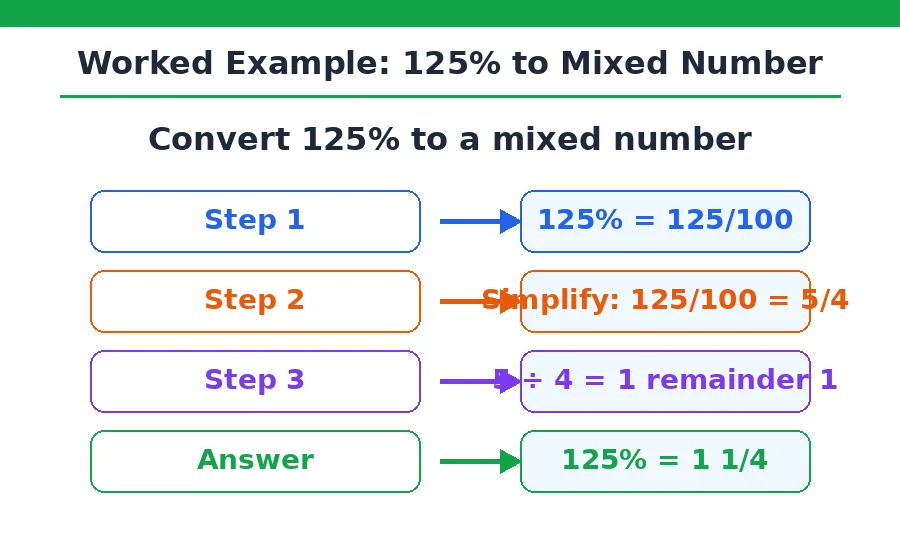
125% as a Mixed Number
Start by writing 125% as a fraction over 100:
125% = 125/100
Reduce the fraction by dividing both numbers by 25:
125/100 = 5/4
Now convert the improper fraction to a mixed number:
5/4 = 1 1/4
Therefore:
125% = 1 1/4
As a decimal, this is 1.25, which confirms that 125% represents one whole plus one-quarter of another.
150% as a Mixed Number
Write the percentage as a fraction:
150% = 150/100
Simplify by dividing the numerator and denominator by 50:
150/100 = 3/2
Convert the improper fraction:
3/2 = 1 1/2
Therefore:
150% = 1 1/2
The decimal equivalent is 1.5, so 150% represents one and a half wholes.
175% as a Mixed Number
Convert the percentage to a fraction first:
175% = 175/100
Divide both terms by 25:
175/100 = 7/4
Then convert the improper fraction:
7/4 = 1 3/4
Therefore:
175% = 1 3/4
Its decimal form is 1.75, providing another quick way to check the result.
225% as a Mixed Number
Start with:
225% = 225/100
Simplify by dividing by 25:
225/100 = 9/4
Now divide 9 by 4:
9 ÷ 4 = 2 remainder 1
So:
9/4 = 2 1/4
Therefore:
225% = 2 1/4
This means 225% is two complete wholes and one-quarter of another.
75%, 100%, and 200%: Boundary Cases
These three examples show why not every percentage should be written as a mixed number.
75% = 75/100 = 3/4
Because 3/4 is a proper fraction, there is no whole-number part.
100% = 100/100 = 1
Exactly 100% represents one whole, so the result is simply 1.
200% = 200/100 = 2
Here the fraction simplifies to a whole number. There is no remainder, so a mixed-number form is unnecessary.
Together, these examples give a useful rule:
75% → proper fraction
100% → whole number
125% → mixed number
150% → mixed number
175% → mixed number
200% → whole number
225% → mixed number
This pattern is useful when checking a percentage-to-mixed-number calculator because the displayed result should match the mathematical form that best represents the value.
How Decimal Percentages Convert to Fractions and Mixed Numbers
A percentage does not have to be a whole number. Values such as 12.5%, 37.5%, and 25.4% can also be converted into exact fractions. The same basic rule applies: write the percentage over 100, remove the decimal by multiplying the numerator and denominator by the appropriate power of 10, and then simplify the fraction.
Terminating Decimal Percentages
For a decimal percentage, the number of decimal places determines how to clear the decimal before reducing the fraction.
For example:
12.5% = 12.5/100
Because 12.5 has one decimal place, multiply both numerator and denominator by 10:
125/1000 = 1/8
So:
12.5% = 1/8
Another example is:
37.5% = 37.5/100
Multiply both parts by 10:
375/1000 = 3/8
Therefore:
37.5% = 3/8
For 25.4%, the same approach gives:
25.4% = 25.4/100 = 254/1000
Now simplify by dividing both numbers by 2:
254/1000 = 127/500
Therefore:
25.4% = 127/500
These examples produce proper fractions because each percentage is below 100%. A decimal percentage greater than 100% can instead produce an improper fraction and, if there is a remainder, a mixed number.
Very Small Percentages
Very small percentages can look confusing because they represent much less than one whole. However, the conversion rule does not change.
For example:
0.5% = 0.5/100
Multiply the numerator and denominator by 10:
5/1000 = 1/200
So:
0.5% = 1/200
For 0.07%:
0.07% = 0.07/100
There are two decimal places, so multiply by 100:
7/10000
This fraction is already in its simplest form:
0.07% = 7/10000
Because these percentages are far below 100%, their equivalent fractions are proper fractions rather than mixed numbers.
How do you convert a decimal percentage into a fraction?
To convert a decimal percentage into a fraction, write it over 100, multiply the numerator and denominator by 10, 100, or another power of 10 to remove the decimal, and simplify. For example, 12.5% = 12.5/100 = 125/1000 = 1/8.
Is 33.33% the Same as 1/3?
Not exactly. Although 33.33% is often used as a rounded form of one-third, the two values are not mathematically identical. The difference comes from rounding a repeating decimal. Understanding this distinction is important when using a percentage to mixed number calculator, because an exact calculator should preserve the value you actually enter rather than silently changing a rounded percentage into a different fraction.
33.33% as a Fraction
Start by writing the percentage over 100:
33.33% = 33.33/100
Remove the decimal by multiplying the numerator and denominator by 100:
33.33/100 = 3333/10000
So the exact fraction represented by the entered value is:
33.33% = 3333/10000
This fraction does not simplify to 1/3. The value 33.33% is an approximation of one-third, not its exact percentage representation.
33.333…% as a Fraction
A repeating percentage is different:
33.333…% = 33 1/3%
One-third written as a decimal is 0.333…. Multiplying it by 100 gives:
1/3 × 100% = 33 1/3% = 33.333…%
Therefore:
33.333…% = 1/3
The repeating digits continue indefinitely, so there is no rounding involved. Educational resources such as Khan Academy commonly describe percentages as values expressed “per hundred,” which is the basis for this conversion.
Why 33.33% Can Be Confusing
The rounded value 33.33% is extremely close to one-third, so they may appear interchangeable in everyday calculations. However, a small difference remains:
33.33% = 0.3333
while:
1/3 = 0.333333…
That difference can matter when you need an exact fraction or when several calculations depend on the original value. A trustworthy percentage-to-fraction or percent to mixed number calculator should therefore distinguish between a value that was entered exactly and one that represents a rounded approximation.
Is 33.33% equal to 1/3?
Not exactly. 33.33% = 3333/10000, while 33.333…% = 1/3 and 33 1/3% = 1/3. The key difference is rounding: 33.33% stops after two decimal places, whereas 33.333…% repeats indefinitely. Therefore, treating 33.33% as exactly 1/3 introduces a small rounding error.
Can Percentages Be Greater Than 100%?
Yes. A percentage can be greater than 100% when the value being described is larger than the reference amount. Since 100% represents one complete whole, a percentage above 100% represents more than one whole. For example, 125% means 1.25 times the reference amount, while 200% means exactly twice the reference amount.
This is why percentages greater than 100% can produce improper fractions and, when there is a remainder, mixed numbers.
Examples of Percentages Greater Than 100%
For 125%:
125% = 125/100 = 5/4 = 1 1/4
So, 125% represents one whole and one-quarter of another.
For 250%:
250% = 250/100 = 5/2 = 2 1/2
This represents two whole units plus one-half of another.
By comparison:
200% = 200/100 = 2
There is no remainder, so the result is a whole number rather than a mixed number.
Why can a percentage be greater than 100%?
A percentage can be greater than 100% because 100% represents one whole reference amount. Any value above that amount exceeds 100%. For example, 125% = 1.25, and 200% = 2, meaning the values are 1.25 times and 2 times the reference amount, respectively.
What About Negative Percentages?
Negative percentages follow the same conversion rule as positive percentages. The negative sign stays with the value throughout the calculation; it does not change how the percentage is converted into a fraction.
For example:
−25% = −25/100
Simplify by dividing the numerator and denominator by 25:
−25/100 = −1/4
Therefore:
−25% = −1/4
The same approach works for other negative values. Convert the percentage to a fraction over 100, simplify it, and keep the negative sign with the final result.
Can You Convert a Mixed Percentage Such as 12 1/2%?
Yes. A mixed percentage such as 12 1/2% can be converted to a fraction using the same basic percentage rule. The most important point is that the % sign applies to the entire mixed percentage, not just the fractional part.
Converting 12 1/2% to a Fraction
First, change the mixed percentage into a decimal or improper fraction:
12 1/2% = 12.5%
Now write the percentage over 100:
12.5/100
Clear the decimal by multiplying both numerator and denominator by 10:
125/1000
Simplify:
125/1000 = 1/8
Therefore:
12 1/2% = 1/8
Converting 110 1/2% to a Mixed Number
A larger mixed percentage follows the same process. First convert the percentage to a decimal:
110 1/2% = 110.5%
Write it over 100:
110.5/100
Clear the decimal:
1105/1000
Simplify by dividing by 5:
1105/1000 = 221/200
Because 221/200 is an improper fraction, convert it to a mixed number:
221 ÷ 200 = 1 remainder 21
So:
221/200 = 1 21/200
Therefore:
110 1/2% = 1 21/200
The key is to treat the complete mixed percentage as one value before applying the percentage-to-fraction conversion. This prevents the common mistake of applying the percent sign only to the whole-number or fractional part.
Percentage, Fraction, Decimal, and Mixed Number Explained
Percentages, fractions, decimals, and mixed numbers are different ways of representing the same mathematical value. Knowing how they relate makes percentage conversions much easier. For example, 125%, 5/4, 1 1/4, and 1.25 all represent the same quantity, just in different forms.
Percentage
A percentage expresses a value in terms of 100. The percent sign (%) means “per hundred,” so a percentage can always be written as a fraction with 100 as its denominator.
For example:
125% = 125/100
This form provides the starting point for converting a percentage into a simplified fraction or mixed number.
Fraction
A fraction represents part of a whole using two numbers. The top number is the numerator, and the bottom number is the denominator. The numerator tells you how many parts are being considered, while the denominator tells you how many equal parts make up one whole.
For example:
5/4
means five parts when the whole is divided into four equal parts. Because the numerator is larger than the denominator, this is an improper fraction.
Improper Fraction
An improper fraction has a numerator that is greater than or equal to its denominator. It represents one whole or more.
For example:
5/4
can be divided into one whole with one part remaining, so it becomes:
1 1/4
An improper fraction does not automatically need to be rewritten as a mixed number. If it simplifies to a whole number, such as 200/100 = 2, the whole number is the most natural final form.
Mixed Number
A mixed number combines a whole number with a proper fraction. It is useful for expressing an improper fraction as complete wholes plus a remaining part.
For example:
1 1/4
contains:
- 1 as the whole-number part
- 1/4 as the fractional part
The mixed number 1 1/4 has the same value as 5/4 and 125%.
Decimal
A decimal represents a value using a decimal point instead of a fraction bar. Decimals provide another convenient way to move between percentages and fractions.
For example:
125% = 1.25
To convert a decimal to a percentage, multiply by 100:
1.25 × 100 = 125%
To convert a percentage to a decimal, divide by 100:
125% ÷ 100 = 1.25
How These Forms Connect
The same value can move between representations without changing its mathematical meaning:
| Form | Example |
| Percentage | 125% |
| Fraction | 5/4 |
| Mixed number | 1 1/4 |
| Decimal | 1.25 |
Understanding these relationships helps you check a percentage to mixed number calculator result from more than one direction. For example, 1 1/4 = 5/4 = 1.25 = 125%, so all four forms describe exactly the same value.
Common Mistakes When Converting Percentages to Mixed Numbers
Converting a percentage is straightforward once you understand the relationship between a percentage and a fraction, but a few common errors can change the result. Knowing what to watch for makes it easier to check your answer and use a percentage to mixed number calculator correctly.
Forgetting to Divide by 100
A percentage means “per hundred,” so the number must first be written over 100. A common mistake is to remove the percent sign and treat the number itself as the final value.
For example, this is incorrect:
125% = 125
The correct conversion is:
125% = 125/100
Only after writing the percentage as a fraction can you simplify or convert it to a mixed number.
Not Simplifying the Fraction
The fraction obtained directly from a percentage is not always in its simplest form. Leaving it unsimplified can make the answer harder to read and may prevent you from recognizing the correct mixed-number form.
For example:
125/100
Both numbers are divisible by 25:
125/100 = 5/4
So the simplified fraction is 5/4, which can then be converted to:
1 1/4
Always reduce the fraction to its lowest terms before presenting the final result.
Treating 33.33% as Exactly 1/3
One of the most important precision mistakes is assuming that 33.33% and 1/3 are exactly equal.
In fact:
33.33% = 3333/10000
while:
33.333…% = 1/3
The first value is rounded to two decimal places, while the second continues indefinitely. A calculator that receives 33.33% should preserve the value entered rather than silently replacing it with the nearby value 1/3.
Turning Every Fraction Into a Mixed Number
A mixed number is not required for every result. If the simplified fraction is already proper, it should normally remain in fraction form.
For example:
75% = 75/100 = 3/4
It is unnecessary to write this as:
0 3/4
The standard and clearer answer is simply 3/4.
Similarly, a result such as 100% = 1 should remain a whole number rather than being forced into a mixed-number format.
Losing the Remainder
When an improper fraction is converted to a mixed number, the division remainder becomes the numerator of the fractional part.
For example:
7/4
Divide:
7 ÷ 4 = 1 remainder 3
The quotient gives the whole-number part, 1, and the remainder gives the new numerator, 3. The denominator stays 4:
7/4 = 1 3/4
A common error is to ignore the remainder or use the quotient as the fractional numerator. Keeping these two parts separate prevents that mistake.
What are common mistakes when converting a percentage to a fraction?
The most common mistakes are forgetting that a percentage must be written over 100, failing to simplify the resulting fraction, confusing a rounded value such as 33.33% with the exact value 1/3, forcing proper fractions into mixed-number form, and losing the remainder when converting an improper fraction.
Percentage to Mixed Number Conversion Formula
The basic formula for converting a percentage to a fraction is:
x% = x/100
After writing the percentage over 100, simplify the fraction to its lowest terms. If the simplified fraction is improper, convert it into a mixed number.
The complete process is:
Percentage → Fraction over 100 → Simplified fraction → Mixed number, if applicable
For example:
125% = 125/100 = 5/4 = 1 1/4
Using Quotient and Remainder
To convert an improper fraction a/b into a mixed number, divide the numerator by the denominator.
a ÷ b = quotient with a remainder
The:
- quotient becomes the whole-number part,
- remainder becomes the numerator of the fractional part,
- denominator stays the same.
For example:
7/4
Since:
7 ÷ 4 = 1 remainder 3
the mixed-number form is:
7/4 = 1 3/4
This formula works consistently for percentages greater than 100% that produce an improper fraction with a nonzero remainder.
Percentage to Mixed Number Conversion Table
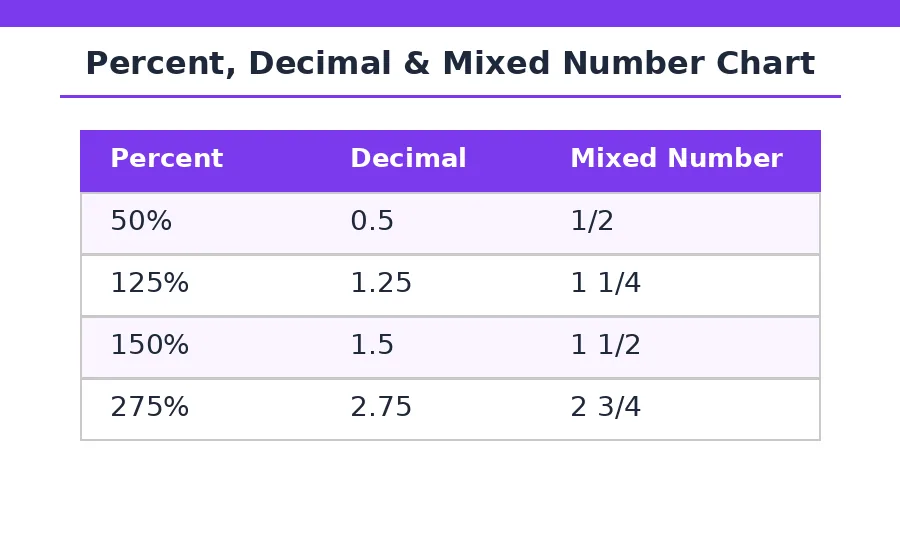
Use the table below as a quick reference for common percentage-to-fraction conversions. It also shows when a mixed number is actually needed. Percentages below 100% usually simplify to proper fractions, 100% becomes a whole number, and percentages above 100% become mixed numbers only when a fractional remainder remains after simplification.
| Percentage | Fraction | Mixed Number | Decimal |
| 25% | 1/4 | — | 0.25 |
| 50% | 1/2 | — | 0.5 |
| 75% | 3/4 | — | 0.75 |
| 100% | 1 | — | 1 |
| 125% | 5/4 | 1 1/4 | 1.25 |
| 150% | 3/2 | 1 1/2 | 1.5 |
| 175% | 7/4 | 1 3/4 | 1.75 |
| 200% | 2 | — | 2 |
| 225% | 9/4 | 2 1/4 | 2.25 |
The dash (—) means that a mixed number is unnecessary because the simplified result is already a proper fraction or a whole number. For example, 75% = 3/4, while 200% = 2. In contrast, 225% = 9/4 = 2 1/4 because the improper fraction contains two complete wholes and a remaining quarter.
Why Trust This Percentage to Mixed Number Calculator?
A useful percentage to mixed number calculator should do more than display a final answer. It should use a transparent mathematical process, preserve the value entered by the user, and make the result easy to verify. The conversion method is based on the standard relationship between percentages and fractions: a percentage represents a quantity out of 100.
How the Calculation Works
The percentage to mixed number calculator follows these mathematical steps:
- Interpret the percentage as per hundred.
An input of 125% becomes 125/100. - Create the fraction.
The percentage value becomes the numerator, while 100 becomes the denominator. - Clear decimals when necessary.
For an input such as 12.5%, the decimal is removed by multiplying the numerator and denominator by the appropriate power of 10. - Reduce the fraction.
Common factors are divided out until the fraction reaches its simplest form. For example, 125/100 = 5/4. This follows the standard fraction-simplification process used in mathematical instruction. - Convert an improper fraction when appropriate.
If the simplified fraction is improper, division gives the whole-number part and remainder. For example, 5/4 = 1 1/4. - Preserve the entered value.
The calculator should not silently replace an exact input with a nearby rounded value. This is especially important for decimal percentages such as 33.33%, which is not exactly equal to 1/3.
This step-by-step approach makes the calculation transparent rather than treating the result as a number produced by a black box.
Accuracy and Exactness
Accuracy depends not only on the arithmetic but also on how the calculator interprets the input. An exact percentage should produce its corresponding exact fraction whenever that fraction can be represented mathematically. A rounded percentage should remain a rounded input.
For example:
33.33% = 3333/10000
while:
33.333…% = 1/3
These values are close, but they are not identical. Keeping that distinction prevents the calculator from introducing an unintended approximation.
The same principle applies to mixed numbers. A proper fraction such as 3/4 should remain 3/4, while an improper fraction such as 7/4 can be displayed as 1 3/4. A whole-number result such as 200% = 2 should remain 2 rather than being forced into an unnecessary mixed-number format.
Methodology and Review
Trustworthy calculator pages should make their methodology easy to inspect. This page should clearly identify the author or responsible publisher, mathematical reviewer when applicable, last reviewed or updated date, calculation methodology, and a way to report a suspected error. These details help readers understand who is responsible for the information instead of relying on anonymous or unverifiable claims.
The content should also be reviewed against known mathematical examples and checked whenever the calculator’s calculation logic changes. Google recommends helpful, reliable, people-first content that provides substantial value and avoids merely summarizing information found elsewhere.
For Google AI features, there is no separate “AI Overview” optimization requirement; Google states that the same foundational SEO and technical practices apply, including making important content available in text and providing helpful, reliable information.
Any privacy statement should also match the calculator’s actual technical behavior. For example, a claim that calculations run entirely in the browser or that entered values are never stored should be made only when the implementation genuinely works that way.
Frequently Asked Questions
1. How do you convert a percentage to a mixed number?
Write the percentage as a fraction over 100, simplify it, and convert the resulting improper fraction into a mixed number. For example, 125% = 125/100 = 5/4 = 1 1/4. If the simplified result is already a proper fraction or a whole number, there is no need to express it as a mixed number.
2. What is 125% as a mixed number?
125% = 1 1/4. As a fraction, 125% is 125/100, which simplifies to 5/4. Dividing 5 by 4 gives 1 with a remainder of 1, so the mixed-number form is 1 1/4. Its decimal equivalent is 1.25, confirming that 125% represents one whole and one-quarter of another.
3. What is 150% as a mixed number?
150% = 1 1/2. The percentage becomes 150/100, which simplifies to 3/2. Since 3 divided by 2 equals 1 remainder 1, the improper fraction converts to 1 1/2. In decimal form, the same value is 1.5, meaning 150% is one and a half times the reference amount.
4. What is 175% as a mixed number?
175% = 1 3/4. Convert the percentage to 175/100 and simplify it to 7/4. Then divide 7 by 4 to get 1 with a remainder of 3. The result is therefore 1 3/4. As a decimal, 175% is 1.75, which provides a simple way to verify the conversion.
5. What is 225% as a mixed number?
225% = 2 1/4. First, write it as 225/100 and simplify to 9/4. Dividing 9 by 4 gives 2 with a remainder of 1, producing 2 1/4. The decimal equivalent is 2.25, so 225% represents two complete wholes plus one-quarter of another.
6. Is 100% a mixed number?
No. 100% = 1, which is a whole number rather than a mixed number. A mixed number contains a whole-number part and a proper fractional part. Because 100% represents exactly one complete whole with no fractional remainder, the simplest and clearest answer is simply 1.
7. Can a percentage be greater than 100%?
Yes. A percentage can exceed 100% when a value is greater than the reference amount. For example, 125% = 1 1/4, while 200% = 2. In other words, 125% represents 1.25 times the reference amount and 200% represents twice the reference amount. Percentages above 100% are mathematically valid.
8. Is 33.33% equal to 1/3?
Not exactly. 33.33% = 3333/10000, whereas 1/3 = 33.333…%. The difference comes from rounding: 33.33% stops after two decimal places, while 33.333…% continues indefinitely. For an exact conversion, a calculator should preserve 33.33% as the value entered rather than automatically treating it as exactly one-third.
9. How do you convert a decimal percentage to a fraction?
A decimal percentage is first treated as a fraction over 100, then the decimal is removed and the fraction is simplified. For example, 12.5% = 12.5/100 = 125/1000 = 1/8. The same approach works for other terminating decimal percentages, although the number of decimal places determines how much you need to multiply to remove the decimal.
10. Can negative percentages be converted to fractions?
Yes. A negative percentage follows the same conversion process as a positive percentage, and the negative sign remains with the result. For example, −25% = −25/100 = −1/4. The sign does not change the fraction’s denominator or the simplification process; it simply indicates that the value is negative.
11. Can I convert a mixed percentage such as 12 1/2%?
Yes. A mixed percentage can be converted by treating the complete mixed value as the percentage. For example, 12 1/2% = 12.5% = 12.5/100 = 1/8. The percent sign applies to the entire value 12 1/2, not only to the fractional part. The same principle works for larger values such as 110 1/2%.
12. What is the difference between an improper fraction and a mixed number?
An improper fraction has a numerator greater than or equal to its denominator, such as 7/4. A mixed number expresses the same value as a whole number plus a proper fraction, such as 1 3/4. The two forms are equivalent; the mixed number simply makes the whole units and remaining fractional part more explicit.