Improper Fraction to Mixed Number Calculator with Steps
Our Improper Fraction to Mixed Number Calculator helps you convert an improper fraction into a mixed number within seconds. Enter the numerator and denominator to get instant results. The fraction calculator also provides a clear calculator with steps for every answer. This makes each conversion easy to understand and verify.
Whether you are a student, teacher, or parent, this free calculator saves time and improves accuracy. It explains each step, so you can learn while solving problems. Every result follows standard arithmetic rules taught in schools. The conversion keeps the denominator unchanged and uses the remainder to form the fractional part. Trusted educational resources, including the National Council of Teachers of Mathematics and Khan Academy, teach the same method. Use this tool to convert improper fraction values quickly and confidently.
Use the Improper Fraction to Mixed Number Calculator
Use our Improper Fraction to Mixed Number Calculator to solve fraction problems quickly and accurately. Enter the numerator and denominator into the input fields. Then click the Convert button to generate your answer instantly.
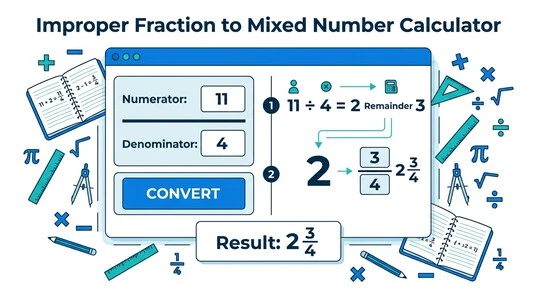
The calculator displays the mixed number in its correct form. It also provides a clear step-by-step solution. You can follow each division step to understand how the answer was calculated. If the remaining fraction can be reduced, the calculator automatically shows the simplified fraction in its lowest terms. Use the Reset button to clear the inputs and start a new calculation. This free tool works well for homework, classroom activities, exam preparation, and daily math practice. It delivers fast, accurate results while helping you learn the conversion process with confidence.
Definition of Improper Fraction
An improper fraction is a fraction where the numerator is greater than or equal to the denominator. It represents a value of one or more whole numbers. When the numerator is larger than the denominator, the fraction equals more than one whole. For example, 7/4 means one whole and three-fourths. When the numerator equals the denominator, the fraction equals exactly one whole. For example, 5/5 equals 1. Every improper fraction is a rational number because it expresses one integer divided by another. It also serves as a valid mathematical expression in arithmetic.
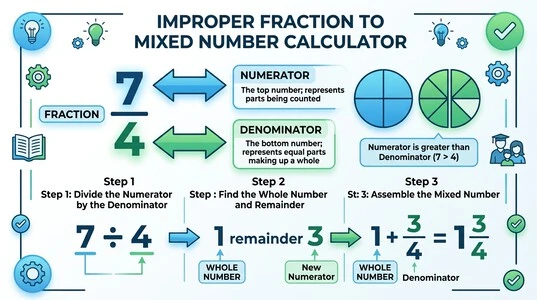
Think of a fraction as parts of a whole. The denominator shows the total number of equal parts. The numerator shows how many parts you have. When the numerator exceeds the denominator, the parts make one or more complete wholes. The extra parts remain as a fraction. Understanding an improper fraction makes it easier to use an Improper Fraction to Mixed Number Calculator. The calculator divides the numerator by the denominator and rewrites the answer as a mixed number. This method follows standard mathematics taught in schools worldwide.
Relationship Between Improper Fractions and Mixed Numbers
An improper fraction and a mixed number have the same equivalent value. They represent the same amount in different forms. This difference is called fraction representation. For example, 7/3 and 2 1/3 describe the same value. Only the way they appear is different. A mixed number combines a whole number with a proper fraction. Many people find this format easier to read and understand. It clearly shows the complete wholes and the remaining part. An improper fraction keeps the entire value as one fraction. This format works well in many math problems and calculations. A mixed number makes the answer easier to interpret after the calculation ends.
Students often see mixed numbers in textbooks, worksheets, and word problems. Teachers also use them to explain quantities greater than one whole. Recipes, measurements, and everyday examples may also use mixed numbers because they are simple to read. Our Improper Fraction to Mixed Number Calculator changes the fraction into a clearer format while preserving its exact value. The calculator never changes the amount. It only presents the answer in a form that is easier to understand.
Conversion Process
Our Improper Fraction to Mixed Number Calculator follows a simple and accurate process. It applies the standard division method taught in elementary mathematics. Each step helps you understand how the final answer is formed.
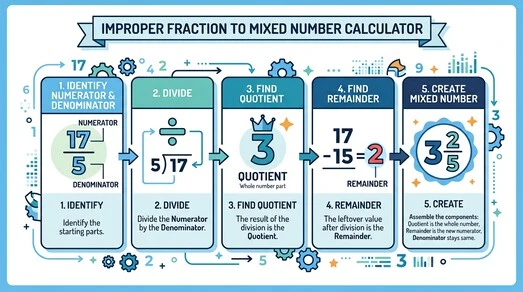
Identify Numerator and Denominator
First, identify the two parts of the fraction.
- The numerator is the number above the fraction bar.
- The denominator is the number below the fraction bar.
For example, in 11/4, 11 is the numerator and 4 is the denominator. The calculator uses these values to begin the conversion.
Divide the Numerator by the Denominator
Next, divide the numerator by the denominator.
The result gives you two important values:
- Quotient: The whole number from the division.
- Remainder: The amount left after dividing.
For example, divide 11 ÷ 4.
- Quotient = 2
- Remainder = 3
The quotient becomes the whole number. The remainder becomes part of the final fraction.
Create the Mixed Number
Now, write the mixed number using the division results.
- The whole number equals the quotient.
- The remaining fraction uses the remainder as the numerator.
- Keep the original denominator unchanged.
For 11/4, the mixed number is 2 3/4. This representation has the same value as the original improper fraction. It simply presents the answer in a clearer format.
Simplify the Fraction (If Needed)
The calculator checks whether the remaining fraction can be reduced. It finds the Greatest Common Factor (GCF) of the numerator and denominator. If both numbers share a common factor, it divides them by that factor. This creates an equivalent fraction in its simplest form without changing its value. For example, 2 4/8 simplifies to 2 1/2 because 4 and 8 share a GCF of 4.
By following these steps, the Improper Fraction to Mixed Number Calculator produces accurate, easy-to-read answers that match standard mathematical methods.
Division Method
The Improper Fraction to Mixed Number Calculator uses the standard division algorithm to convert an improper fraction into a mixed number. This method follows the same arithmetic rules taught in schools. It produces accurate and easy-to-understand results.
Step 1: Divide the Numerator
Start by dividing the numerator by the denominator. For example, divide 17 ÷ 5.
Step 2: Find the Quotient
The whole number from the division is called the quotient. In 17 ÷ 5, the quotient is 3 because 5 fits into 17 three times.
The quotient becomes the whole number in the mixed number.
Step 3: Find the Remainder
After the division, check whether any amount remains. This leftover value is the remainder.
For 17 ÷ 5, the remainder is 2 because: 17 = (5 × 3) + 2
The remainder becomes the numerator of the fractional part.
Step 4: Keep the Denominator Unchanged
Do not change the original denominator. It stays the same throughout the conversion. For 17/5, the denominator remains 5.
This rule preserves the fraction’s exact value.
Step 5: Write the Final Mixed Number
Combine all the parts to form the final answer.
- Write the quotient as the whole number.
- Write the remainder over the original denominator.
For 17/5, the final mixed number is 3 2/5. This mixed number has the same value as the original improper fraction. It simply offers a clearer fraction representation. Learning the division method helps you understand every result from the calculator. Once you know these steps, you can quickly check answers and build confidence in solving fraction problems.
Reading the Calculator Results
After you click Convert, the Improper Fraction to Mixed Number Calculator displays a complete and easy-to-read answer. Each part of the result has a specific meaning.
Whole Number Portion
The whole number comes from the quotient of the division. It shows how many complete wholes the improper fraction contains.
For example, in 19/6 = 3 1/6, the whole number is 3. This means the fraction contains three complete wholes.
Fraction Portion
The fraction shows the remaining part after the whole numbers. The remainder becomes the new numerator. The original denominator stays the same. In 3 1/6, the fraction 1/6 represents the part left after making three whole groups.
Simplified Answer
The calculator checks whether the fractional part can be reduced. If the numerator and denominator share a common factor, the calculator simplifies the fraction automatically. This gives the answer in its simplest form while keeping the same value.
Meaning of the Remainder
The remainder tells you how much is left after the division ends. It always becomes the numerator of the fractional part. If the remainder is 0, the improper fraction equals a whole number. No fractional part appears in the final answer.
Checking Correctness
You can quickly verify the result by reviewing each step.
- Confirm the quotient matches the whole number.
- Confirm the remainder matches the fraction’s numerator.
- Confirm the denominator stays unchanged.
- Confirm the fraction is simplified when possible.
These checks help you understand the answer and build confidence in the conversion process. They also make it easier to verify homework and classroom calculations.
Worked Examples
The following examples show how the Improper Fraction to Mixed Number Calculator converts different improper fractions. Each solution follows the same division method used by the calculator.
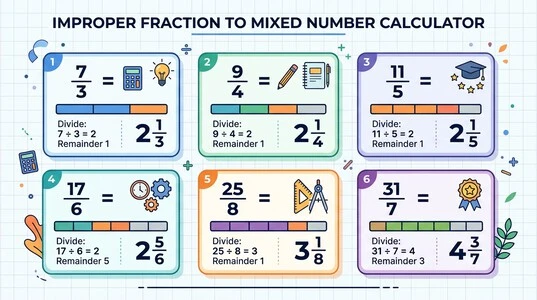
Example 1: Convert 7/3
Input: 7/3
Division: 7 ÷ 3 = 2 remainder 1
Quotient: 2
Remainder: 1
Final Answer: 2 1/3
Simplified Fraction: Already in simplest form.
Explanation: The quotient becomes the whole number. The remainder becomes the numerator.
Example 2: Convert 9/4
Input: 9/4
Division: 9 ÷ 4 = 2 remainder 1
Quotient: 2
Remainder: 1
Final Answer: 2 1/4
Simplified Fraction: Already in simplest form.
Explanation: Keep the original denominator and place the remainder above it.
Example 3: Convert 11/5
Input: 11/5
Division: 11 ÷ 5 = 2 remainder 1
Quotient: 2
Remainder: 1
Final Answer: 2 1/5
Simplified Fraction: Already in simplest form.
Explanation: The mixed number has the same value as the improper fraction.
Example 4: Convert 17/6
Input: 17/6
Division: 17 ÷ 6 = 2 remainder 5
Quotient: 2
Remainder: 5
Final Answer: 2 5/6
Simplified Fraction: Already in simplest form.
Explanation: The remainder forms the fractional part of the answer.
Example 5: Convert 25/8
Input: 25/8
Division: 25 ÷ 8 = 3 remainder 1
Quotient: 3
Remainder: 1
Final Answer: 3 1/8
Simplified Fraction: Already in simplest form.
Explanation: The denominator stays the same throughout the conversion.
Example 6: Convert 31/7
Input: 31/7
Division: 31 ÷ 7 = 4 remainder 3
Quotient: 4
Remainder: 3
Final Answer: 4 3/7
Simplified Fraction: Already in simplest form.
Explanation: The quotient tells you how many complete wholes the fraction contains.
Example 7: Convert 49/12
Input: 49/12
Division: 49 ÷ 12 = 4 remainder 1
Quotient: 4
Remainder: 1
Final Answer: 4 1/12
Simplified Fraction: Already in simplest form.
Explanation: One part remains after forming four complete wholes.
Example 8: Convert 83/15
Input: 83/15
Division: 83 ÷ 15 = 5 remainder 8
Quotient: 5
Remainder: 8
Final Answer: 5 8/15
Simplified Fraction: Already in simplest form.
Explanation: The remaining fraction cannot be reduced further.
Example 9: Convert 101/16
Input: 101/16
Division: 101 ÷ 16 = 6 remainder 5
Quotient: 6
Remainder: 5
Final Answer: 6 5/16
Simplified Fraction: Already in simplest form.
Explanation: The calculator combines the quotient and remaining fraction to produce the final mixed number.
Common Mistakes When Converting Improper Fractions
Small mistakes can lead to incorrect answers. Knowing these common errors helps you use the Improper Fraction to Mixed Number Calculator correctly and improves your fraction skills.
Using the Wrong Denominator
Some learners change the denominator after dividing. This is incorrect. The original denominator always stays the same in the mixed number.
Correct Example: 13/4 = 3 1/4, not 3 1/3.
Changing the Denominator
The denominator shows the size of each equal part. Division does not change that size. Only the numerator changes when you write the remaining fraction. Always keep the original denominator in the final answer.
Ignoring the Remainder
The remainder is an important part of the answer. Do not leave it out. It becomes the numerator of the fractional part.
Example: 14 ÷ 5 = 2 remainder 4.
The correct answer is 2 4/5, not 2.
Not Simplifying the Fraction
Always check whether the remaining fraction can be reduced. Simplifying creates an equivalent fraction in its simplest form.
Example: 18/8 = 2 2/8.
Reduce 2/8 to 1/4.
The correct answer is 2 1/4.
Incorrect Division
A single division error affects the entire answer. Check the quotient and remainder carefully before writing the mixed number.
For example, 23 ÷ 6 = 3 remainder 5.
The correct mixed number is 3 5/6.
Taking a few seconds to review each step helps you avoid these mistakes. The calculator follows the correct division method every time, making it a reliable tool for homework, classroom practice, and self-study.
Practical Uses
The Improper Fraction to Mixed Number Calculator helps anyone who needs quick and accurate fraction conversions. It saves time, reduces calculation errors, and explains each step. The tool supports learning as well as problem-solving.
Students
Students can check their answers in seconds. The calculator explains each conversion, making fraction concepts easier to understand.
Homework
Homework often includes improper fractions. This calculator provides accurate answers and clear steps for every problem. Students can compare each step with their own work.
Teachers
Teachers can use the calculator to create examples and verify classroom exercises. It also helps demonstrate the standard division method during lessons.
Exams
Regular practice improves speed and confidence. Students can use the calculator before exams to strengthen their understanding of improper fractions and mixed numbers.
Online Learning
Many online math courses include fraction topics. This calculator supports self-paced learning with instant feedback and step-by-step solutions.
Math Practice
Daily practice builds stronger arithmetic skills. The calculator lets learners solve multiple problems quickly while understanding the conversion process.
Elementary Mathematics
Elementary math introduces fractions as a core concept. This tool helps learners understand how values greater than one whole become mixed numbers.
Pre-Algebra
Pre-algebra builds on fraction knowledge. Understanding improper fractions prepares students for more advanced topics involving rational numbers and algebraic expressions. Whether you study at home or teach in a classroom, this calculator offers a reliable way to learn, practise, and verify fraction conversions with confidence.
Why Use This Calculator?
The Improper Fraction to Mixed Number Calculator makes fraction conversion fast, simple, and accurate. It helps learners understand each step instead of only showing the final answer.
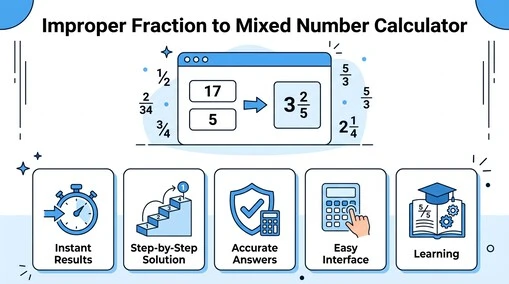
Instant Calculation
Enter the numerator and denominator, then click Convert. The calculator generates the mixed number in seconds.
Step-by-Step Solution
Every answer includes a clear breakdown of the conversion process. You can follow the division, identify the quotient and remainder, and see how the mixed number forms.
Accurate Answers
The calculator uses the standard division method taught in mathematics. It also checks whether the fractional part needs simplification before displaying the final answer.
Reduces Mistakes
Manual calculations can lead to division errors or incorrect fractions. The calculator helps you avoid common mistakes, such as changing the denominator or forgetting the remainder.
Easy Interface
The calculator features simple input fields and easy-to-use buttons. You can enter values, convert the fraction, reset the fields, and start a new calculation without confusion.
Educational Tool
This calculator does more than solve problems. It teaches the correct conversion method through clear explanations and worked steps. Students can build confidence, teachers can support classroom learning, and parents can help children practise fractions at home.
Whether you need a quick answer or want to improve your fraction skills, the Improper Fraction to Mixed Number Calculator provides a reliable and easy learning experience.
FAQs
What is an improper fraction?
An improper fraction has a numerator that is greater than or equal to its denominator. Its value is always one whole or more.
What is a mixed number?
A mixed number combines a whole number with a proper fraction. It represents the same value as an improper fraction but in an easier-to-read format.
How do you convert an improper fraction into a mixed number?
Divide the numerator by the denominator. Use the quotient as the whole number. Use the remainder as the new numerator. Keep the original denominator unchanged. Simplify the remaining fraction if possible.
Why does the denominator stay the same?
The denominator shows the size of each equal part. Division changes how many whole groups you have, not the size of the parts. Keeping the denominator the same preserves the fraction’s value.
Why do we use the remainder?
The remainder shows the part left after making complete wholes. It becomes the numerator of the fractional part in the mixed number.
Can an improper fraction equal a whole number?
Yes. If the remainder is 0, the improper fraction equals a whole number. For example, 12/4 = 3.
Why should the remaining fraction be simplified?
Simplifying creates an equivalent fraction in its lowest terms. This makes the answer easier to read and follows standard mathematical practice.
Is this calculator suitable for students?
Yes. The Improper Fraction to Mixed Number Calculator is suitable for students of all skill levels. Teachers and parents can also use it to explain fraction concepts, check homework, and support classroom learning.
Conclusion
The Improper Fraction to Mixed Number Calculator provides a fast and reliable way to convert improper fractions into mixed numbers. It uses the standard division method taught in schools, ensuring accurate results every time. Simply enter the numerator and denominator to receive an instant answer. The calculator explains each step, including the quotient, remainder, and final mixed number. It also simplifies the fractional part when possible, making every result easy to read and understand.
This tool supports more than quick calculations. It helps students learn fraction concepts, allows teachers to demonstrate the conversion process, and gives parents a simple way to assist with homework. The clear explanations build confidence and strengthen mathematical skills. Whether you need to solve one problem or practise many examples, our Improper Fraction to Mixed Number Calculator offers an accurate, educational, and easy-to-use solution. Try it whenever you need a quick conversion or want to improve your understanding of improper fractions and mixed numbers.